CBSE Class 8 English Chapter 25 Direct- Indirect Speech

CBSE Class 8 English Chapter  25 Direct- Indirect Speech

Let us quickly revise the rules for changing Direct Speech into Reported (Indirect) Speech.

Rule 1. Tense Changes

A) When the Reporting Verb is in the Past Tense then :

  1. The Simple Present changes into the Simple Past.
  2. The Present Continuous changes into the Past Continuous.
  3. The Present Perfect changes into the Past Perfect.

Direct: Sita said, “Ram works hard.”
Indirect: Sita said that Ram worked hard.

Direct: Sita said, “Rani is working hard.”
Indirect: Sita said that Rani was working hard.

Direct: Sita said, “Rani has worked hard.”
Indirect: Sita said that Rani had worked hard.

Note: If the reporting verb is in the present tense or future tense, then no changes are made.

Examples:

Sita says, “Rani works hard.”
Sita says that Rani works hard.
Sita will say, “Rani works hard”
Sita will say that Rani works hard.

B) The Simple Past changes into Past perfect. There is no change in other Past forms.

Direct: Sita said, “Rani worked hard.”
Indirect: Sita said that Rani had worked hard.

C) The Simple Future and Future Continuous change to the Conditional form with would used instead of will and shall.

Direct: Sita said, “Lots of people will help you.”
Indirect: Sita said that lots of people would help me.

Note:

  • is / are / am changes into was / were.
  • was / were – had been
  • had / been – no change
  • has / have – had
  • had – no change
  • do – did
  • did – had done
  • had done – no change
  • will / shall – would

Direct: Sita said, “Lots of people will be willing to help you.”
Indirect: Sita said that lots of people would be willing to help me

D) The modals usually do no change their form would/should/might/could/ought to/used to.

Only: may/can — might/could; must — had to

Sometimes shall changes into should.

Direct: I said, “I shall try to help her.”
Indirect: I said that I should try to help her.

Direct: Rani said, “Meera may be leaving the school.”
Indirect: Rani said that Meera might be leaving the school.

Direct: Rani said, “You can do this sum.”
Indirect: Rani said that I could do this sum.

Note: Remember if the Reported Speech contains some universal or habitual fact, then the Simple Present in the Reported Speech is not changed into Simple Past. It remains unchanged.

Examples:

Direct: The teacher said, “Honesty is the best policy.”
Indirect: The teacher said that honesty is the best policy.

Direct: Sita said, “God loves all human beings.”
Indirect: Sita said that God loves all human beings.

E) Rule 2. Pronoun Changes

  1. When the speaker is reporting his/her own words, no change is made in the person.
  2. Pronouns in the second persons are changed in the Indirect speech to the same person or noun.
  3. The verb said in Direct Speech becomes told in the Indirect and the preposition to is omitted.
  4. Pronouns in the Third Person in Direct Speech remain the same in the Indirect Speech.
  5. No change of person is made when the Speech is reported to the person to whom it is first addressed.

Direct: I said, “I will not go there.”
Indirect: I said that I would not go there.

Direct: Rama said, “The teacher likes me.”
Indirect: Rama said that the teacher liked her.

Direct: Sita said to me, “You are a liar.”
Indirect: Sita told me that I was a liar.

Direct: Sita said to her, “You have worked very hard.”
Indirect: Sita told her that she had worked very hard.

Direct: Harish said to me, “I am not well.”
Indirect: Harish told me that he was not well.

Direct: Harish said to you, “You are very honest.”
Indirect: Harish said to you that you were very honest.

F) Rule 3. Changes In Expressions Of Time

CBSE Class 8 English Chapter 25 Direct to Indirect Speech Conversion Rules

Examples:

Direct: Sita said, “I will go to Pune, tomorrow.
Indirect: Sita said that she would go to Pune the next day.

Direct: Sita said, “I went to a movie last night.
Indirect: Sita said that she had gone to a movie the night before / or the previous night.

G) Rule 4. Nearness Changes To Distance

CBSE Class 8 English Chapter 25 Reported Speech Word Conversion

Examples:

Direct: He said, “I am busy now.
Indirect: He said that he was busy then.

Direct: Sita said, “I have seen this girl before.”
Indirect: Sita said that she had seen that girl before

Important: Instead of said, the following word can be used for the reporting verb : told, assured, remembered, promised, explained, reminded, argued, etc.

Examples:

  1. Direct: Sita said to Radhika, “Do not worry, many girls will help you in the hostel.”
    Indirect: Sita assured Radhika that many girls would help her in the hostel and she should not worry.
  2. Direct: Father said to me, “I will give you a present when you finish this work.”
    Indirect: Father promised that he would give me a present when I finished that work.

OR

Father promised to give me a present when I would finish that work.

Exercise-1

Change the following sentences into Indirect Speech:—

Question 1. Our teacher said to us, “Do not make a noise while I am away.”

Answer: Our teacher told us not to make a noise while she was away.

Question 2. “I haven’t seen you for ages,” said Leela to her cousin Sumit.

Answer: Leela told her cousin Sumit that she hadn’t seen him for ages.

Question 3. The detective said to Raman, “I saw you at the hotel last week.”

Answer: The detective told Raman that he had seen him at the hotel the previous week.

Question 4. He said, “Key West is the southern most point of the United States.”

Answer: He said that Key West is the southernmost point of the United States.

Question 5. My mother said to me, “I think your friend Tania is not a trustworthy girl.”

Answer: My mother told me that she thought my friend Tania was not a trustworthy girl.

Question 6. My father said to my brother, “Pay attention while you are driving.”

Answer: My father advised my brother to pay attention while he was driving.

Question 7. My friend said, “I will bring your birthday cake in the evening.”

Answer: My friend said that she would bring my birthday cake in the evening.

Question 8. Rashmi said, “Please help in carrying these heavy packages to my car.”

Answer: Rashmi requested me to help her in carrying those heavy packages to her car.

Question 9. “Don’t put any sugar in my coffee,” said my friend to me.

Answer: My friend asked me not to put any sugar in her coffee.

Question 10. The shopkeeper said to my friend, “Buy this pair of shoes. They are the latest design and will last you a long time.”

Answer: The shopkeeper persuaded my friend to buy that pair of shoes, saying they were the latest design and would last him a long time.

H) 5. Rules For Reporting Questions

1. The introductory verb is changed to ask, inquire, demand or some other word having a similar meaning.

2. When the direct question has a yes or no for an answer, if or whether is used after the introductory verb.

The conjunction that is not used after asked or while reporting wh-questions.

Remember the interrogative form is changed into a declarative one.

  1. Direct: My neighbour said to me, “What is your dog’s name?”
    Indirect: My neighbour asked me what my dog’s name was.
  2. Direct: My friend said to me, “Are you going to the football match?”
    Indirect: The friend inquired whether I was going to the football match.
  3. Direct: Neetu said, “Where have you been for the last one month?”
    Indirect: Neetu asked where I had been for the last one month.

Exercise-2

Change the following sentences into Indirect Speech:—

Question 1. My mother said to me, “Are your brothers playing in the garden?”

Answer: My mother asked me if my brothers were playing in the garden.

Question 2. The teacher said to the boys, “When did the match end?”

Answer: The teacher asked the boys when the match had ended.

Question 3. The master said, “Mohan, why didn’t you inform me earlier about this accident?”

Answer: The master asked Mohan why he hadn’t informed him earlier about that accident.

Question 4. “Please Sir, can I have some more food?” said Oliver.

Answer: Oliver politely asked the sir if he could have some more food.

Question 5. My father said to me, “Have you paid the electricity bill?”

Answer: My father asked me whether I had paid the electricity bill.

Question 6. The Director said to the young applicant for the job, “Is it for the first time you have applied for a manager’s post?”

Answer: The Director asked the young applicant if it was the first time he had applied for a manager’s post.

Question 7. She said to the beautician, “How can I lose weight?”

Answer: She asked the beautician how she could lose weight.

Question 8. “Why don’t you come over for dinner on Friday?” Sheila said to me.

Answer: Sheila invited me/suggested that I come over for dinner on Friday.

I) 6. Commands And Requests

Exercise-3

Change the following sentences into Indirect Speech. Use the words given in box for the Introductory Verb “said”: —

command, advise, beseech, request, deny, order, promise, remind, apologise, inform

Question 1. The nurse said to me, “The doctor can spare only a few minutes for you.”

Answer: The nurse informed me that the doctor could spare only a few minutes for me.

Question 2. The boy said, “I didn’t hit Ramesh.”

Answer: The boy denied that he had hit Ramesh.

Question 3. The gardener said to the boys, “Get off the grass immediately.”

Answer: The gardener commanded/ordered the boys to get off the grass immediately.

Question 4. Jasbir said to his mother, “I will tidy up my room when I come back from the match.”

Answer: Jasbir promised his mother that he would tidy up his room when he came back from the match.

Question 5. Radha said to her teacher, “I am sorry I forgot to do the homework.”

Answer: Radha apologised to her teacher for forgetting to do the homework.

Question 6. My brother said to me, “Remember to thank your friend for his help.”

Answer: My brother reminded me to thank my friend for his help.

Question 7. The mother said to them, “I beg you not to hurt my child.”

Answer: The mother beseeched them not to hurt her child.

Question 8. The Instructor said, “Don’t cry, you try again to do the exercise.”

Answer: The Instructor advised them not to cry and to try again to do the exercise.

Question 9. “Would you please lend me your camera?” said the boy to his friend.

Answer: The boy requested his friend to lend him his camera.

Question 10. The teacher said to the boy, “You must work hard if you want to win the scholarship.”

Answer: The teacher advised the boy to work hard if he wanted to win the scholarship.

J) 7. Exclamations And Wishes

Rule 1. The introductory verb is changed into wish, exclaim, pray, cry, bless, or some other similar verb.

Rule 2. The sign of exclamation is omitted.

Rule 3. The words of exclamation like, hurrah, alas, etc, are omitted.

Examples:

Direct: He said, “May you live long!”
Indirect: He wished that he might live long.

Direct: Rani said, “Bravo! you have played well.”
Indirect: Rani applauded him and said he had played well.

Direct: “What a clever fellow you are!” The boy said.
Indirect: The boy praised him and said he was a clever fellow.

Exercise-4

Change the following into Indirect Speech

Question 1. “Oh! what a lovely dress,” said Roshini.

Answer: Roshini exclaimed with delight that it was a very lovely dress.

Question 2. “Happy New Year,” said John to Mary.

Answer: John wished Mary a Happy New Year.

Question 3. “Alas ! I lost my best gold chain,” said Rani to her friend.

Answer: Rani lamented to her friend that she had lost her best gold chain.

Question 4. “What a tragedy!” said he.

Answer: He exclaimed that it was a great tragedy.

Question 5. “May God bless you for your kindness!” said the poor boy to his master.

Answer: The poor boy prayed that God might bless his master for his kindness.

K) Study carefully how the following conversation has been changed into Reported speech.

Sameer: “Oh, I am so sorry to be so late, Kabir.”
Kabir: “Yes you are late, but it doesn’t matter. Some friends have yet to come.”

Sameer: “Can I help you in doing something?”
Kabir: “Yes, please help me in setting the table.”

Sameer apologised to his friend Kabir for being so late for his party.

Kabir agreed that Sameer was late but added that it did not matter as some friends had yet to come.

Sameer requested if he could help by doing something.

Kabir then requested Sameer to help him in setting the table.

Exercise-5

Change the following sentences into Indirect Speech

Question 1. The teacher cried out angrily, “What are you doing, Raman? If you do not attend to the lesson, I shall send you to the Headmaster and you will be punished. Look into your book and do not let me catch you playing again.”

Answer: The teacher angrily demanded of Raman what he was doing. She warned him that if he did not attend to the lesson, she would send him to the Headmaster and he would be punished. She sternly ordered him to look into his book and not let her catch him playing again.

Question 2. Next morning at breakfast his wife said to him, “George, I think I can tell what is wrong with our clock.” “Well, what is it?” he sharply asked. “It wants winding up,” said his partner quietly.

Answer: Next morning at breakfast, his wife told George that she thought she could tell what was wrong with their clock. He sharply asked her what it was, and his partner quietly replied that it wanted winding up.

Question 3. The father said angrily to his son, “Where have you been all this time? I saw you here last at ten in the morning. Go at once and change for dinner.”

Answer: The father angrily asked his son where he had been all that time. He added that he had seen him there last at ten in the morning and commanded him to go at once and change for dinner.

Question 4. “What will you give me if I spin this straw into gold?” he asked. “You shall have the ring from my finger,” said the girl.

Answer: He asked what she would give him if he spun that straw into gold. The girl replied that he would have the ring from her finger.

Question 5. “Will you come to my palace with me and be my wife?” said the king. “Yes”, said she, “if you allow me to have my fawn with me always.”

Answer: The king asked if she would come to his palace with him and be his wife. She agreed but added that she would do so only if he allowed her to have her fawn with her always.

Question 6. He said, “Who are you to speak to me like this? Don’t you know that I am your master and you are my servant? You must carry out my orders, whether you like them or not.”

Answer: He angrily demanded who they were to speak to him like that. He asked if they didn’t know that he was their master and they were his servants. He declared that they must carry out his orders, whether they liked them or not.

Question 7. “Are you angry, my friends,” said the king, “Because you have lost your leader? I am your king; I will be your leader.”

Answer: The king asked his friends if they were angry because they had lost their leader. He reminded them that he was their king and assured them that he would be their leader.

Question 8. “Curse it!” exclaimed the driver. “Who could have foreseen such ill-luck? But for the accident we should have reached home before the sunset.”

Answer: The driver cursed and exclaimed that no one could have foreseen such ill-luck. He added that but for the accident, they would have reached home before sunset.

Question 9. The traveller said to the policeman, “Can you tell me the way to the nearest hotel?” “Yes,” said the policeman, “Do you want one in which you can spend the night?” “No,” replied the traveller, “I only want a meal.”

Answer: The traveller asked the policeman if he could tell him the way to the nearest hotel. The policeman confirmed and asked whether he wanted one where he could spend the night. The traveller replied negatively, explaining that he only wanted a meal.

Question 10. “You say,” said the judge, “The bag you lost contained one hundred and ten rupees.” “Yes, your Honour,” replied the miser. “Then as this one contains one hundred rupees it cannot be yours.”

Answer: The judge noted that the miser claimed the bag he had lost contained one hundred and ten rupees. The miser affirmed this, addressing the judge as “your Honour.” The judge then concluded that since the found bag contained one hundred rupees, it couldn’t be his.

L) 8. Conversion Of Indirect Into Direct

Study the following sentences carefully:—

Indirect: My mother said that she had gone to the Mall the day before.
Direct: My mother said, “I went to the Mall yesterday.”

Indirect: The instructor asked me if I had played football before.
Direct: The instructor said to me, “Have you played football before?”

Indirect: My son requested me to lend him the car for a day.
Direct: My son said to me, “Please lend me your car for a day.”

Indirect: We all exclaimed with joy that Abhinav Bindra had won a gold medal for India.
Direct: We said, “Hurrah! Abhinav Bindra has won a gold medal for India.”

Exercise-6

Turn the following into Direct Speech

Question 1. The policeman ordered the driver to step out of the car.

Answer: The policeman ordered, “Step out of the car!”

Question 2. The policeman charged the driver with speeding.

Answer: The policeman said to the driver, “You are speeding!”

Question 3. The driver denied the charge.

Answer: The driver exclaimed, “I deny the charge!”

Question 4. The policeman insisted that he did and would have to pay a fine for speeding.

Answer: The policeman insisted, “You did speed, and you will have to pay a fine!”

Question 5. The driver protested but then gave Rs 600 as fine.

Answer: The driver protested, “This is unfair!” but then said, “Here is Rs 600 as fine.”

Note: Punctuation in Direct Speech.

  • The first word of the quoted speech is written in capital letters. The full stop, the question mark, the exclamation mark and the comma come inside the inverted commas.

Example: “She is on a holiday,” she said.

The comma comes outside the inverted commas only when you begin the sentence with a reporting verb.

He said, “Will you sing for me?”

Each time the speaker changes we start a new paragraph.


CBSE Class 8 English Chapter 16 The phrase And The Clause

CBSE Class 8 English Chapter 16 The phrase And The Clause

1. Look at the groups of words in italics in the following sentences —

Examples:

  1. He left us in the morning.
  2. He left us when the morning came.

2. The group of words in sentence 1, in the morning, has a meaning, or makes sense, but it does not make complete sense. It is not a sentence, for it has no Subject and no Predicate. Such a group of words is called a Phrase.

3. A Phrase is a group of words that makes sense, but not complete sense. It has no Subject and no Predicate.

4. The group of words in sentence 2, when the morning came, is not a Phrase, for it has a Subject (the morning) and a Predicate (came) of its own. Such a group of words is called a Clause.

A Clause is a group of words that forms part of a larger sentence, and has a Subject and a Predicate of its own.

5. Study the words in italics in the following sentences

Example:

  1. He returned at sunset. [Returned when ?]
  2. He returned when the sun set.[Returned when ?]

6. It is evident that both the groups of words in italics, in sentences 1 and 2, do the work of an Adverb, as they show when he returned. But in sentence 1, the group of words at sunset is a phrase. Since it does the work of an Adverb, it is called an Adverb Phrase.

In 2, the group of words when the sun set is a clause, for it has a Subject (the sun) and a Predicate (set) of its own. But since it does the work of an Adverb, it is called an Adverb Clause.

An Adverb Clause is a group of words that contains a Subject and a Predicate of its own, and does the work of an Adverb.

7. Study the words in italics in the following sentences —

Examples:

  1. He likes a story with a moral in it.[Which story ?]
  2. He likes a story that has a moral in it. [Which story ?]

The first group of words, with a moral in it, describes what sort of story he likes, that is, it qualifies the Noun story and does the work of an Adjective. It is, therefore, called an Adjective Phrase.

8. The second group of words, which has a moral in it, also describes what sort of story he likes, and so does the work of an Adjective. But since it contains a Subject and a Predicate of its own, it is called an Adjective Clause.

An Adjective Clause is a group of words that contains a Subject and a Predicate of its own, and does the work of an Adjective.

9. Study the words in italics in the following sentences:—

Examples:

  1. They expected to win the match. [Expected what?]
  2. They expected that they would win the match. [Expected what?]

The first group of words, to win the match, does not contain a Subject and a Predicate of its own. It is, therefore, a Phrase. This Phrase does the work of a Noun, since it is the Object of the Verb expected. It is, therefore, called a Noun Phrase.

The second group of words, that they would win the match, contains a Subject (they) and a Predicate (would win the match). It is, therefore, a Clause. This Clause is the Object of the Verb expected and so does the work of a Noun.

It is, therefore, called a Noun Clause. A Noun Clause is a group of words that contains a Subject and a Predicate of its own, and does the work of a Noun.

10. Thus, there are three kinds of Clauses —

  1. The Adverb Clause
  2. The Adjective Clause
  3. The Noun Clause

Exercise -1

Underline the Clauses in the following sentences, and tell the kind of each

Question 1. I asked her where she was going. ________________
Answer: Noun clause

Question 2. He expected that he would win a prize. ________________
Answer: Noun clause

Question 3. The boys went home when the school was over. ________________
Answer: Adverb clause

Question 4. He will pass if he works hard. _______________
Answer: Adverb clause

Question 5. No one knows where he lives. ________________
Answer: Noun clause

Question 6. The mice will play when the cat is away. ________________
Answer: Adverb clause

Question 7. God helps those who help themselves. ________________
Answer: Adjective clause

Question 8. This is the house where I was born. ________________
Answer: Adjective clause

Question 9. I do not know what she wants. ________________
Answer: Noun clause

Question 10. I think he will pass this year. ________________
Answer: Noun clause

Question 11. This is the boy who saved your child’s life. ________________
Answer: Adjective clause

Question 12. I met her when I was in Mumbai.
Answer: Adverb clause

Question 13. The dog that bit the child was mad.____________
Answer: Adjective clause

Question 14. I know who is to blame. ________________
Answer: Noun clause

Question 15. I know the man who is there. ________________
Answer: Adjective clause

Question 16. This is the house that Jack built. ________________
Answer: Adjective clause

Question 17. People who eat too much die early. ________________
Answer: Adjective clause

Question 18. This is the beggar whom we met yesterday. ________________
Answer: Adjective clause

Question 19. I know when he will come. ________________
Answer: Noun clause

Question 20. I know the time when he will come.
Answer: Relative Clause

Exercise 2

Fill in the blanks with suitable Clauses

Adverb Clauses

Question 1. He will pass______
Answer: If he studies hard.

Question 2. He came______
Answer: When the bell rang.

Question 3. They fought______
Answer: As if their lives depended on it.

Question 4. Make hay______
Answer: While the sun shines.

Question 5. His father died______
Answer: Before he could see his grandchild.

Question 6. Work hard______
Answer: So that you may succeed.

Question 7. Wait______
Answer: Until the rain stops.

Question 8. Do I
Answer: As I say.

Question 9. We eat ______
Answer: Because we need energy.

Question 10. ______ will keep it.
Answer: Wherever you put it

Adjective Clauses

Question 1. He lost the book ______
Answer: That you gave him.

Question 2. I know the man ______
Answer: Who lives next door?

Question 3. This is the pen______
Answer: Which I bought yesterday

Question 4. They never fail______
Answer: Those who trust in God.

Question 5. I found an umbrella______
Answer: That someone had left behind.

Question 6. I remember______
Answer: What you told me.

Question 7. God helps those ______
Answer: Those who help themselves.

Question 8. This is the book______
Answer: That inspired me.

Question 9. All that glitters is ______
Answer: Not gold.

Question 10. He is the boy______
Answer: Who won the competition?

Noun Clauses

Question 1. Do you know______
Answer: Where did she go?

Question 2. He spends______
Answer: What he earns.

Question 3. We Know ____________
Answer: That the Earth is round.

Question 4. Can you guess______
Answer: Who called me today?

Question 5. I often wonder______
Answer: Why do birds migrate?

Question 6. She says______
Answer: She will come tomorrow.

Question 7. Do you deny ______
Answer: that you take the money?

Question 8. ______ is quite certain.
Answer: That he is guilty

Question 9. This is______
Answer: What I wanted.

Question 10.______ is a mystery.
Answer: Why did he disappear

CBSE Class 8 English Chapter 12 Adverbs

CBSE Class 8 English Chapter 12 Adverbs

1. You already know that Adverbs add something to the meaning of a verb, an adjective or another adverb.

Examples:

He can run fast, (adds to the meaning of a verb)

He is a very fast runner, (adds to the meaning of an adjective)

He can run quite fast, (adds to the meaning of an adverb)

2. Kinds of Adverbs :

Adverbs of Manner: carefully, gladly, merrily, etc.

Adverbs of Place: here, there, yonder, etc.

Adverbs of Time: today, yesterday, now, then, 6 P.M., etc.

Adverbs of Degree: only, extremely, very, etc.

Adverbs of Frequency: seldom, rarely, frequently, etc.

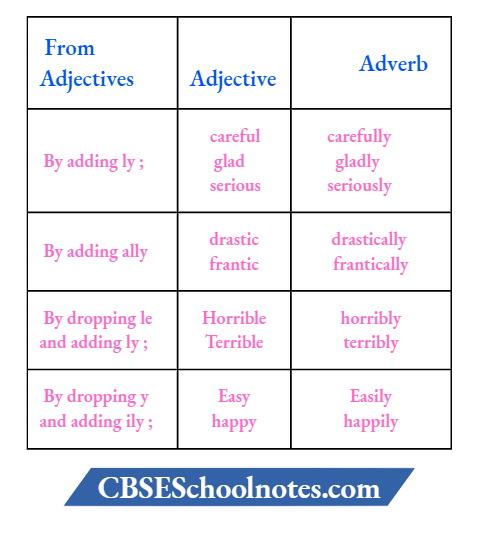
3. How some Adverbs are formed

CBSE Class 8 English Chapter 12 Adjective to Adverb Conversion Rules

4. Remember all words ending in ly are not Adverbs of Manner. They are Adjectives also.

Examples:

  1. The manager was wearing a very ugly tie.
  2. The elderly soldier gave sound advice to the new recruit.

Some other words : lively, lonely, lovely, silly.

5. There are some words which can be either adjectives or adverbs. It depends how they are used in a sentence.

  1. Ramu got up early and went for a walk. (Adverb)
  2. My mother is an early riser. (Adjective)

He is a fast runner. (Adjective)

He can run very fast. (Adverb)

Some other words: best, better, free hand, last, weekly, wide, wrong, etc.

6. Look at the following pairs of words :

  1. last-lastly
  2. wrong-wrongly
  3. wide-widely
  4. late-lately
  5. near-nearly
  6. hard-hardly

They are two forms of Adverbs but have different meanings.

Examples:

  1. I was breathing hard after I finished the race. (with difficulty)
  2. I hardly visit them. (scarcely)
    1. He stood last in the class. (after all the others)
    2. Lastly, I recommend this book because of its beautiful illustrations. (finally)

Exercise 1

Form Adverbs from the following Adjectives:

Question 1. Dreadful ______________

Answer: Dreadfully

Question 2. Wonderful___________

Answer: Wonderfully

Question 3. Coward____________

Answer: Cowardly

Question 4. Free______________

Answer: Freely

Question 5. Lone_____________

Answer: Lonely

Question 6. Happy___________

Answer: Happily

Question 7. Scarce_________

Answer: Scarcely

Question 8. Logical___________

Answer: Logically

Question 9. Dramatic_________

Answer: Dramatically

Question 10. Casual____________

Answer: Casually

Exercise 2

Write the opposites of the following Adverbs

Question 1. Legally______________

Answer: Illegally

Question 2. Gratefully__________

Answer: Ungratefully

Question 3. Successfully___________

Answer: Unsuccessfully

Question 4. Regularly__________

Answer: Irregularly

Question 5. Politely____________

Answer: Impolitely

Question 6. Agreeably___________

Answer: Disagreeably

Question 7. Possibly________

Answer: Impossibly

Question 8. Honestly_________

Answer: Dishonestly

Exercise 3

Choose the right wordfrom the brackets to complete the sentences given below:

Question 1. He has not___________(full/fully) recovered from his illness yet.

Answer: He has not fully ecovered from his illness yet.

Question 2. The tensions are running very ___________ (high/highly) in the district and may lead to violence.

Answer: The tensions are running very high in the district and may lead to violence.

Question 3. It was not quite__________ (easy/easily) to walk through the jungle. But they __________found their target.

Answer: It was not quite easy to walk through the jungle. But they found their target.

Question 4. I had ____________ (hardly/hard) talked to them before and found it very to start a conversation.

Answer: I had hardly talked to them before and found it very to start a conversation.

Question 5. We began our journey_________ (short/shortly) and reached Mysore on time.

Answer: We began our journey shortly and reached Mysore on time.

Question 6. He was______(nearly/near) blinded by his tears.

Answer: He was nearly blinded by his tears.

Question 7. The child cried________ (bitter/bitterly) when he was not taken to the circus.

Answer: The child cried bitterly when he was not taken to the circus.

Question 8. He shouted______(angry/angrily) at his subordinates for not completing the work on time.

Answer: He shouted angrily at his subordinates for not completing the work on time.

Question 9. You can meet the Chairman and speak to him ________ (directly/direct) about your complaints.

Answer: You can meet the Chairman and speak to him directly about your complaints.

Question 10. His friend’s behaviour_________ (terrible/terribly) upsets him.

Answer: His friend’s behaviour terribly upsets him.

7. How to use certain Adverbs.

So — Such

Examples:

The book was so amusing.

Her talk was so interesting.

This is such an amusing book.

She is such an interesting talker.

Remember

1. With so we use an Adjective.
so amusing, so interesting, so gladly, so loudly, so politely.

2. With such we use a noun.
Such an amusing book.
Such an interesting talker.

3. We can also use so – that and such – that

She was so angry that she hit him hard.

It was such an interesting book that I couldn’t put it down.

Exercise 4

Complete the following sentences by using so, such, that, or such…. that:

Question 1. His voice was_______powerful.

Answer: His voice was so powerful.

Question 2. Her lecture was________ dull that everyone left the hall quietly.

Answer: Her lecture was so dull that everyone left the hall quietly.

Question 3. It was_________ an interesting movie _______ it broke all box office records.

Answer: It was such an interesting movie that it broke all box office records.

Question 4. It was________terrible to watch the river rising.

Answer: It was so terrible to watch the river rising.

Question 5. _______was her plight ________everyone rushed to help her.

Answer: Such was her plight that everyone rushed to help her.

Question 6. Are you always________ emotional.

Answer: Are you always so emotional

Question 7. Why are you in_________ a hurry?

Answer: Why are you in such a hurry?

Question 8. The food was______ delicious, we kept asking for more.

Answer: The food was so delicious, we kept asking for more.

Question 9. It was__________ a shock to hear about Jasmit’s death.

Answer: It was such a shock to hear about Jasmit’s death.

Question 10. The whole village was__________ happy to hear about his success.

Answer: The whole village was so happy to hear about his success.

8. Quite – rather

This shop is quite crowded today.

This shop is very crowded today.

Very means there are more people than quite which has less. Quite also means completely, For Example.

This rumour is quite true.

Remember

Quite is used as a favourable comment.

Rather is used when you want to make an unfavourable comment.

Examples : He is rather silly in his behaviour.

Rather is also used with the Comparative Degree.

It is rather colder today than yesterday.

Quite is used before a/an and Rather used after a/an.

Examples:

  1. It was quite a dull book.
  2. It was a rather cold day.

Exercise 5

Fill in the blanks with quite or rather

Question 1. I know Harish is a_________dull person.

Answer: I know Harish is a rather dull person.

Question 2. I found it_______a curious situation.

Answer: I found it quite a curious situation.

Question 3. Didn’t you find the plot of ‘Singh is King’ a__________stupid one?

Answer: Didn’t you find the plot of ‘Singh is King’ a rather stupid one?

Question 4. No, people found it_________an amusing plot.

Answer: No, people found it quite an amusing plot.

Question 5. Those people seem to have a_________ peculiar taste.

Answer: Those people seem to have a rather peculiar taste.

9. Fairly – Too

Fairly is another adverb used like quite to express a favourable comment.

She is fairly good at singing.

She is a fairly good swimmer.

You have already learnt in previous class how to use too and enough.

Too means excess of some kind more than what is proper.

Examples: It is too good to be true.

He is too proud to be liked by his peers.

Enough is used in the positive sense and means sufficient.

Examples: He is strong enough to deal with any problem.

He has enough money to cope with any situation

Exercise 6

Fill in the blanks with quite, rather, fairly, too or enough :

Question 1. He was__________ short to be selected for the basketball team.

Answer: He was too short to be selected for the basketball team.

Question 2. It was__________ decent of him to help us at this time.

Answer: It was quite decent of him to help us at this time.

Question 3. I would______go to a circus than watch this stupid movie.

Answer: I would rather go to a circus than watch this stupid movie.

Question 4. This house is ___________ small for our family but __________ big for my bachelor friend.

Answer: This house is too small for our family but quite big for my bachelor friend.

Question 5. You do not eat ________to be healthy and strong.

Answer: You do not eat enough to be healthy and strong.

Question 6. It was __________ obvious that he was__________ weak to be selected as a member of the boxing team.

Answer: It was quite obvious that he was too weak to be selected as a member of the boxing team.

Question 7. Sushil Kumar proved ________ good for his opponent and defeated him.

Answer: Sushil Kumar proved too good for his opponent and defeated him.

Question 8. He is rich ________ but he is _________ stingy to part with his money.

Answer: He is rich enough but he is too stingy to part with his money.

Question 9. He was__________ upset at his rude behaviour.

Answer: He was rather upset at his rude behaviour.

Question 10. I find this boy _________ irresponsible and would___________ not make him a monitor.

Answer: I find this boy quite irresponsible and would rather not make him a monitor.

10. Comparison Of Adverbs

You have leamt already that Adverbs have also three Degrees of Comparison.

Examples:

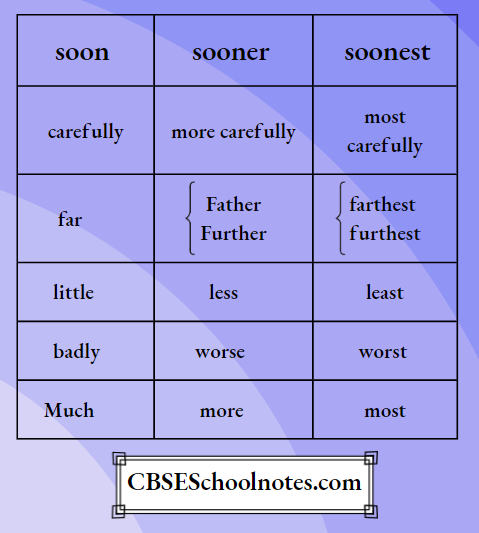
CBSE Class 8 English Chapter 12 Grammar Irregular Adverbs Comparison

Exercise 7

Fill in the blanks with correct  form of Adverbs:

Question 1. The ______ (long) we had to wait for the tickets; _________(impatient) we became.

Answer: The longer we had to wait for the tickets; the more impatient we became.

Question 2. The _________(small) the house, the _________ (low) is the rent for it.

Answer: The smaller the house, the lower is the rent for it.

Question 3. He drove _______ and _______ (faster) and his ______ expensive car helped him to reach his destination on time.

Answer: He drove faster and faster and his more expensive car helped him to reach his destination on time.

Question 4. The weather was getting _______ and we knew we hadn’t faced the ______ yet. (bed)

Answer: The weather was getting worse and we knew we hadn’t faced the worst yet.

Question 5. The ______ (rash) you drive, the _________ (great) is the risk of an accident.

Answer: The more rashly you drive, the greater is the risk of an accident.

Question 6. The kite flew ______ and ____ (high) in the sky and became invisible.

Answer: The kite flew higher and higher in the sky and became invisible.

Question 7. She is ________ than any other runner in the team (fast) and can beat ________ (strong) in any group.

Answer: She is faster than any other runner in the team and can beat the strongest in any group.

Question 8. The ______ you cry, the _______ notice will be taken of you. (much, little).

Answer: The more you cry, the less notice will be taken of you. (much, little).

Question 9. He lived in a house which was _______ from the market. (far)

Answer: He lived in a house which was far from the market.

Question 10. He drove _________ and completed the race without any mishap, (much/careful).

Answer: He drove carefully and completed the race without any mishap.

11. Position Of Adverb

It is important to know where adverbs should be placed in a sentence. Adverbs can be placed in the beginning, in the middle or in the end.

Example: Obviously she will never play again.

1. Adverbs of Manner (How)? : They can be used like the above sentence.

Examples: Easily, he is the best runner in the Indian Team.

He is easily the best runner in the Indian Team.

He can beat any runner in the Indian Team easily.

2. Adverbs of Place (Where)?: Usually they come after the verb.

Examples: He lives in a city.

He was mshed to the hospital.

3. Adverb of Time (When)?They come usually after Adverbs of Place.

Examples: I go to school every day.

I have been living in Mumbai since 1980.

4. Sometimes Adverbs of Time are placed in the beginning also.

Examples: Tomorrow he will leave for Dubai.

Every evening my brother rings me up.

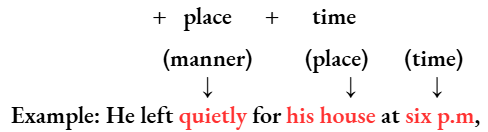
5. If there are more than one adverb in a sentence, then the order is manner

More Than One Verb

6. If there are more than one time adverbs, then we place the more specific time before the more general one.

Example: I was bom at 7 a.m. on Monday, March 24, 1982.

7. Adverbs of Frequency (after, before, often, seldom, never, ever, usually, etc) are placed after the auxiliary verb but before the main verb.

Examples: He is often late.

She always comes late.

She was never late.

She never comes late.

8. Adverbs of Degree (completely, totally, extremely, very, etc.) go before the adjective or adverb they describe.

Examples: She is absolutely helpless in dealing with her son.

I have quite finished my maths.

She nearly lost her possessions.

9. If the verbs consist of more than one word, the adverbs are placed after the first verb.

Examples: She was absolutely thrilled with her brother’s performance.

The party has always supported him.

Exercise 8

Complete the sentences by putting the Adverbs (given in the brackets) in the right position. One is done for you:

Question 1. I have lived in Nainital _________ (among) the locals ________ (peacefully) all my life.

Answer:

I have lived peacefully all my life among the locals in Nainital.

Question 2. Pandit Jasraj holds concerts __________ (often, successfully, abroad).

Answer: Pandit Jasraj holds concerts successfully.

Question 3. I am certain you will be successful _________ (in life, absolutely, very).

Answer: I am certain you will be successful in life.

Question 4. The injured were taken to a safe place ________ (immediately/seriously/luckily).

Answer: The injured were taken to a safe place immediately.

Question 5. We saw _________ (suddenly/on the road/an accident/yesterday).

Answer: We saw an accident on the road suddenly yesterday.

Question 6. This bank ________ (strangely/on Rakshabandhan day/till one p.m.).

Answer: This bank is strangely open on Rakshabandhan day till one p.m.

Question 7. I met her __________ (last night/unexpectedly/at the party).

Answer: I met her unexpectedly at the partly last night.

Question 8. I take my dinner _________ (8 p.m./always/everyday).

Answer: I always take my dinner at 8 p.m every day.

Question 9. Traffic is ________ (usually/at this hour/very heavy).

Answer: Traffic is usually very heavy at this hour.

Question 10. Vanita __________ (hardly/strangely/lost her temper).

Answer: Vanita hardly lost her temper.

Exercise 9

Change the underlined phrases with single words chosen from the box:

CBSE Class 8 English Chapter 12 Adjective to Adverb Single Words

Question 1. She looked in all places for her lost keys.

Answer: Everywhere

Question 2. You will hear from her in a short time.

Answer: Soon

Question 3. All of a sudden, the stranger took out his revolver and fired at him.

Answer: Suddenly

Question 4. Now and then I have letters from my sister.

Answer: Sometimes

Question 5. She shouted in an angrv manner.

Answer: Angrilly

Question 6. Please come here without delay.

Answer: Immediately

Question 7. Diwali is celebrated once a year.

Answer: Annually

Question 8. The train arrived at the fixed time.

Answer: Punctually

Question 9. Can you explain your plan in a few words?

Answer: Briefly?

Question 10. Where is your mother living at the present time?

Answer: Now?

CBSE Class 8 English Chapter 11 Active and Passive Voice

CBSE Class 8 English Chapter 11 Active and Passive Voice

1. Study the following chart.

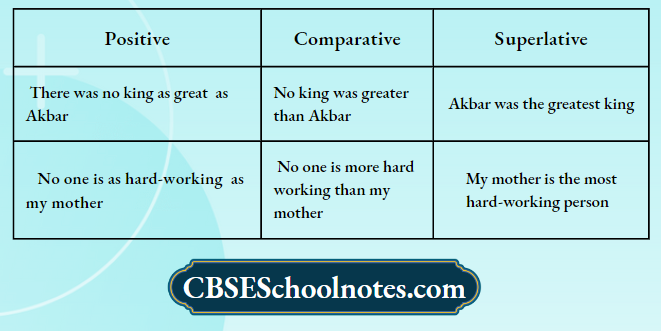
CBSE Class 8 English Chapter 11 Positive Comparative Superlative Adjectives

Note:

  1. When no comparison is made, it is said to be in the Positive degree.
    Sujata is a clever girl.
  2. When two persons or things of the same class are compared, we use the Comparative Degree. The Comparative Degree is generally followed by the Conjunction than.
    • She is wiser than her sister.
    • Comparative Degree can sometimes be used without than.
    • She is wiser of the two girls.
    • The poor fellow had seen happier days.
  3. When more than two persons or things of the same class are compared, it is said to be in the Superlative Degree.
    • Akbar was the greatest king.

Note:

The Superlative Degree is preceded by the and followed by of, as :

Sheila is the cleverest of all the girls.

But we can also say :

Sheila is the cleverest girl

The Comparative Degree

2. We form Comparatives by adding er or more.

Examples: Big – bigger

Deep – deeper

Beautiful – more beautiful

Comfortable – more comfortable

Note: Adjectives which are bigger, are of more than two syllables, form the Comparative by adding the word more.

3. Some Adjectives form their

Comparatives in an irregular way.

Examples:

Good – better

Little – less

Bad – worse

Much – more

Many – more

Exercise 1

Complete the sentences using the Comparative form:-

Question 1. I have seen many tall buildings, but the buildings in New York are _____________.

Answer: I have seen many tall buildings, but the buildings in New York are taller.

Question 2. The flight over the mountains was rather short. I had expected it __________.

Answer: The flight over the mountains was rather short. I had expected it to be longer.

Question 3. Please give me some sugar. I like my coffee to be __________.

Answer: Please give me some sugar. I like my coffee to be sweeter.

Question 4. Don’t walk so slowly. I know you can ________.

Answer: Don’t walk so slowly. I know you can walk faster.

Question 5. We went to the next room to find some quiet place but it ____________.

Answer: We went to the next room to find some quiet place, but it was noisier.

Question 6. You have no experience of doing this work. We want someone ___________.

Answer: You have no experience of doing this work. We want someone more experienced.

Question 7. Raman was rejected because he was only 18. The company wanted someone __________.

Answer: Raman was rejected because he was only 18. The company wanted someone older.

Question 8. This movie is awful. Let us watch ___________.

Answer: This movie is awful. Let us watch a better one.

Question 9. We missed the train. We should have ____________.

Answer: We missed the train. We should have left earlier.

Question 10. He was already feeling bad about his behaviour at the party. His friends’ comments made him ____________.

Answer: He was already feeling bad about his behaviour at the party. His friends’ comments made him feel worse.

Exercise 2

Use much, better, a lot, a little, a bit in the following sentences to turn them to Comparative degrees:

Question 1. The old woman was very tired; she requested us to walk__________ slowly.

Answer: The old woman was very tired; she requested us to walk a little slowly.

Question 2. It is_________ to eat at home than in a restaurant.

Answer: It is much better to eat at home than in a restaurant.

Question 3. He had made _________ of effort to make his party a ___________.

Answer: He had made a lot of effort to make his party a bit.

Question 4. Ashok is______ than me and can resist any infection.

Answer: Ashok is much than me and can resist any infection.

Question 5. If you had been _________ more careful, the accident would not have taken place.

Answer: If you had been a little more careful, the accident would not have taken place.

Question 6. He was too proud to bend even________ and make _______ friends in his neighborhood.

Answer: He was too proud to bend even a bit and make a lot friends in his neighborhood.

Exercise 3

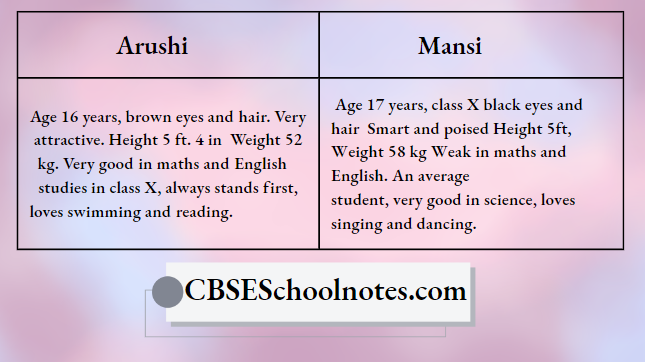
Read the biodata of two girls given below. Then complete the blanks in the passage given below using the Comparative Degree:

CBSE Class 8 English Chapter 11 Academic Achievements Swimming Interest Arushi

Fill in the blanks in the suitable Comparative forms :

Arushi and Mansi study in the same school and class. Mansi is(1)________ (old) than Arushi by one year. She is (2)____________ (short) in height but is(3)__________ (weight) than Arushi. Mansi is (4)____________ (smart) than Arushi who is(5)__________(attractive). Arushi is(6)__________ (good) in studies than Mansi, who is an average student. Arushi is(7)_________(good) in English and Maths, but Mansi scores(8)____ (much) in Science. The difference in their hobbies is (9)__________(big) as Arushi loves swimming and reading, whereas Mansi loves singing and dancing(10)___________ (much) than anything else.

Answer:

Arushi and Mansi study in the same school and class. Mansi is Older than Arushi by one year. She is Shorter in height but is Heavier than Arushi. Mansi is Smarter than Arushi, who is more attractive. Arushi is Better in studies than Mansi, who is an average student. Arushi is Better in English and Maths, but Mansi scores much more in Science. The difference in their hobbies is bigger as Arushi loves swimming and reading, whereas Mansi loves singing and dancing much more than anything else.

4. Study how Comparisons are made in some cases.

The faster you walk, the sooner you will reach the place.

The more he argued, the more angry I felt.

We use the – the with two comparatives when one thing is directly related to the other. (Rule the + Comparative ____________, the + Comparative)

Exercise 4

Question 1. Life is getting__________and _______________ (hard).

Answer: Life is getting harder and harder.

Question 2. The_________you start, the__________ you will finish the work, (soon)

Answer: The sooner you start, the sooner you will finish the work.

Question 3. The_____(rich) you are, the_________ (greedy) you become.

Answer: The richer you are, the greedier you become.

Question 4. The_________(high) you climb, ___________ (difficult) it becomes.

Answer: The higher you climb, more difficult it becomes.

Question 5. The__________(much) you work, the____________ (much) you achieve.

Answer: The more you work, the more you achieve.

Question 6. The__________(more) the prices, the______________ (less) are the buyers.

Answer: The higher the prices, the fewer are the buyers.

5. Special Note: We usually say: He is as poor as me. (Not that I)

He is poorer than me. (Not I)

He is poorer than I am.

He is as poor as I am.

Exercise 5

Rewrite the following sentences using

Question 1. It is hot today, but it was hotter yesterday.

Answer: Yesterday was not as hot as today.

Question 2. This is an interesting story, but the one I read yesterday was more interesting.

Answer: The story I read yesterday was not as interesting as this one.

Question 3. Dhoni could captain the team better than Dravid.

Answer: Dravid could not captain the team as well as Dhoni.

Question 4. I do not think Ishant Sharma can bowl better than Irfan Pathan.

Answer: I think Irfan Pathan can not bowl as well as Ishant Sharma.

Question 5. Delhi is a costlier city than Chennai.

Answer: Chennai is not as costly as Delhi.

6. The Superlative Degree

We usually form Superlatives by adding est or using most. Just as in Comparative degree, est is added to short words and most to longer words.

tall – tallest

beautiful- most beautiful

  • One must use the before a Superlative, the best, the most beautiful.
  • After Superlatives, we use in with places and of with periods of time.

Examples: Mukesh Ambani is the richest person in India.
Yesterday was the saddest day of my life.

Exercise 6

Complete the following sentences with Superlative degree

Question 1. Monday is___________ (busy) day of the week for us.

Answer: Monday is the busiest day of the week for us.

Question 2. Who is the___________________ (famous) novelist in the country?

Answer: Who is the the most famous novelist in the country?

Question 3. Of the three reports, yours was___________ (good) one.

Answer: Of the three reports, yours was the best one.

Question 4. This is__________(pretty) dress in the showroom.

Answer: This is the prettiest dress in the showroom.

Question 5. China is________(big) country in the world.

Answer: China is the biggest country in the world.

Question 6. My mother is__________ (graceful) lady I have ever seen.

Answer: My mother is the most graceful seen.

Question 7. Amita dresses_________ (good) in the class.

Answer: Amita dresses the best in the class.

Question 8. The new washing machine brought out by Samsung is_________ (economical) model in the market.

Answer: The new washing machine brought out by Samsung is the most economical model in the market.

Question 9. It is the best as it uses____________ (less) energy and saves your money.

Answer: It is the best as it uses the least energy and saves your money.

Question 10. The __________ (bad) floods of the century destroyed plants, animals, and buildings, besides killing thousands.

Answer: The worst floods of the century destroyed plants, animals, and buildings, besides killing thousands.

Exercise 7

Fill in the blanks with the Comparative or Superlative form of the words given in brackets

Question 1. The Mississippi is a large river, but the Amazon is_______ (large).

Answer: The Mississippi is a large river, but the Amazon is larger.

Question 2. The circus company had many strong men in their employees, but Suliman was __________ (strong).

Answer: The circus company had many strong men in their employees, but Suliman was the strongest.

Question 3. How is your brother today? Is he _______(good) now ?

Answer: How is your brother today? Is he better now?

Question 4. Of the two evils before him, he chose_________(little)

Answer: Of the two evils before him, he chose the lesser

Question 5. He thinks he is________(wise) than his parents which is_________(foolish) on his part.

Answer: He thinks he is wiser than his parents, which is the most foolish on his part.

Exercise 8

Fill in each blank with a Superlative. You can take the help of the adjectives given in the box

strong, great, common, serious, large

The sun is the (1)_______________ force on earth. But we are still not using the sun to the (2) _________ extent possible. Instead, fossil fuels are presently the (3)____________source of electricity. However, these fuels are also one of (4)___________ causes of air pollution. To use the force of the sun to the maximum, we need our most creative thinking and our (5)_____________efforts.

Answer:

The sun is the strongest force on Earth. But we are still not using the sun to the greatest extent possible. Instead, fossil fuels are presently the most common the source of electricity. However, these fuels are also one of the most serious causes of air pollution. To use the force of the sun to the maximum, we need our most creative thinking and our greatest efforts.

Exercise 9

Fill in the blanks with a Superlative in each of the following sentences:

Question 1. Who made the_____(early) spaceship?

Answer: Who made the earliest spaceship?

Question 2. Which country has the _________ (large) number of spaceships?

Answer: Which country has the largest number of spaceships?

Question 3. Which spaceship made the_____________(long) journey in space?

Answer: Which spaceship made the longest journey in space?

Question 4. Is a space module the _______ (easy) way to travel in space?

Answer: Is a space module the easiest way to travel in space?

Question 5. Isn’t space travel the __________ (cost) and not the _________(easy) way to travel?

Answer: Isn’t space travel the most costly, and not the easiest way to travel?

Exercise 10

Change the following sentences as directed: 

Question 1. Ashoka was one of the greatest kings (Change to Positive degree)

Answer:

Positive degree: Very few kings were as great as Ashoka.

Question 2. I have not eaten a more delicious cake.( Change to Superlative degree)

Answer: Superlative degree: This is the most delicious cake i have ever eaten.

Question 3. This is the oldest church in Spain. (Change to Comparative degree)

Answer: Comparative degree: This church is older the any other church in spain.

Question 4. No pop singer is more famous than Michael Jackson. (Change to Superlative degree)

Answer: Superlative degree: Michael Jackson is the most famous pop singer.

Question 5. No one is as lazy as Mohan in the class.(Change to Comparative degree)

Answer: Comparative degree: Mohan is lazier than any other student in the class.

Question 6. Hari and you are taller than me. (Change to Positive degree)

Answer: Positive degree: I am not as tall as Hari and you.

CBSE Class 8 English Chapter 10 Active And Passive Voice

CBSE Class 8 English Chapter 10 Active And Passive Voice

1. Let us have a quick recapitulation by looking at the chart given below

CBSE Class 8 English Chapter 10 Active Passive Voice Tenses Comparison

2. Miscellaneous Examples

CBSE Class 8 English Chapter 10 Grammar Infinitives Questions Commands Passive

Study the above forms thoroughly.

Exercise 1

Turn the following present-tense sentences from Active to Passive Voice:

Question 1. Simon teaches children the art of watercolour painting.

Answer:

Active Voice: Simon teaches children the art of watercolour painting.

Passive Voice: Children are taught the art of watercolour painting by Simon.

Question 2. We have donated a variety of books to the library.

Answer:

Active Voice: We have donated a variety of books to the library.

Passive Voice: A variety of books have been donated to the library.

Question 3. The captain always encourages us to do our best.

Answer:

Active Voice: The captain always encourages us to do our best.

Passive Voice: We are always encouraged to do our best by the captain.

Question 4. What does the company charge as fee for this course?

Answer:

Active Voice: What does the company charge as fee for this course?

Passive Voice: What is charged as the fee for this course by the company?

Question 5. Has someone seen my new bag?

Answer:

Active Voice: Has someone seen my new bag?

Passive Voice: Has my new bag been seen.

Question 6. You must help the poor.

Answer:

Active Voice: You must help the poor.

Passive Voice: The poor must be helped.

Question 7. Everyone laughed at the poor beggar.

Answer:

Active Voice: Everyone laughed at the poor beggar.

Passive Voice: The poor beggar was laughted at by everyone.

Exercise 2

The following sentences are in the Past Tense, Active Voice. Turn them from Active to Passive Voice

Question 1. My mother knitted this cardigan for me.

Answer:

Active Voice: My mother knitted this cardigan for me.

Passive Voice: This cardigan was knitted for me by my mother.

Question 2. The villagers had lost all their possessions during the floods.

Answer:

Active Voice: The villagers had lost all their possessions during the floods.

Passive Voice: All their possessions had been lost by the villagers during the floods.

Question 3. Did you forget to post this letter yesterday?

Answer:

Active Voice: Did you forget to post this letter yesterday?

Passive Voice: Was this letter forgotten to be posted (by you) yesterday?

Question 4. The children were helping the teacher decorate the class.

Answer:

Active Voice: The children were helping the teacher in decorating the class.

Passive Voice: The teacher was being helped by the children in decorating the class.

Question 5. Did the police stop the strikers from doing damage to public property?

Answer:

Active Voice: Did the police stop the strikers from doing damage to public property?

Passive Voice: Were the strikers stopped by the public from doing damage to public property?

Question 6. Why did you frighten the horse?

Answer:

Active Voice: Why did you frighten the horse?

Passive Voice: Why was the horse frightened by you?

Question 7. Someone stole my suitcase from the railway compartment.

Answer:

Active Voice: Someone stole my suitcase from the railway compartment.

Passive Voice: My suitcase was stolen from the railway compartment by someone.

Question 8. He did not tell the members about the meeting on time.

Answer:

Active Voice: He did not tell the members about the meeting on time.

Passive Voice: The members were not told about the meeting on time by him.

Question 9. She asked me to shut the door and lock it properly.

Answer:

Active Voice: She asked me to shut the door and lock it properly.

Passive Voice: I was asked by her to shut the door and lock it properly.

Question 10. They believed that the experiment failed because of bad planning.

Answer:

Active Voice: They believed that the experiment failed because of bad planning.

Passive Voice: It was believed by them that the experiment failed because of bad planning.

Exercise 3

Fill in the blanks with the Passive form of the verbs in the Future Tense:

Question 1. The complete details of the tour __________ (explain) to you by the leader.

Answer: The complete details of the tour will be explained to you by the leader.

Question 2. A new high rise building___________ ( construct) by us.

Answer: A new high rise building will be constructed by us.

Question 3. When________ the date___________ (new election announce)?

Answer: When will date be announced (new election announce)?

Question 4. The hotel__________(provide) guests with breakfast free of charge.

Answer: The hotel will be provided guests with breakfast free of charge.

Question 5. Many improvements_________(made) in controlling traffic at peak time by next month.

Answer: Many improvements will be made in controlling traffic at peak time by next month.

Exercise 4

Put the verbs in brackets into the correct passive form:-

This week a new Mall (1)____________(open) in South Delhi. The Mall (2)_________(believe) to be the largest in Delhi and it (3) ________(hope) that it (4)_________ (visit) by over a lakh of people in a month. Unfortunately, it (5)_________ (not/finish) yet, but it (6)________ (complete) by the next month. The Mall includes twelve cine complexes, food courts, and every possible foreign brand in clothes, cosmetics, and furnishings. Every kind of facilities and security (7)___________(provide) and people can shop here in peace and comfort.

Answer:

  1. will be opened
  2. is believed
  3. is hoped
  4. will be visited
  5. has not been finished
  6. will be completed
  7. will be provided

Exercise 5

Rewrite the following passage in the Passive Voice in the Past Tense:

The villagers witnessed a terrible train accident last night. The fire brigade fought the fire involving five bogies, while ambulances rescued the survivors. Ambulances took all the survivors to the hospital. No one knows yet the cause of the accident. The government has ordered a full investigation. Newspapers and TV reporters have already interviewed many of the survivors. They say that there must be some eyewitnesses. The police and the reporters are continuing the search.

Answer:

The villagers was witnessed a terrible train accident last night. The fire brigade was fought the fire involving five bogies, while ambulances were rescued the survivors. Ambulances were taken all the survivors to hospital. No one is not yet known yet the cause of the accident. The government has been ordered a full investigation. Newspapers and TV reporters have already been interviewed many of the survivors. It is said that there must be some eye witnesses. The police and the reporters is beeing continued the search.

Exercise 6

Rewrite the following passage in the passive form. (Future Tense)

The government is going to make an important announcement tomorrow. They will ban all cars from entering Delhi. They will enter according to their serial numbers. Cars ending in numbers 123 will not enter on Monday, 456 on Tuesdays, 678 on Wednesdays, and so on. This will help people, as pollution is seriously affecting their health. The government is making plans for a new environmental police force. After all, they must do something before it is too late.

Answer:

The government is going to will be made an important in the announcement tomorrow. They will be banned all cars from entering Delhi. They will be allowed according to their serial numbers. Cars ending in numbers 123 will not be permitted on Monday, 456 on Tuesdays, 678 on Wednesdays and so on. This will be helped people, as pollution is being seriously affected their health. The government are being made plans for a new environmental police force. After all they must be done something before it is too late.

3. Modals

Look at the following examples.

Examples:

1. Everyone should obey the laws of the country. (Active)

The laws of the country should be obeyed by everyone. (Passive)

2. Ramesh could have avoided the accident if he had been careful. (Active)

The accident could have been avoided by Ramesh if he had been careful. (Passive)

Exercise 7

Change the following sentences into the passive form according to the examples given:

Question 1. One must keep one’s promises.

Answer:

Active voice: One must keep one’s promises.

Passive voice: Promises must be kept.

Question 2. The police may have caught the culprit by now.

Answer:

Active voice: The police may have caught the culprit by now.

Passive voice: The culprit may have been caught by the police by now.

Question 3. You should do your duty come what may.

Answer:

Active voice: You should do your duty come what may.

Passive voice: your duty should be done come what may.

Question 4. Without sincere hard work, you cannot achieve success.

Answer:

Active voice: Without sincere hard work, you cannot achieve success.

Passive voice: Success cannot be achieved without sincere, hard work.

Question 5. You should have helped your brother when he needed it.

Answer:

Active voice: You should have helped your brother when he needed it.

Passive voice: Your brother should have been helped when he needed it.

Question 6. You ought to win this race, you have worked hard for it.

Answer:

Active voice: You ought to win this race, you have worked hard for it.

Passive voice: This race ought to be won by you; you have worked hard for it.

Question 7. You might disturb the whole system by what you are doing.

Answer:

Active voice: You might disturb the whole system by what you are doing.

Passive voice: The whole system might be disturbed by what you are doing.

Question 8. We may revise the pay scales shortly.

Answer:

Active voice: We may revise the pay scales shortly.

Passive voice: The pay scales may be revised shortly.

Question 9. We could hear the noise of the drums from a distance.

Answer:

Active voice: We could hear the noise of the drums from a distance.

Passive voice: The noise of the drums could be heard from a distance.

Question 10. Why couldn’t you complete the building in the stipulated time?

Answer:

Active voice: Why couldn’t you complete the building in the stipulated time?

Passive voice: Why couldn’t the building be completed in stipulated time?

4. Command Sentences

Active – Go away!

Passive – You should be gone.

Active – Do this work now.

Passive – This work should be done now.

Active – Do not neglect anyone.

Passive – Let no one be neglected.

Active – Help the poor.

Passive – Let the poor be helped.

Exercise 8

Change the following from Active into Passive

Question 1. Shut the door.

Answer: Let the door be shut.

Question 2. Do not tell him anything about our new plan.

Answer: Let nothing be told to him about our new plan.

Question 3. Spare no efforts in completing this assignment.

Answer: Let no efforts be spared in completing this assignment.

Question 4. Clear all the dues by the end of this week.

Answer: Let all the dues be cleared by the end of this week.

Question 5. Don’t move.

Answer: Let nothing be moved.

5. Use Of Let

Exercise 9

Use Let at the beginning of each of the sentences given in Exercise 8 above

Example:

Question 1. ____ us shut the door.

Answer: Let us shut the door

Question 2. ___________

Answer: Let us not tell him anything about our new plan.

Question 3. ___________

Answer: Let us spare no effort in completing this assignment.

Question 4. ____________

Answer: Let us clear all the dues by the end of this week.

Question 5. ____________

Answer: Let us not move.

6. Sometimes, Commands Are Expressed In The Passive In Another Way

Examples: Please don’t make a noise.

You are requested not to make a noise.

Exercise 10

Change the following sentences into Passive form with the help of the words given in the box. One is done for you:

requested, ordered, expected, believed, advised, warned, hoped

Question 1. Keep off the grass.

Answer:

You are requested to keep off the grass.

Question 2. Do not pluck flowers.

Answer: You are advised not to pluck flowers.

Question 3. Do not trespass or you will be prosecuted.

Answer: You are warned not to trespass, or you will be prosecuted.

Question 4. All guests should be in their seats by five o’clock.

Answer: All guests are expected to be in their seats by five O’clock.

Question 5. All members must follow the new rules.

Answer: All members are ordered to follow the new rules.

Question 6. Everyone expected Akhil Singh to win a medal at the Beijing Olympics.

Answer: Akhil Singh was expected to win a medal at the Beijing Olympics.

Question 7. They hope to find a cure for this disease soon.

Answer: A cure for this disease is hoped to be found soon.

Question 8. Some still believe that Subhash Chandra Bose did not die in the air crash.

Answer: It is still believed by some that Subhash Chandra Bose did not die in the air crash.

Exercise 11

Change the verbs in the following sentences into either Active or Passive Form:

Question 1. His performance in the shooting event was praised by everyone.

Answer: Everyone praised his performance in the shooting event.

Question 2. This Mall was built ten years ago.

Answer: They built this mall ten years ago.

Question 3. By whom was this exercise written?

Answer: Who wrote this exercise?

Question 4. I was astounded by her stupid behaviour at the club.

Answer: Her stupid behaviour at the club astonished me.

Question 5. Let the post be advertised.

Answer: Advertise the post.

Question 6. I should be allowed to attend the meeting by them.

Answer: They should allow me to attend the meeting.

Question 7. You are not allowed to walk on the grass.

Answer: They do not allow you to walk on the grass.

Question 8. It is expected that the new changes in the salary structure will be announced shortly.

Answer: We expect that they will announce the new changes in the salary structure shortly.

Question 9. You are requested to be seated on time.

Answer: We request you to be seated on time.

Question 10. I found that my bag had been stolen from the bus before it reached Delhi.

Answer: I found that someone had stolen my bag from the bus before it reached Delhi.

Question 11. The ticket will be given to you by my secretary tomorrow.

Answer: My secretary will give the ticket to you tomorrow.

Question 12. The parents will have been informed by post by them.

Answer: They will have informed the parents by post.

CBSE Class 8 English Chapter 9 Verbs – Non Finites

CBSE Class 8 English Class 8 Chapter 9 Verbs – Non-Finites

1. You have already learnt that verbs can be divided into two forms :

Finite Verbs and Non-Finite Verbs.

Finite Verb: The verb has a subject which is limited by number and person.

Example: He always succeeds in business.

The verb succeeds has a subject ‘He’.

Example: He tries to succeed in business.

To succeed has no subject and hence it is not limited by number or person. It only names the action denoted by the Verb ‘tries’.

Hence it is a Non-Finite Verb. Non-Finites can be divided into three groups.

1. The Infinitive: They are called to-verbs: to work, to write, to sing (present infinitive).

    1. I want to work.
    2. He is going to write a letter to his father.
    3. I want to sing in the school campus.

Note: Infinitives can be used without ‘to’ also. Verbs like bid, make, let, see, hear,need, dare take the infinitive after them without ‘to’.

Examples:   I made her confess that she had stolen the book.
He dare not do it. You need not go.

2. Participles: They are Verb-Adjectives ending in -ing.

Examples: working, singing, crying.

Gerunds: They are Verb-Nouns, ending in –‘ing’.

Example: Singing is an art.

Remember

Both Participles and Gerunds end in ing, but their functions are different. The Participles are like Adjectives and Gerunds like Nouns.

Example: Hoarding money is his hobby.

Here hoarding describes the Noun money. It is functioning like an adjective, so it is a Participle.

Example: Hoarding and black marketing has become his second nature.

Here hoarding as well as black marketing are the subject of the verb has become.

They are functioning as Nouns, so they are Gerunds.

Infinitives

Exercise – 1

Complete the following sentences by using infinitives

Verb + Infinitive

Example: Is it proper to use this room?

Question 1. Is it safe ______

Answer: to swim here

Question 2. It was a pleasure________

Answer: to meet you

Question 3. Everybody hopes_________

Answer: to succeed

Question 4. The book is_________

Answer: to read

Question 5. It was impossible ____________

Answer: to finish on time

Exercise – 2

Complete the exercise by using: Verb + Object + Infinitive.

Example: He wanted us to go and meet the Principal.

Question 1. He advised_________ ____________a seat well in advance for the show.

Answer: me to, book

Question 2. I would like ___________ _____________ harder in future.

Answer: you to , work

Question 3. The Director invited_________ _____________round the factory and see how it functioned.

Answer: us to , walk

Question 4. I was permitted by_________ _____________ early and visit my ailing father.

Answer: the manager to, leave

Question 5. She warned _______ not ________to strangers on the road.

Answer: me,to talk

Question 6. He promised__________ _______________the officer in the evening.

Answer: me to , meet

Question 7. The Principal did not allow________ ________________ on leave.

Answer: them to go

Question 8. I ordered _______ not _________TV but play games with his friends instead.

Answer: him, to watch

2. Read the following sentences :

  • To advise others is easy.
  • To live without air is impossible.
  • These sentences would look better if ‘It’ is used as a subject in each case.
  • Examples: It is easy to advise others.
  • It is impossible to live without air.

Exercise -3

Rewrite the following sentences using ‘It ’

Question 1. To tell lies is wrong.

Answer: Telling lies is wrong

Question 2. To reject this offer will be foolish.

Answer: Rejecting this offer will be foolish

Question 3. To be present at your party will be a pleasure.

Answer: Being present at your party will be a pleasure.

Question 4. To play on the road is unsafe for children.

Answer: playing on the road is unsafe for children.

Question 5. To grab all the presents was very selfish on her part.

Answer: Grabbing all the presents was very selfish on her part.

Question 3. The Infinitive is often used with Adjectives and Participles. They can be modified by ‘too’.

Examples:

  • He is so weak that he cannot run fast.
  • He is too weak to run fast.

Exercise -4

Rewrite the following sentences by using the Adverb too (Remember to place it before an adjective) + an infinitive

Question 1. It was so hot today that we could not work.

Answer: It was too hot to work today.

Question 2. She was so frightened that she could not speak for a few minutes.

Answer: She was too frightened to speak for a few minutes.

Question 3. This news is so good that I can’t believe it.

Answer: This news is too good to believe.

Question 4. The room was so noisy that I could not hear what my friend said.

Answer: The room was too noisy to hear what my friend said.

Question 5. His clothes were so shabby that he was not allowed to enter the club.

Answer: His clothes were too shabby to be allowed into the club.

Exercise -5

Join the following sentences by using ‘enough ’ + an infinitive.

Examples: The boy was not tall. He would not reach the shelf.

The boy was not tall enough to reach the shelf.

Question 1. She was not very smart. She could not solve the puzzle in time.

Answer: She was not smart enough to solve the puzzle in time.

Question 2. He wasted all his wealth. He was very foolish.

Answer: He was foolish enough to waste his wealth.

Question 3. He is quite honest. He can face any temptation.

Answer: He is honest enough to face any temptation.

Question 4. He never complained about his work. He was patient.

Answer: He was patient enough never to complain about this work.

Question 5. Martin was not a strong boy. He could not lift heavy objects.

Answer: Martin was not strong enough to lift heavy objects.

Question 4. Remember the infinitive is used without to after certain verbs. We drop to before infinitive in negative sentences.

Examples: bid, make, let, see, hear, need.

The above verbs do not need ‘to’ to form an infinitive.

  • I bid her do this.
  • I saw her run away.
  • I made her confess.
  • I heard him weep.
  • You need not go.
  • He dare not do it.

Exercise -6

Fill in the blanks with the Infinitive with or without to. Take the help of the words given in the brackets:-

Question 1. The landlord had____________ the lock and occupy the house. (break)

Answer: to break

Question 2. You had better______________your Income Tax before 30th July. (pay)

Answer: pay

Question 3. You need not __________for me at the station,I may be late.(wait)

Answer: wait

Question 4. He did nothing at home but____________TV all the time.(watch)

Answer: watch

Question 5. Very few people dare_______ the might of the Don in Mumbai. (challenge)

Answer: to challenge

Question 6. We made them ________ the exercise before going home. (complete)

Answer: complete

Question 7. The foolish boy tried_____________ his parents’ room at night without being caught. (enter)

Answer: to enter

Question 8. Bid the policemen____________ quickly and arrest the culprit. (action)

Answer: act

Question 9. I heard the woman__________ out in terror but couldn’t help her. (cry)

Answer: cry

Question 10. You need ______ for longer hours before you can think of entering the inter-school competition. (practice)

Answer: to practice

Participles

Participles are Verb + Adjective.

Example: Walking on the road. Hari met his friend.

Walking qualifies the Noun ‘Hari’ as an Adjective does. It is formed from the Verb ‘walk’, and given an object.

Therefore, the word walking is both like a Verb and an Adjective.

Participles are of two kinds :

1. The Present Participle shows that the action is going on or is incomplete.

  1. I can hear the girls singing on the stage.
  2. Do you see the boy riding a pony?

2. The Past Participle denotes an action which is completed and hence is no longer in progress.

Examples:

  • Driven by fury, he fired the shot.
  • Terrified, the girl hid behind the thick bushes.

Important: We use Participles to join sentences.

Examples:

  • I saw an old man. He was walking very slowly on the road.
  • I saw an old man walking very slowly on the road.
  • The weather was fine. I went out.
  • The weather being fine, we went out.

Exercise – 7

Combine the pair of sentences using a Participle

Question 1. I was in the hotel. I was waiting for my friend to arrive.

Answer: Being in the hotel, I was waiting for my friend to arrive.

Question 2. The little boy saw a monkey. He began to cry.

Answer: Seeing a monkey, the little boy began to cry.

Question 3. Ramesh picked up the mobile phone. He rang up his mother.

Answer: Picking up the mobile phone, Ramesh rang up his mother.

Question 4. His friend seized his arm. He led him away from the party.

Answer: Seizing his arm, his friend led him away from the party.

Question 5. The crow stole a piece of cheese. He flew to his nest to enjoy it.

Answer: Stealing a piece of cheese, the crow flew to his nest to enjoy it.

Question 6. He seized his stick. He rushed out to chase the thief.

Answer: Seizing his stick, he rushed out to chase the thief.

Question 7. I met Abid on the road. He was carrying a load of books in his bag.

Answer: Meeting Abid on the road, I noticed he was carrying a load of books.

Question 8. The enemy was beaten thoroughly. The enemy ran away from the field.

Answer: Thoroughly beaten, the enemy ran away from the field.

Question 9. He was elected President. The people gave their full support.

Answer: Elected President, he received the people’s full support.

Question 10. The master was absent for a long time. The business was badly neglected.

Answer:

The business,(having been) neglected for a long time, suffered due to the master’s absence.

Exercise-8

Pick out the Participles in the following sentences and state whether they are Present or Past Participles

Question 1. The enemy, beaten at every point,fled from the field.

Answer: beaten – Past participle

Question 2. Seeing the sunshine we decided to go for a picnic.

Answer: Seeing – Present participle

Question 3. The hungry fox saw some grapes hanging from the vines.

Answer: hanging – Present participle

Question 4. She kept us waiting outside her office for two hours.

Answer: waiting – Present participle

Question 5. We saw a car driven at full speed crash against a bus.

Answer: driven – Past participle

Question 6. Encouraged by his success, he expanded his business.

Answer: Encouraged -Past participle

Question 7. Dissatisfied with his present job he resigned and left.

Answer: Dissatisfied – Past participle

Question 8. Displeased by his servant’s actions he ordered him to leave at once.

Answer: Displeased – Past participle

Question 9. Charmed by her presence, they offered her a role in their next picture.

Answer: Charmed – Past participle

Question 10. Walking up to the front door he rang the bell loudly.

Answer: Walking – Present participle

Gerunds

Read the following sentence.

  • Swimming is a very good exercise.
  • The word swimming is formed by joining the base verb ‘swim’ with –ing. So it is like a verb.
  • Swimming is also the name of an action and also the subject of a sentence hence it does the work of a Noun.
  • The word swimming is both like a Verb and a Noun. It is therefore, a Verb Noun, and is called a Gerund.

Remember:

Participles also end in ‘ing’ but they are Verbal Adjectives.

Swimming across the river, he was chased by a crocodile. (Participle) The word ‘swimming’ here describes the Noun ‘he’. It is a participle.

Important Note: The only part of a verb that can follow a Preposition is a Gerund.

Examples:

CBSE Class 8 English Part 1 Functional Grammar And Correct Usage Chapter 9

Exercise – 9

Match A and B to make sensible sentences:-

            A                                                                 B

1. Don’t try                                         (c)    a. breaking this window?

2. I do not agree to                            (g)   b. without meeting my sister.

3. The camera is not suitable for      (I)    c. bullying the poor child?

4. Please excuse                                 (j)     d. Snowing now?

5. Would you mind                           (h)     e. reporting the matter to the police. 

6. Has it stopped                              (d)   f. your going on leave very often.

7. We insisted on                             (e)  g. driving the car when I go away.

8. I went home                                (b)  h. playing this tune again?

9. Who is responsible for               (a)  I. taking pictures without proper light.

10. Why don’t you stop                 (f)  j. my being late again.

Exercise – 10

Complete the following sentences by adding a suitable Infinitive, Present Participle or Gerund of the verbs given in the brackets:-

Question 1. I should advise you _________a doctor, (see)

Answer: to see

Question 2. The bad weather compelled us ___________indoors.(stay)

Answer: to stay

Question 3. I have come________you. (help)

Answer: to help

Question 4. I am sorry _________ this. (hear)

Answer: to hear

Question 5. She was quick_________ the point. (see)

Answer: to see

Question 6. Please allow us__________ outside. (wait)

Answer: to wait

Question 7. The prisoner begged the judge __________him. (forgive)

Answer: to forgive

Question 8. She is fond of _________cards. (play)

Answer: playing

Question 9. He was found ___________ desperately for his life.(fight)

Answer: fighting

Question 10. We saw a clown _______on his head. (stand)

Answer: standing

Question 11. We objected to _____________her.(meet)

Answer: meeting

Question 12.____________ on the grass is for bidden. (walk)

Answer: walking

Question 13. We insisted on ______ the letter .(see)

Answer: seeing

Question 14. They always disapproved of __________ cards.(play)

Answer: playing

Question 15. Her parents never approved of her __________ an old man. (marry)

Answer: marrying

Question 16. She is very clever at_________ excuses. (make)

Answer: making

Question 17. I hate __________ in a queue. (stand)

Answer: standing

Question 18. Would you mind___________ outside? (wait)

Answer: waiting

Question 19. I remember _____________ you in London two years ago. (meet)

Answer: meeting

Question 20. I enjoy____________ in the sun on a cold day. (bask)

Answer: basking

CBSE Class 8 English Chapter 8 Models

CBSE Class 8 English Class 8 Chapter 8 Models

Remember

Modals are Auxiliaries. We use them to express our moods, manners, and attitudes.

Auxiliaries are of two kinds :

1. Principal Auxiliaries are :

to be, to have, and   to do

Examples:   am, is, are was, were
has, have   had
do, does    did

The Modal Auxiliaries

They do not change with the number or person of the subject. They cannot be used with the Continuous Tense.

Modals express the following :

  1. ability – can, could
  2. advice – had better, ought to, should
  3. certainty/intention – shall, will, would
  4. necessity – need to, must
  5. obligation -ought to, should
  6. permission – can, may
  7. willingness – shall, will, would
  8. habit – used to
  9. wish – may

Shall and Will

1. Uses of Shall: Denotes simple + active time in First Person.

Examples: I shall go.

I shall help her

Shall is used in the Second and Third Person to express: promise, command, threat and determination.

Examples: You shall receive a prize, (promise)

He shall go there, (command)

She shall be fined for lying,(threat)

They shall obey us, whether they like it or not. (determination)

2. Uses of Will : It is used in Second and Third Person to express :

Simple Future Tense :

Examples:

  • He will go there.
  • They will help her.
  • Will he come today?

Will is used in First Person to express :

willingness, promise, threat, command and determination.

Examples:

I will do it. (determination)

I will help you. (promise)

I will expose her. (threat)

I will lend you my pen. (willingness)

Exercise-1

Fill in the blanks with shall or will

Question 1. I ____________be twenty next Wednesday.

Answer: Shall

Question 2. I___________ give you a blow if you abuse me.

Answer: will

Question 3. I__________ help her, come what may.

Answer: will

Question 4. I ________ never be late again.

Answer: Shall

Question 5. He__________ do as I bid him.

Answer: Shall

Question 6. You __________ obey my orders.

Answer: Shall

Question 7. They___________ come here tomorrow.

Answer: will

Question 8. They____________ be rewarded.

Answer: Shall

Question 9. We___________ never do such a thing again.

Answer: Shall

Question 10. You___________ be given the first prize.

Answer: will

Question 11. You _______ not do as you like.

Answer: Shall

Question 12. She________ be given a prize.

Answer: will

Question 13. He________ be punished for this.

Answer: Shall

Question 14. She___________ obey you, whether she likes it or not.

Answer: Shall

Question 15. You_____________ not move; I warn you.

Answer: Shall

Exercise – 2

Use can, could, be able to, to fill in the blanks with them

Remember

The above modals express ability and possibility.

Question 1. You____________ not enter the class as you are late.

Answer: can

Question 2. The new teacher___________ teach us how to make flowers from paper and cloth.

Answer: can

Question 3. We are____________ get information on many subjects from the Internet.

Answer: able to

Question 4. Hari ________ not buy a new computer today as all the shops were closed.

Answer: colud

Question 5. My mother _______ have forgotten to ring up her friend.

Answer: colud

Question 6. I ____________ go to a movie today.

Answer: can

Question 7. He was____________ to revise all his lessons for the test.

Answer: able to

Question 8. Father _________ have taken the house keys with him by mistake.

Answer: colud

Question 9. The skirt_________ be of a cheap quality.

Answer: colud

Question 10. He____________ have helped you to solve your problem.

Answer: colud

Modals must, have to, had to express necessity or compulsion. Have to suggests some external compulsion and must the speaker’s personal feelings.

Examples:

  1. I have to complete this work by the evening.
  2. You must see the new mall, it is beautiful.

Exercise-3

Complete the following sentences with must or have to

Question 1. You___________ show your passport at the gate before you can enter the airport.

Answer: must

Question 2. I ________see my dentist today, I have a terrible toothache.

Answer: must

Question 3. You ____________ go to the new restaurant that serves fabulous food.

Answer: should

Question 4. You will _________ pay a big fine if you don’t follow traffic laws.

Answer: have to

Question 5. I _________ go and meet my father, he is not keeping well.

Answer: should

Must does not have a past tense. But have to can be used in past tense as well as future tense.

Examples:

  1. I have to finish the exercise.
  2. I had to finish the exercise.
  3. I will have to finish the exercise.

Exercise-4

Answer the following questions with either have to, had to or will have to. One is done for you

Question 1. Did you pay a fine yesterday for wrong parking?

Answer: Yes, I had to pay Rs 300 as a fine.

Question 2. How long will you wait for her?

Answer: I will have to wait for her 30 minutes.

Question 3. Are you asked to stay back after school for rehearsals?

Answer: Yes, I have to stay back after school.

Question 4. Why have you come to the bank at this hour?

Answer: I have to withdraw money urgently.

Question 5. Why did he miss the concert yesterday?

Answer: He had to attend a familt function.

Question 6. Do I tip the waiter?

Answer: Yes, you have to tip the waiter

Question 7. Why did he cancel his trip to Agra?

Answer: He had to finish an important project.

Question 8. How do I pay the bill — in cash or by a cheque?

Answer: You have to pay in cash: cheques aren’t accepted

Question 9. How much did you pay for this dress?

Answer: I have to pay Rs 1,500 for it.

Question 10. How will I travel to Nainital?

Answer: You will have to take a bus or a taxi.

Should and Ought to are used to express duty, obligation or advice.

Examples:

  1. You ought to obey your parents, (duty)
  2. You should take regular exercise to reduce, (advice)
  3. You should help your poor friend, (obligation)

Note: Should is not so strong as must or have to.

  1. You have to park your car in the proper parking lot. (It is the law and has to be done.)
  2. You must park your car in the proper parking lot. (Necessary and I advise you to do so.)
  3. You should park your car in the proper parking lot. (Right thing to do)

Ought to — is used to express a moral duty.

Example: You ought to follow the traffic rules.

Exercise-5

A few situations are given below. What advice will you give? (Use must, should, ought to) :—

Question 1. A beggar asking you for money.

Answer: You should help if you can,but cautions

You Ought to consider giving food instead of money.

Question 2. A big boy bullying a small child.

Answer:

You must stop bullying immediately.

You should trat others with kindness.

Question 3. Two students whispering to each other in class.

Answer: You must pay attention to the teacher .

You should save your conversation for break time.

Question 4. To a policeman who has caught a thief.

Answer: To a police

You must take the theif to the police station.

You should handle the situation calmly.

Question 5. To a person trying to cross a railway line, when the gate has been closed at the crossing.

Answer: You must not cross now its dengerous!

You ought to wait until the gate opens.

Can, could, will, would and may are used to express requests.

Examples:

  1. Could I use your telephone please?
  2. Can I open the door now?
  3. Would you help him please?
  4. Will you help him?

May is the most polite form of making requests or asking for permission.

Example: May I come in, Sir?

Exercise -6

In the given situation how will you make a request?

Situation

Question 1. Help in solving a sum from a classmate.

Request___________

Answer: Could you please help me solve this sum?

Situation

Question 2. You need some information about trains.

Request____________

Answer: Can you give me some information about the trains?

Situation

Question 3. Want to be shown around a farm by the owner.

Request____________

Answer: Would you mind showing me around your farm?

Situation

Question 4. Ask for more time to finish your homework.

Request____________

Answer: May I have some more time to finish my homework?

Situation

Question 5. Permission to use your neighbour’s lawn mower.

Request___________

Answer: Can I use your lawn mower, please?

Note: You have to use can, could, will, would or may.

May is used to express a wish.

Example: May you live long!

An exclamation mark is used at the end of the sentence.

Exercise – 7

Use may as a wish in five sentences of your own.

Answer:

  1. May you have a joyful and successful life.
  2. May your dreams come true.
  3. May peace and happiness be with you always.
  4. May God bless you with good health.
  5. May your journey be safe and pleasant.

Modals as Questions

We use a Modal to begin a question which has a Yes or No answer.

Examples:

  1. Can I come with you to the movie?
    Answer:

    1. Yes/No, you can/you can’t.
    2. May I come in, Madam?
  2.  Answer: Yes, you can.
    No, you can’t
  3. Could Meera look after the class in my absence?
  4. Would you like to read a storybook?
  5. Should we go out and play in this weather?

Exercise – 8

Use the following sentences to form appropriate questions. The first one has been done for you :—

Question 1. Please get me a cup of coffee.

Could you get me a cup of coffee?

Answer: Could you get me a cup of coffee?

Question 2. Father, I want to watch the match on the TV.

Father, may_______________

Answer: Father, may I watch the match on the TV?

Question 3. I would like to accompany you.

Would___________

Answer: Would you like me to accompany you?

Question 4. She doesn’t know who to approach for help.

Whom should____________

Answer: Whom should she approach for help?

Question 5. I do not know what to give her as a birthday present.

What shall____________

Answer: What shall I give her as a birthday present?

Question 6. I do not know where I am supposed to meet her.

Where should____________

Answer: Where should I meet her?

Question 7. I wish he wasn’t so rude to his juniors.

Why must he____________

Answer: Why must he be so rude to his juniors?

Question 8. Sir, I want a favour from you.
_________________

Answer: Sir, may I ask a favour of you?

Question 9. Peter was brave he liked to wander in the forest at night.

__________________

Answer: Why was Peter brave to wander in the forest at night?

Question 10. Please wait for ten minutes, I’ll be able to talk to you.
______________________

Answer: Could you please wait for ten minutes so I can talk to you?

Modals have both Positive and Negative Forms.

CBSE Class 8 English Part 1 Functional Grammar And Correct Usage Chapter 8 Models Modals have both Positive and Negative Forms

CBSE Class 8 English Part 1 Functional Grammar And Correct Usage Chapter 8 Models Modals have both Positive and Negative Forms 1

Special Note: may not, might not, ought not to, do not, have contracted forms.

Examples:

  1. We needn’t/need not wait for them any more.
  2. You shouldn’t scold your children so much.
  3. You ought not to blame your servant every time for every mishap.
  4. He wouldn’t play, though we tried our best to persuade him.

Exercise -9

Underline the correct word given in the brackets

Question 1. The bus (should/should have) arrive any minute now.

Answer: The bus should arrive any minute now.

Question 2. Mother (shouldn’t/couldn’t) be doing so much housework at her age.

Answer: Mother shouldn’t be doing so much housework at her age.

Question 3. Raman (would, wouldn’t) listen to his father’s advice and now he is without a job.

Answer: Raman wouldn’t listen to his father’s advice and now he is without a job.

Question 4. You (must, mustn’t) present your project by Saturday.

Answer: You must present your project by Saturday.

Question 5. Jack (ought to/ought not to) have spoken so rudely to his neighbour.

Answer: Jack ought not to have spoken so rudely to his neighbour.

Exercise – 10

Use Modals to ask questions on the following situations. One is done for you

Question 1. To ask for something.

Example: Can Seema come with me to the market, auntie?

Question 2. To make a suggestion.

Answer: Shall we go for a walk after dinner?

Question 3. To ask if something is necessary.

Answer: Must I bring my ID to enter the building?

Question 4. To offer.

Answer: Shall I help you with your homework?

Exercise – 11

Fill in the blanks with appropriate Modals :

Notice:

Library Clearance

All class XII students are here by informed that they ____________(1) get their library
clearance done by 2nd February, 2013. Students_______ (2)be required to deposit their library cards and _________(3)have to pay a fine if there is any delay. In case of any irregularity, they __________(4)not be allowed to appear for their board exams. Librarian.

Answer:

  1. must
  2. will
  3. may
  4. shall

Exercise -12

Choose the most suitable modal from the ones given in brackets.

You(1)_________[(1) might (2) may (3) will] rebel against domination at work by peoplein power and control. Some associates
(2)_____________ [(1) shall (2) will (3) could] hamper your progress. You(3)___________ [(1) shall (2) can (3) would] go beyond limitation and thinking personal relationships(4)___________________ [(1) might (2) will (3) can] be sensitive. You (5)____________[(1) should (2) will (3) shall] be courageous and bold and move ahead.

Answer:

  1. might
  2. could
  3. can
  4. might
  5. should

CBSE Class 8 English Chapter 7 The Future Tense

CBSE Class 8 English Class 8 Chapter 7 The Future Tense

Simple Future

  • We form Simple Future by using will and shall.
    Examples:

    • Rohan will certainly win the 1500 metres race tomorrow.
    • I shall visit my birthplace next month.
    • Shall we go for a walk in the evening?
  • We use Future Tense for actions or events that will happen in the future.
    We use Future Tense with will to make predictions.
    We use Future Tense to talk about actions we decide to do at the time of speaking.
    Examples:

    • I will retire as head of the English department at the end of this year, (future action)
    • India will certainly defeat Sri Lanka in the third Test Match and win the trophy. (prediction)
    • I will explain this poem to you later. (Intention to do something)
  • Important Note: The Simple Future and Future Continuous Tense can be formed by using shall for I and we. But it is now common to use will for both nouns and pronouns.

Exercise -1

Fill in the blanks with Simple Future Tense

Tomorrow is Friday, my friend and I(1) ____________(go) to the library in the morning. My friend (2) _____________ (borrow) autobiographies of famous men, but I am more interested in Science. I (3) _________ (look) for books on space travel. I (4) _________(get) some information on space travel.

Answer:

1. will go
2. will borrow
3. will look
4. will get

Future Continuous Tense: It is used to express an action that will be continuing at some point in future.

Future Continuous Tense is formed: will be + base form of verb + ing

Examples:

  1. We shall be sleeping by the time they come.
  2. The girls will be going for a walk in the morning.

Exercise – 2

Fill in the blanks with Future Continuous Tense

Question 1. Our Principal__________ (join) us for lunch after the show is over.

Answer: I will be joining

Question 2. Our school __________ (participate) in the Inter-school Debate next week.

Answer: will be participating

Question 3. We _______(waiting) for you at home after you finish your work.

Answer: will be waiting

Question 4. The Olympics ________ (attract) thousands of tourists to Beijing.

Answer: will be attracting

Question 5. I _________  (talk) to foreign visitors when you come to see me.

Answer: will be talking

Future Perfect Tense denotes an action that will be completed at some point in future.

Future Perfect Tense is formed: will have + past participle of the verb.

Examples:

  • I shall have finished my work by ten o’clock tomorrow.
  • You will have met your brother before we meet again.

Exercise-3

Fill in the blanks with Future Perfect Tense:-

Question 1. I hope you__________ (bath) before you go to bed.

Answer: will have bathed

Question 2. He ________ (spend) all his money by then.

Answer: will have spent

Question 3. We__________(reach) the airport before the plane leaves.

Answer: will have reached

Question 4. Everyone__________ (hear) the news by this time tomorrow.

Answer: will have heared

Question 5. Nobody_______ (reach) the venue before you arrive there.

Answer: will have reached

Future Perfect Continuous Tense: We use this tense when we want to refer to the duration of an action or an event at a definite time in the future tense.

The Future Perfect Continuous Tense is formed: will have + been + ing form of the verb

Examples: I will have already been studying in London for three years by next October.

My wife and I will have been working as doctors in Mumbai for five years by the end of this month.

Exercise – 4

Fill in the blanks with suitable form of verbs given in the brackets

Question 1. We ____________ (play) for three hours when you come to the club.

Answer: will have been playing

Question 2. They________(make) preparations for the Annual Day celebrations for almost six months.

Answer: will have been making

Question 3. I __________ (teach) you for one whole year when this session ends.

Answer: will have been teaching

Question 4. My family__________(live) in Delhi for ten years by the end of this month.

Answer: will have been living

Question 5. I__________ (write) this novel for almost three years by the end of next month.

Answer: will have been writing

Future Tense is also formed by using going to. This form shows that there is an intention or a decision to do something in future.

Examples:

  1. We are going to have a debate competition in school next week.
  2. The workers are going to strike very soon for a rise in pay.
  3. We are going to shift to our new house on coming Sunday.

We use will if a decision is made at the time of speaking.

Example: We will shift to a new house. (The decision will be made at the time of speaking)

We use going to if an intention or decision exists beforehand.

Example: We are going to take a holiday next week, (decision is already made)

Exercise – 5

Rewrite the following sentences using ‘going to’ in place of the future tense of the verb

Example: We won’t come to school tomorrow.

We are not going to come to school tomorrow.

Question 1. We shall have three weeks holiday during Christmas this year.

Answer: We are going to have three week’s holiday during christmas this year .

Question 2. When will you visit Bengaluru next?

Answer: When are you going to visit Bengaluru next.

Question 3. I shall see all the new movies this month.

Answer: I am going to see all the new movies this month.

Question 4. I will take medical leave tomorrow, I am very tired.

Answer: I am going to take medical leave tommorrow, i am very tired.

Question 5. It will rain soon, you must carry your umbrella with you.

Answer:

It is going to rain soon,you must carry your umbrella with you .

Exercise-6

Replace ‘going to’ in the sentences given below with the Future Tense of the verb

Examples: We are going to have a big celebration in school next week.

We shall have a big celebration in school next week.

Question 1. He is going to be a doctor very soon.

Answer: He ‘will be ‘ a doctor very soon.

Question 2. I am going to read the newspapers in the evening.

Answer:

I ‘ will read’ the newspaper in the evening.

Question 3. When are you going to start playing cricket again?

Answer:

when ‘will you’ ‘start’playing cricket again.

Question 4. I am going to buy a new car next week.

Answer:

I ‘ will buy’ a new car next week.

Question 5. The police are going to question you very soon.

Answer: The police ‘will question ‘you every soon.

Exercise -7

Use the words given in the box to form questions with ‘‘going to”. One is done or you

Use the words given in the box toform questions with going to One is donefor you

Exercise-8

Fill in the blanks with suitable words from the box :—

Fill in the blanks with suitable words from the box

Question 1. Hurry up, by now the early-comers _______ the best seats in the stadium.

Answer: will have occupied

Question 2. The Independence Day celebrations ___________ by the time you reach the Red Fort.

Answer: will have ended

Question 3. The marriage party_____ the venue for the wedding by then.

Answer: will have reached

Question 4. The committee___________ to all the demands of the workers by Monday.

Answer: will have agreed

Question 5. The Indian team ________ their last match in Sydney by 4th March.

Answer: will have played

Question 6. The Prime Minister_______ to the reporters already on the subject by then.

Answer: will have spoken

Exercise – 9

Your are leaving for a Trek near Manali. Using all the forms of Future Tense, write ten lines about what you expect to enjoy in this Trek.

  1. I ‘will go’ on a trek near Manali n ext week.
  2. We ‘ are going to climb some beautiful hills during the trip.
  3. I ‘shall enjoy’ the breathtaking views of the snow-covered mountains.
  4. Our group ‘wil be camping’ near a river under the stars
  5. We ‘are going to cook’ food together around a bonafire.
  6. I ‘will be taking’ lots of photography of the scenery and wildlife.
  7. The guides ‘ will have prepared’ everything for our safety and comfort.
  8. By the end of the trek, ‘I eill heve learned’ many survival skill.
  9. We ‘shall be sharing’ stories and experiences every night.
  10. I will never forget’this amazing adventure in the mountains.


CBSE Class 8 English Chapter 6 The Past Tense

CBSE Class 8 English Class 8 Chapter 6 The Past Tense

Forms of the Past Tense

Simple Past

CBSE Class 8 English Part 1 Functional Grammar And Correct Usage Chapter 6 The past Tense Simple Past

Uses: We use Simple Past Tense

  1. to express actions which have been finished before the time of speaking.
  2. to express some past habit.

Examples:

  1. We went to the new Mall in Saket yesterday.
    Did you go to the new Mall in Saket?
    No, we didn’t.
  2. My father always read the newspaper before going to his office.

Exercise – 1

Fill in the blanks with the Past Form of the verbs given in the brackets:—

Question 1. In the olden days, children ________(treat) their elders with great respect.

Answer: teated

Question 2. In 1980, we___________(leave) India to settle down in Canada.

Answer: left

Question 3. American planes continually ________ (bomb) Taliban positions in Afghanistan.

Answer: bombed

Question 4. He __________ (take) early retirement from the army and__________ (start) a publishing firm in Delhi.

Answer: took ; started

Question 5. Kailash __________(try) to persuade his brother to give up his bad habits.

Answer: tried

Question 6. Why ______ (don’t) you stop the boy from throwing stones at people on the road?

Answer: did not

Question 7. We _______(look) everywhere but ______(not) find our little puppy.

Answer: Looked; did not

Question 8. __________ (do) you go to the new showroom opened by Marks and Spencers yesterday?

Answer: Did

Question 9. Last night,I _______(has) a shock when I _______(find) my car missing.

Answer: had ; found

Question 10. The smoke ________(sting) my eyes and I ______(can’t) see where I____________ (be) going.

Answer: stung; couldn’t;was

Exercise – 2

Rewrite the following passage in Simple Past Tense. (First underline all the verbs.):—

Near the bed, two little children — a boy and a girl — sleep together in a cradle and are smiling in their sleep. How soundly they sleep in their old tottering cradle! It seems as if nothing can wake them up. Outside the rain beats down in floods and the sea gives forth a sound like an alarm bell. From the old roof, drops of water fall on the floor.

Answer:

Near the bed, two little children — a boy and a girl — ‘slept’ together in a cradle and are ‘smiled’ in their sleep. How soundly they ‘slpt’ in their old tottering cradle! It ‘seemed’ as if nothing can wake them up. Outside the rain ‘beat’ down in floods and the sea ‘gave’ forth a sound like an alarm bell. From the old roof, drops of water ‘fell’ on the floor.

Past Continuous Tense

CBSE Class 8 English Part 1 Functional Grammar And Correct Usage Chapter 6 The past Tense Past Continuous Tense

Uses :

  1. We use Past Continuous Tense to express an action in progress at some moment before the time of speaking.
    Examples:

    1. I was checking my car tyres.
    2. The rescue team was looking for survivors of the boat disaster.
  2. We use Past Continuous Tense for the longer action and the Simple Past Tense for the shorter action, to show something happened when a longer action was going on.
    Examples: I was checking my car tyres when my friends arrived.
    My brother and I were fighting over the new game when our mother came and scolded us.
  3. Past Continuous Tense is used to refer to repeated actions in past with always or forever.
    Examples: Anuj and Sheela were forever fighting about their possessions.

Exercise – 3

Rewrite the following sentences, changing the verbs to Past Continuous Tense

Question 1. The boy leans against the tree.

Answer:

The boy ‘was leaning’ against the tree.

Question 2. A cold wind blows.

Answer:

A cold wind ‘was blowing’

Question 3. She hide herself.

Answer:

She ‘was hiding’ herself

Question 4. The leaves fell to the ground.

Answer:

The leaves ‘were falling’ to the ground

Question 5. He works hard for his examination.

Answer:

He ‘was working’ hard for his examination

Question 6. The soldiers fight and win.

Answer:

The soldiers ‘were fighting’ and winning.

Question 7. The birds are flying out of the cage since morning.

Answer:

The birds ‘were flying’ out of the cage since morning

Question 8. She is singing and cannot answer your phone call.

Answer:

She ‘wass singing’ and cannot answer your phone call

Question 9. Many of us live and work great distances from where we are bom or grow up.

Answer:

Many of us ‘were living’ and ‘working’ great distances from where we are bom or grow up

Question 10. They are praising her creative abilities, specially in dancing.

Answer:

They ‘were praising’ her creative abilities, especially in dancing.

Exercise – 4

Tick (S) the correct verb form in the brackets:—

Question 1. While mother (cooked/was cooking) for the party, my sisters cleaned the rooms.

Answer:

was cooking

Question 2. As the car (speeded/was speeding) down the hill, we heard a loud explosion.

Answer: was speeding

Question 3. While the teacher (was correcting/correcting) the exercise books, the children  (were reading/read) storybooks quietly.

Answer: was correcting ; were reading

Question 4. The old lady (was crossing/crossed) the road when she was (knocking/knocked) down.

Answer:

was crossing ; knocked

Question 5. Why (were you fighting/you fought) with your brother last night, whenI came to see you?

Answer:

Were you fighting

Exercise-5

Some of the verbs in the sentences given below are incorrect. Underline them and write the correct form

Question 1. My son coughing so badly last night that he could not sleep.

Answer:

My son ‘coughed’ so badly last night that he could not sleep

Question 2. The book reading this afternoon is very interesting,I couldn’t leave it.

Answer:

The book ‘I read’ this afternoon is very interesting,I couldn’t leave it

Question 3. While I clearing my cupboard,I found my old diary.

Answer:

While I ‘was clearing’ my cupboard,I found my old diary

Question 4. Our teacher last year always reminding us to work harder.

Answer:

Our teacher last year always ‘reminded’ us to work harder

Question 5. The farmers fought to save their homes from the fire which spread quickly through their fields.

Answer:

The farmers ‘were fighting’ to save their homes from the fire which spread quickly through their fields.

Past Perfect Tense

CBSE Class 8 English Part 1 Functional Grammar And Correct Usage Chapter 6 The past Tense Past Perfect Tense

Uses :

The Past Perfect Tense is used when we wish to say that some action had been completed before another was started.

Examples: We had eaten our dinner before the guests arrived.

Note: The verb expressing the previous action is put into Past Perfect Tense.

CBSE Class 8 English Part 1 Functional Grammar And Correct Usage Chapter 6 The past Tense Past Perfect Tense 1

Exercise – 6

Complete the sentence by putting a tick () against the correct part

Question 1. He had visited many towns before

  1. he was returning home.
  2. he had returned home.
  3. he returned home.

Answer: 3. he returned home.

Question 2. I had been reading this book for two weeks before

  1. she had arrived.
  2. she arrived.
  3. she has arrived.

Answer: 2. she arrived.

Question 3. The servant had finished his work when

  1. I had called him.
  2. I called him.
  3. I have called him.

Answer:

2. I called him.

Question 4. The rain had stopped when

  1. we came out.
  2. we had come out.
  3. we would come out.

Answer:

1. we came out.

Question 5. Three years have passed since

  1. his father had died.
  2. his father have died.
  3. his father died.

Answer:

3. his father died.

Exercise – 7

Fill in the blanks with the correct Past Perfect Tense of the verbs in brackets:—

Question 1. She_____ the dress before she went to sleep, (complete)

Answer: had completed

Question 2. They ________ to India to meet us before returning home,(come)

Answer: had come

Question 3. They went home only after they ___________f or four hours, (work)

Answer: had worked

Question 4. The servant _____ all the cash before his master_____home, (steal, return)

Answer: had stolen; returned

Question 5. We _______ dinner only after we_______ our drinks, (eat,finish)

Answer: had finished

Past Perfect Continuous

CBSE Class 8 English Part 1 Functional Grammar And Correct Usage Chapter 6 The past Tense Past Perfect Continuous Tense

Use :

We use the Past Perfect Continuous Tense to refer to an action which had been going on continuously up to that time in the past that we are talking about.

Example: My father had been managing the factory for thirty years before he retired.

Exercise-8

Fill in the blanks with the correct form of the verbs given in the brackets

Question 1. They ______ for an hour when they _______the doors of the theatre, (wait, open)

Answer: had been waiting; opened

Question 2. Suman ________for almost two hours before the concert__________ (sing, conclude)

Answer: had been singing; concluded

Question 3. Rajan___________throughout the day before his mother_______ him up. (sleep, wake)

Answer: had been sleeping; woke

Question 4. The hospital __________ other specialists before they the treatment of the patient, (consult, started)

Answer: had consulted; started

Question 5. They __________ the examination until all the students ___________ (not start, thoroughly check)

Answer: did not start; had been thoroughly checked.

Exercise – 9

There is an error in each sentence of this passage. Underline error and write the correct word in its place in the space given. One is done for you.

Question 1. The writer was twelve years old and she use to____________

Answer: Usually

Question 2. stay with her grandparents in north Karnataka_________

Answer: North

Question 3. Since there are very few diversions_________

Answer: diversions

4. The entire family eagerly wait for a_______

Answer: waits

Question 5. Weekly magazine call “Karamveera.”________

Answer: called

Question 6. This magazine is publishing a famous____________

Answer: was publishing

Question 7. Novel “Kashi Yatre” as a serial which deal______

Answer: deals

Question 8. With the heroine’s struggle visit Kashi.__________

Answer: to visit

Question 9. Since grandmother believe in Kashi Yatra________

Answer: grandmother believed

Question 10. As a pilgrimage, she would identify with__________

Answer: No error

Question 11. The problems of the main characters._________

Answer: character

Exercise – 10

Take any person you admire — he/she can be a sportsman, a leader, an actor or even a relative. Write ten sentences about him or her using all four forms of the Past Tense.

Here are ten sentences about Dr. A.P.J. Abdul Kalam using all four forms of the past tense:-

  1. Simple past:- Dr. Kalam worked as a scientist at ISRO before becoming president.
  2. Simple past:- He wrote many inspiring book for young indians.
  3. Past Continuous:- while he was serving as president, he was teaching students every weekend.
  4. Past Continuous:- People were cheering when he was giving motivational speeches.
  5. Past Perfect:- Before he became famous, he had developed India’s missile technology.
  6. Past Perfect:- The government had awaeded him the Bharat Ratna long before 2002.
  7. Past perfect continuous : He had been inspiring youth for decaded before his passing.
  8. Past perfect continuous: Scientists had been collaborarting with him long before his presidency.
  9. Mixed past:- When he arrived at events children had been waiting for hours to meet him.
  10. Mixed past:- After he had delivered a speech, the audience clapped for minutes.

CBSE Class 8 English Chapter 5 The Present Tense

CBSE Class 8 English Class 8 Chapter 5 The Present Tense

Simple Present

1. Remember the rules you have learnt in the earlier classes.

Form of Simple Present

CBSE Class 8 English Part 1 Functional Grammar And Correct Usage Chapter 5 The Present Tense Form of Simple Present

2. When do we use the Simple Present?

  1. To express custom or habit; as,
    I play badminton every evening.
    He plays the guitar for his school orchestra.
    Does she take lessons in English?
  2. To express what is actually happening at the present moment; as
    See, how it rains!
    How sweetly Mary sings!
  3. To express general truths; as
    Man is mortal.
    The earth moves round the sun.

Exercise -1

Raman copied some notes about Rameshwaram

Rameshwaram – belief—built on the spot where Lord Rama placed his feet.

Centre of Pilgrimage — during annual Shri Sita-Rama Kalyanam Ceremony.

Pilgrims ferried across the sea—between Rameshwaram and Dhanushkodi.

Dhanushkodi — 20 kilometres away in the sea.

Lord Rama — bathed here – sanctified the place.

Boulders between Dhanushkodi and Sri Lanka — remnants of the bridge used by Lord Rama.

Lanka — Kingdom of Ravana – Epic Ramayana.

Write the account in complete sentences in Simple Present Tense.

Begin: People believe that Rameshwaram is built on the spot where Lord Rama placed his feet.

Answer:

People believe that Rameshwaram is built on the spot where Lord Rama placed his feet.

It serves as a centre of pilgrimage during the annual Shri Sita-Rama kalyanam ceremony.

Pilgrims ferry across the sea between Rameswaram and dhanushkodi.

Dhanushkodi lies 20 kilometers aways in the sea.

Lord Rama baths here and sanctifies the place.

Boulders between dhanushkodi and sri lanka are considered remnants of the bridge used by lord rama.

Sri Lanka is known as the kingdom of Ravana in the epic ramayana.

Exercise -2

Rewrite the passage using the Simple Present Tense of the words given in the brackets :—

At the New Delhi railway station, the Kalam family_______(attract) the attention of a large number of curious onlookers and the media. Dr. Kalam _________ (remain) untouched by the excitement of the masses. The day of the ceremony________ (start) off like any other day with the regular 5 km walk at the Asiad Village. He_____(take) a shower and ______(eat) a light South Indian breakfast consisting of idli, sambar butter milk. He and ______ (dress) immaculately in a suit and ___________ (step) out to acknowledge the greetings of the crowd. There______(be) hordes of cameramen and T.V. crew who________ (focus) on him as he ________ (drive) to the Rashtrapati Bhawan.

At the New Delhi railway station, the Kalam family ‘attracts’ the attention of a large number of curious onlookers and the media. Dr. Kalam ‘remains’ untouched by the excitement of the masses. The day of the ceremony ‘starts’ off like any other day with the regular 5 km walk at the Asiad Village. He’take’ a shower and ‘eats’ a light South Indian breakfast consisting of idli, sambar butter milk. He and dresses immaculately in a suit and ‘steps ‘ out to acknowledge the greetings of the crowd. There’are hordes of cameramen and T.V. crew who ‘focus’ on him as he ‘drives to the Rashtrapati Bhawan.

Exercise-3

Write five sentences about the things you like andfive about things you do not like. (Keep to Simple Present Tense.)

Answer:

Five Things I Like ( simple Present Tense )

  1. I like ‘reading books’ in my free time.
  2. I like ‘listening to music’ while working.
  3. I like ‘playing football’  with my friends.
  4. I like ‘watching movies’ on weekends.
  5. I like ‘eating chocolate ice cream’.

Five Things I Dislike ( Simple Present Tense )

  1. I dislike ‘ waking up early ‘ on holidays
  2. I dislike ‘ loud noises’ when I’m studying.
  3. I dislike ‘rainy days’ because they makes me lazy.
  4. I dislike ‘spicy food’ as it upsets my stomach.
  5. I dislike ‘ waiting in long queues’.

Present Continuous Tense

CBSE Class 8 English Part 1 Functional Grammar And Correct Usage Chapter 5 The Present continuous Tense

Use of Present Continuous Tense

To show that the action is still continuing — that is, the action is incomplete or continuous.

The girls are singing and dancing on the stage.

The audience is clapping loudly

Exercise – 4

Circle the correct words in the boxes to complete the sentences:—

Question 1. It _________ right now [is raining/rains/are raining]

Answer: is raining

Question 2. but the sky______ [tums/are tuming/is turning]

Answer: is turning

Question 3. dark and a cool breeze _________[blows/is blowing/are blowing]

Answer: is blowing

Question 4. All________ [carries/carry/are carrying] umbrellas as the rain__________ [is increasing/increases/are increasing] every minute.

Answer: carry, is increasing

Exercise- 5

Complete the sentences given below with Present Continuous form of the verb :—

Question 1. It_______ (rain) heavily now.

Answer: is raining

Question 2. Normally people speak in English in the Parliament but the new M.P. _________(speak) in Tamil.

Answer: is speaking

Question 3. He___________ (take) a long time to finish his breakfast.

Answer: is taking

Question 4. The Principal________ (announce) the annual result and the students_______ (cheer) the prize winners.

Answer:

is announcing, are cheering

Question 5. The dog____ (chase) the cat, who ______(mew) loudly in fright.

Answer:

is chasing, is mewing

Present Perfect Tense

CBSE Class 8 English Part 1 Functional Grammar And Correct Usage Chapter 5 The Present Perfect Tense

Answer:

Use of the Present Perfect Tense

1. We use the Present Perfect Tense to talk about completed action.

Examples: 1. He has sung in many countries.

2. I have won praise for my research work.

We use since and for to refer to an action that began in the past and is still going on at the point of speaking.

Examples:

1. I have been a member of this club for ten years. (Means: I am still a member.) [mentions time in general]

2. I have studied in this institution since 1988 (means : I joined in 1988 and I am still here.) [mentions specific time]

We use already and just with Present Perfect Tense to show completed actions. We use yet to show that an action is expected to happen but has not taken place at the time of speaking.

Examples: 1. They have already completed the assignment.

2. They have left just now. We use never and ever with the Present Perfect Tense to a time frame that began in past and continues in the present.

Examples: 1. I have never gone to the aquarium.

2. Have you ever been to a dance performance?

Note: The above words already, just, ever, never are not used with Simple Past Tense.

Exercise -6

Answer the following questions using already/just/yet/along with verbs given in brackets. One is done for you

Question 1. Where is he?

Answer: He has just come back (come back, just) from the market.

Question 2. Have you visited Bengaluru?

No, I________(not visit/yet) it.

Answer:

No, I’have not visited’ it ‘yet’.

Question 3. Do you know this town?

I________(live/already) in this town for more than 30 years.

Answer:

I ‘have already lived’ in this town for more than 30 years.

Question 4. We_____(mailed/already) our Diwali Greetings to our friends in India.

Answer:

we have  already mailed our diwali greetings to our friends in india.

Question 5. How is Sania?

I ______(not meet) her _________(since) we left the college a year ago.

Answer:

I ‘have not met’ her since we left the college a year ago.

Exercise -7

Correct the following sentences:-

Question 1. I waited for a bus since 3 o’clock but haven’t caught one.

Answer:

I have been waiting for a bus since 3 O’clock but haven’t caught one.

Question 2. I forgot the exact time of the meeting; let me ask my secretary.

Answer:

I have forgotten the exact time of the meeting; let me ask my secretary.

Question 3. Ramesh already seen this movie so he know story.

Answer:

Ramesh has already seen this movie, so he knows the story.

Question 4. We never won a prize in this competition.

Answer:

We have never won a prize in its competion

Question 5. We didn’t go to the museum yet; we will go next week

Answer:

We haven’t gone to the museum yet ; we will go next week.

Exercise -8

Fill in the blanks with Simple Present / Present Continuous or Present Perfectforms of the Verb given in brackets

Question 1. The rain ________and the sun_________ now. (stop/shine)

Answer: has been stopped; is shining

Question 2. We ________already_________ them that we______donationsfrom business magnates. (tell/accept)

Answer: have; told; accept

Question 3. My sister__________the dinner and her son_______. (cook/play)

Answer: is cooking; is playing

Question 4. I will go out______when ________ my work, (finish/only)

Answer: only; I finish

Question 5. Why__________the child________ ? (be/cry)

Answer: is; crying

Question 6. I asked her where she __________. She____________ me that she_________ to the central market. (be/tells/go)

Answer: was; tells;has gone

Question 7. He____________ in this institution for twenty years, (work)

Answer: has worked

Question 8. I ____________ the table for dinner, can I serve food now? (lay)

Answer: has laid

Question 9. We___________ a very enjoyable holiday in Kashmir, (has)

Answer: have had

Question 10. Why are you_ _______(hide) from me? Have you__________ (do) something wrong?

Answer: hiding; done

Present Perfect Continuous

This form is used to indicate that the action has been going on continuously over a period of time starting in the past and continuing up to the present.

Example:

1. I have been writing letters since 10 o’clock today.

2. It has been raining for the last fifteen minutes.

Exercise – 9

Fill in the blanks in the following sentences with the Present Perfect Continuous Tense of the Verbs given in the brackets:—

Question 1. India’s population _________(steadily, increase) every year.

Answer: has been steadily increasing

Question 2. He__________ (practice) for the match since last week.

Answer: has been practicing

Question 3. You________(disturb) this class for the last one hour, please stop it at once.

Answer: has been distrubing

Question 4. The old man_________ (stand) patiently in the sun for a bus to arrive.

Answer: has been standing

Question 5. The child_______ (cry) for his mother but she has disappeared.

Answer: has been crying

Question 6. I________(watch) the parliament debate on the no-confidence vote with great interest.

Answer: has been watching

Exercise – 10

Use Present Perfect Tense to write a sentence on the following situations

Question 1. You are watching a cricket match. You have never seen before.

Answer: This is the first time I’ve seen a cricket match.

Question 2. You have lost your bank card. It has happened once before.

Answer: This Is The second time I’ve lost my bank card.

Question 3. You have missed the School Bus. This is 4th time in one month.

Answer: This Is the fourth time I’ve missed the school bus this month.

Question 4. You are staying in a hotel for the first time in your life.

Answer: This is the first time I’ve stayed in a hotel.