Important Questions for CBSE Class 12 Physics Chapter 5 Magnetism and Matter

CBSE Class 12 Physics Chapter 5  Magnetism And Matter Multiple Choice Questions And Answers

Important Questions for CBSE Class 12 Physics Chapter 5 Magnetism and Matter

Question 1. The vertical component of the earth’s magnetic field at a place is \(\frac{1}{\sqrt{3}}\) times the horizontal component. The angle trip of dip at that place is:

  1. 30°
  2. 45°
  3. 60°

Answer: 2. 30°

Read and Learn More Important Questions for Class 12 Physics with Answers

Question 2. Inside a bar magnet, the magnetic field lines

  1. Are not present
  2. Are parallel to the cross-sectional area
  3. Are in the direction from N-poIcs to S-pole
  4. Are in the direction from S-pole to N-pole

Answer: 4. Are in the direction from S-pole to N-pole

Question 3. A magnetic needle is kept nonparallel to the magnetic field in non-uniform magnetic field experiences.

  1. A force but not a torque
  2. Torque but not a force
  3. Both a force and a torque
  4. Neither a force nor a torque

Answer: 3. Both a force and a torque

Question 4. When a paramagnetic substance is brought near a north pole or a south pole of a bar magnet, it __________.

  1. Experience repulsion
  2. Docs do not experience attraction or repulsion
  3. Experience attraction
  4. Experience attraction or repulsion depending upon which pole is brought near to it.

Answer: 3. Experience attraction

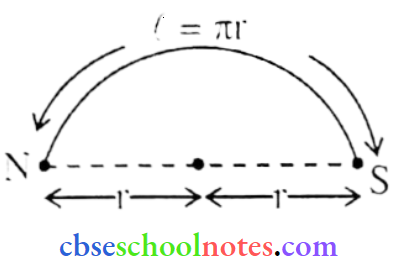
Initially m’ = qm x l

Magnetism And Matter Bar magnet

after bending

m’ = qm x 2r

⇒ \(m^{\prime}=\frac{m}{l} \times 2 \times \frac{l}{\pi}\)  [ πr = l ]

∴ \(m^{\prime}=\frac{2 m}{\pi}\)

question 5. A straight steel wire of length l has magnetic moment m. If the wire is bent in the form of a semicircle, the new value of the magnetic dipole moment is.

  1. m
  2. \(\frac{\mathrm{m}}{\pi}\)
  3. \(\frac{m}{2}\)
  4. \(\frac{2 \mathrm{~m}}{\pi}\)

Answer: 4. \(\frac{2 \mathrm{~m}}{\pi}\)

Magnetism And Matter A Straight Steel Wire

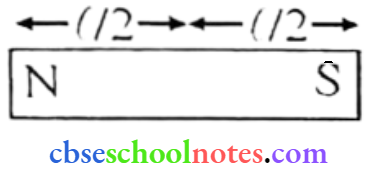
Initially

m = qm x l

⇒ \(\mathrm{m}^{\prime}=\mathrm{q}_{\mathrm{m}} \times \frac{l}{2}\)

(qm will not change)

⇒ \(\mathrm{m}^{\prime}=\frac{\mathrm{m}}{2}\)

∴ \(\vec{P}\) remains constant.

Question 6. A bar magnet of length l, pole strength ‘P’, and magnetic moment ‘\(\vec{m}\)‘ is split into two equal pieces each of length l/2. The magnetic moment and pole strength of each piece respectively ________ and ________.

  1. \(\vec{m}, \frac{p}{2}\)
  2. \(\frac{\vec{m}}{2}, p\)
  3. \(\frac{\vec{m}}{2}, \frac{p}{2}\)
  4. \(\vec{m}, p\)

Answer: 2. \(\frac{\vec{m}}{2}, p\)

Question 7. For superconductors, μr = _________.

  1. Zero
  2. Infinite
  3. Positive
  4. Negative

Answer: 1. Zero

Question 8. Which one of the following represents Curie’s law?

  1. \(M=\frac{C B_0}{T}\)
  2. \(M=\frac{C \chi}{T}\)
  3. \(M=\frac{C \chi}{T-T_C}\)
  4. \(M=\frac{C T}{B_0}\)

Answer: 1. \(M=\frac{C B_0}{T}\)

Question 9. Meissner effect is observed in _________ substance.

  1. Paramagnetic
  2. Ferromagnetic
  3. Superconducting
  4. Permanent magnetic

Answer: 3. Superconducting

Question 10. According to Gauss’s law for magnetism, the net magnetic flux through any closed surface is _________.

  1. Equal to ε0
  2. Infinite
  3. Zero
  4. Equal to μ0

Answer: 3. Zero

CBSE Class 12 Physics Chapter 5  Magnetism And Matter Assertion And Reason

For question numbers 1 to 4 two statements are given-one labelled Assertion (A) and the other labelled Reason (R). Select the correct answer to these questions from the codes (1), and (2). (3) and (4) as given below.

  1. Both A and R are true and R is the correct explanation of A
  2. Both A and R are true but R is NOT the correct explanation of A
  3. A is true but R is false
  4. A is false and R is also false

Question 1. Assertion: A bar magnet experiences a torque when placed in a magnetic field.

Reason: A bar magnet exerts a torque on itself due to its magnetic field.

Answer: 3. A is true but R is false

Question 2. Assertion: The magnetic moment of the helium atom is zero.

Reason: All the electrons are paired in helium atom orbitals.

Answer: 1. Both A and R are true and R is the correct explanation of A

Question 3. Assertion: An atom behaves as a magnetic dipole.

Reason: It is because an atom contains equal positive and negative charges.

Answer: 3. A is true but R is false

Question 4. Assertion: When the radius of a circular loop carrying current is doubled, its magnetic moment becomes four times.

Reason: Magnetic moment depends on the area of the loop.

Answer: 2. Both A and R are true but R is NOT the correct explanation of A

CBSE Class 12 Physics Chapter 5  Magnetism And Matter Short Questions And Answers

Question 1. The magnetic moment of a circular coil carrying current I, having N turns, each of radius r, is M. Find the magnetic moment of the same coil if it is unwound and rewound into a coil having 2N turns for the same current.

Answer:

M = NIA = NIπ2

According to question N(2πr) = 2N(2πr’)

⇒ \(r^{\prime}=\frac{r}{2}\)

So, New magnetic movement M’ = \((2 \mathrm{~N}) \mathrm{I} \pi\left(\frac{\mathrm{r}}{2}\right)^2=\frac{\mathrm{NI} \pi \mathrm{r}^2}{2}=\frac{\mathrm{M}}{2}\)

Question 2. The bar magnet of magnetic moment 6 J/T is aligned at 60° with a uniform external magnetic field of 0.44 T. Calculate

  1. The work done in turning the magnet to align its magnetic moment
    1. Normal to the magnetic field,
    2. Opposite to the magnetic field, and
  2. The torque on the magnet in the final orientation in case (2)

Answer:

Magnetic moment M = 6J/T

Magnetic field B = 0.44 T

(1). Work done in rotating the magnet normal to the magnetic field

W = MB(cosθ1 – cosθ2)

where θ1 =60° and θ2 = 90°

W = 6 x 0.44 (cos60°- cos90°) = 6 x 0.44 (0.5- 0) = 1 .32 J

(2). Work done in rotating the magnet opposite to the magnetic field

W = MB(cosθ1 – cosθ2)

Where θ1 =60°and θ2 = 180°

W = 6 x 0.44 (cos60°- cos 180°) = 6 x 0.44 (0.5 + 1 ) = 3.96 J

2. Torque in case (2) τ = MB sin θ2 ⇒ τ = 6 x 0.44 x sin 180° = 0

Question 3.

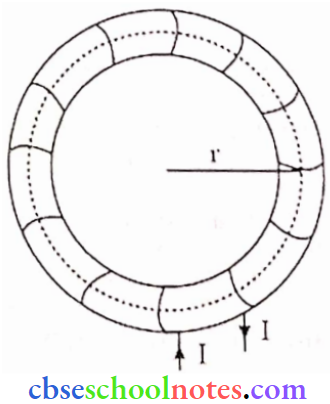
  1. An iron ring of relative permeability |.ir has windings of insulated copper wire of n turns per meter. When the current in the windings is I, find the expression for the magnetic field in the ring.
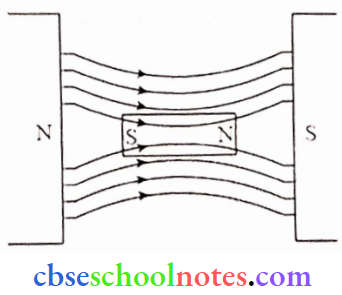
  2. The susceptibility of a magnetic material is 0.9853. Identify the type of magnetic material. Draw the modification of the field pattern by keeping a piece of this material in a uniform magnetic field.

Answer:

1. Consider a ring of radius r having n turns per meter, If n is the number of turns per meter, then the total number of turns in the ring = perimeter times the number of turns = 2πrn = N

Current enclosed = NI = 2πrn I.

By Ampere’s circuital law, \(\oint \vec{B} \cdot d \vec{l}=\mu_0 I\)

B x 2πr = μ0 2π rnI or B= μ0nl

Magnetism And Matter Ampere's Circuital Law

2. Given, susceptibility, χ = 0.9853.

The material is paramagnetic.

If a piece of this material is kept in a uniform magnetic field, then the field pattern gets modified as follows:

The lines of force tend to pass through the material rather than the surrounding air.

Magnetism And Matter Paramagnetic In Nature

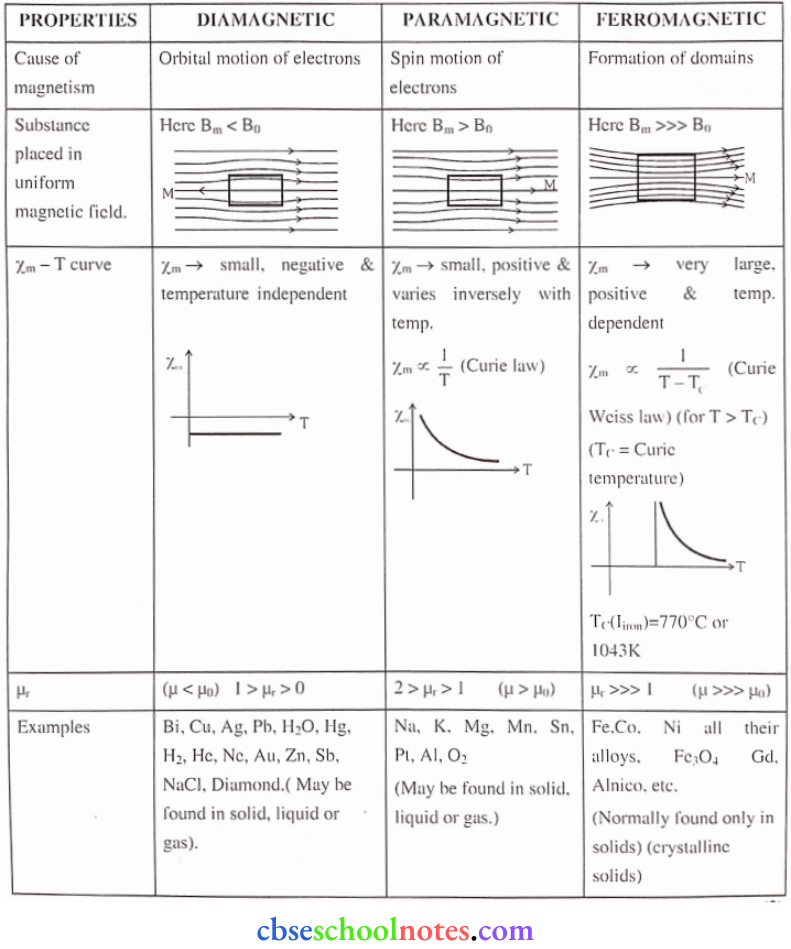
Question 4. Different diamagnetic, paramagnetic, and ferromagnetic substances based on their properties.

Answer:

Magnetism And Matter Differentiate Diamagnetic, Paramagnetic And Ferromagnetic substances And Their Properties

CBSE Class 12 Physics Chapter 5 Magnetism And Matter Long Questions And Answers

Question 1. When the atomic dipoles are aligned partially or fully, there is a net magnetic moment in the direction of the field in any small volume of the material. The actual magnetic field inside the material placed in a magnetic field is the sum of the applied magnetic field and the magnetic field due to magnetization. This field is called magnetic intensity (H).

H = B/μ0-M

where M is the magnetization of the material p0, is the permittivity of vacuum and B is the total magnetic field. The measure that tells us how a magnetic material responds to an external field is given by a dimensionless quantity is appropriately called the magnetic susceptibility; for a certain class of magnetic materials, the intensity of magnetization is directly proportional to the magnetic intensity.

(1). Identify the wrongly matched quantity and unit pair.

  1. Pole strength – A-m
  2. Magnetic susceptibility – dimensionless number
  3. Intensity of magnetisation – A/m
  4. Magnetic permeability- henry-m

Answer: 4. Magnetic permeability- henry-m

(2). A bar magnet has a length of 3 cm, a cross-sectional area of 2 cm2, and a magnetic moment of 3 A-m2. The intensity of magnetization of a bar magnet is

  1. 2 x 10⁵ A/m
  2. 3 x 10⁵ A/m
  3. 4 x 10⁵ A/m
  4. 5 x 10⁵ A/m

Answer: 4. 5 x 10⁵ A/m

(3). A solenoid has a core of material with a relative permeability of 500 and its windings carry a current of A. The number of turns in the solenoid is 500 per meter. The magnetization of the material is nearly:-

  1. 2.5 x 10³ A/m
  2. 2.5 x 10⁵ A/m
  3. 2 x 10³ A/m
  4. 2 x 10⁵ A/m

Answer: 2. 2.5 x 10⁵ A/m

(4). The relative permeability of iron is 6000. Its magnetic susceptibility is

  1. 5999
  2. 6001
  3. 6000 x 10-7
  4. 6000 x 10-7

Answer: 1. 5999

Important Questions for CBSE Class 12 Physics Chapter 6 Electromagnetic Induction

Electromagnetic Induction Class 12 Pdf

CBSE Class 12 Physics Chapter 6 Electromagnetic Induction Multiple Choice Questions And Answers

Important Questions for CBSE Class 12 Physics Chapter 6 Electromagnetic Induction

Question 1. Lenz’s law is the consequence of the law of conservation of:

  1. Energy
  2. Charge
  3. Mass
  4. Momentum

Answer: 1. Energy

Read and Learn More Important Questions for Class 12 Physics with Answers

Question 2. The emf induced in a 10H inductor in which current changes from 11 A to 2A in 9 x 10⁻¹ s is :

  1. 104 V
  2. 103 V
  3. 102 V
  4. 10 V

Answer: 3. 102 V

⇒ \(\mathrm{e}=-\mathrm{L} \frac{\Delta \mathrm{I}}{\Delta \mathrm{t}}\)

∴ \(e=\frac{-10 \times(2-11)}{9 \times 10^{-1}}=10^2 \mathrm{~V}\)

Question 3. A metal plate is getting heated. Which one of the following statements is incorrect?

  1. It is placed in a space-varying magnetic field that does not vary with time.
  2. A direct current is passing through the plate.
  3. An alternating current is passing through the plate.
  4. It is placed in a time-varying magnetic field.

Answer: 1. It is placed in a space-varying magnetic field that does not vary with time.

Question 4. The magnetic flux linked with a coil is given by Φ = 5t2+ 3t + 10, where Φ is in Weber and l is in second. The induced emf in the coil at t = 5 sec will be

  1. 53 V
  2. 43 V
  3. 10 V
  4. 6 V

Answer: 1. 53 V

⇒ \(\mathrm{e}=-\frac{\mathrm{d} \phi}{\mathrm{dt}}\)

e = 10t + 3

e = 10(5) + 3 = 53V

Question 5. The magnetic flux linked with a coil changes with time t (second) according to Φ = 6t2– 5t + 1, where Φ is in Wb. At l = 0.5 S, the induced current in the coil is ______ The resistance of the circuit is 10 Ω.

  1. 1 A
  2. 0.1 A
  3. 0.1 mA
  4. 10 A

Answer: 2. 0.1 A

⇒ \(\mathrm{e}=-\frac{\mathrm{d} \phi}{\mathrm{dt}}\)

e = -(12t-5)

e = -(12 x 0.5-5)

e = 1

⇒ \(|\mathrm{e}|=1 \mathrm{~V}\)

∴ \(I=\frac{e}{R}=\frac{1}{10}=0.1 \mathrm{~A}\)

Question 6. A square conducting coil of area 100 cm2 is placed normally inside a uniform magnetic field of 103 Wbm-2. The magnetic flux linked with the coil is ______ wb.

  1. 10
  2. 10-5
  3. 10-g
  4. 0

Answer: 1. 10

= BA

= 103 x 100 x 10– 4

= 100 weber

Electromagnetic Induction Class 12 PDF

Question 7. The self-inductance of two solenoids A and B having equal lengths are the same. If the number of turns in two solenoids A and B arc 100 and 200 respectively. The ratio of radii of their cross-section will be

  1. 2:1
  2. 1:2
  3. 1:4
  4. 4:1

Answer: 1. 2:1

⇒ \(L=\frac{\mu_r \mu_0 N^2 \pi r^2}{l}\)

⇒ \(r^2=\frac{L \times l}{\mu_r \mu_0 N^2 \pi}\)

l, L, r, 0, – constant

\(r \propto \frac{1}{N}\) \(\frac{r_1}{r_2}=\frac{N_2}{N_1}=\frac{200}{100}=2: 1\)

Question 8. A magnet is moving towards a coil along its axis and the emf induced in the coil is s. If the coil also starts moving towards the magnet with the same speed, the induced emf will be

\(\frac{\varepsilon}{2}\)

2


4

Answer: 2. 2

Question 9. The dimensional formula of self-inductance is __________.

M1L2T-2A-2

M1L1T2A-2

M1L1T-2A-2

M1L1T-1A-1

Answer: 1.

Question 10. The mutual inductance of the system of two coils is 5 mH. The current in the first coil varies according to the equation T = I0 sin cot, where I0 = 10A and co = 100 TT rad/s. The value of maximum induced emf in the second coil is __________.

2V

5V

V

4V

Answer: 2. 5V

\(\mathrm{e}=-\mathrm{M} \frac{\mathrm{dI}}{\mathrm{dt}}\)

= -M(I0 cos t) [for max. value cos t = 1]

= -5 x 10-3 x 10 x 100 x (1)

e = -5V

|e| = 5V

Question 11. Current of 2A passing through a coil of 100 turns gives rise to a magnetic flux of 5 x 10⁻³ Wb per turn. The magnetic energy associated with coil is __________.

5 x 10⁻³ J

0.5 x 10⁻³

5 J

0.5 J

Answer: 4. 0.5 J

\(\mathrm{u}=\frac{1}{2} \mathrm{LI}^2 \quad \phi=\mathrm{LI}\)

= \(\frac{1}{2} \mathrm{\phi}{I}=\frac{1}{2} \times 5 \times 10^{-3} \times 100 \times 2=0.5 \mathrm{~J}\)

Question 12. The flux linked per turn of a coil of N turns changes from (|)1 and <f)2- If die total resistance ol the circuit including the coil is R, the induced charge in the coil.

\(-N \frac{\left(\phi_2-\phi_1\right)}{l}\) \(-N \frac{\left(\phi_2-\phi_1\right)}{R}\) \(-N \frac{\left(\phi_2-\phi_1\right)}{R t}\) \(-\mathrm{N}\left(\phi_2-\phi_1\right)\)

Answer: 2. \(-N \frac{\left(\phi_2-\phi_1\right)}{R}\)

\(q=-\frac{N}{R} \Delta \phi\) \(q=-\frac{N\left(\phi_2-\phi_1\right)}{R}\)

Question 13. The magnitude of the induced cmf is equal to the lime rate of change of ____.

Electric flux

Magnetic force

Magnetic flux

Electric force

Answer: 3. Magnetic flux

Question 14. Unit of induced emf is _____.

Tesla

Volt/second

weber/second

volt

Answer: 4. Volt

Electromagnetic Induction Class 12 PDF

Question 15. One conducting wire of length 50 cm is moving perpendicular to uniform magnetic field of 0.2 T. with constant velocity of 10 ms 1 cmf induced between two ends of a wire is _________ V.

1.0

0.1

0.01

10

Answer: 1. 1.0

\(e=-10 \times 0.2 \times \frac{50}{100}\)

e = -1 Volt

|e| = 1 V

CBSE Class 12 Physics Chapter 6 Electromagnetic Induction Class 12 Electromagnetic Induction Assertion And Reason

For question numbers 1 to 5 two statements arc given-one labelled Assertion (A) and the other labelled Reason (R). Select the correct answer to these questions from the codes (1), (2), (3) and (4) as given below.

  1. Both A and R are true and R is the correct explanation of A
  2. Both A and R are true but R is NOT the correct explanation of A
  3. A is true but R is false
  4. A is false and R is also false

Question 1. Assertion: Induced cmf in two coils made of wire of the same length and thickness, one of copper and another of aluminium is the same. The current in copper coil is more than the aluminium coil.

Reason: Resistance of aluminium coil is more than that of copper coil.

Answer: 1. Both A and R are true and R is the correct explanation of A

Question 2. Assertion: If the current in an inductor is zero at any instant, then the induced emf may not be zero.

Reason: An inductor keeps the flux (i.e. current) constant.

Answer: 1. Both A and R are true and R is the correct explanation of A

Question 3. Assertion: Self-induction is called the inertia of electricity.

Reason: The inductor opposes the change in current.

Answer: 1. Both A and R are true and R is the correct explanation of A

Question 4. Assertion: A small magnet takes a longer time to fall into a hollow metallic tube without touching the wall.

Reason: There is an opposition of motion due to the production of eddy currents in metallic tubes.

Answer: 1. Both A and R are true and R is the correct explanation of A

Question 5. Assertion: Faraday’s laws are consequences of the conservation of energy.

Reason: In a purely resistive AC circuit, the current lags behind the EMF in phase.

Answer: 4. A is false and R is also false

CBSE Class 12 Physics Chapter 6 Class 12 Electromagnetic Induction Short Questions And Answers

Question 1. Two identical circular discs, one of copper and another of aluminium, are rotated about their geometrical axes with the same angular speed in the same magnetic field acting perpendicular to their planes. Compare the (1) induced cmf, and (2) induced current produced in discs between their centre and edge. Justify your answers,

Answer:

Emf will be same for both, because it depends on N, A, B, ro and that arc same for both disc But induced current \(I=\frac{\mathrm{e}}{\mathrm{R}}=\frac{\mathrm{NAB}\omega}{\mathrm{R}}\)

Copper has less resistance so induced current will be higher in copper.

Question 2. A rectangular loop PQMN with movable arm PQ of length 10 cm and resistance 2£2 is placed in a uniform magnetic field of 0.1 T acting perpendicular to the plane of the loop as is shown in the figure. The resistances of the arms MN, NP and MQ are negligible. Calculate the

  1. emf induced in the arm PQ and
  2. Current induced in the loop when arm PQ is moved with velocity 20 m/s

Answer:

1. Induced emf in arm PQ

e = -B/v

c = -0.1 x 10 x 1 0-2 x 20

e = -0.2 V

2. Current induced in loop

\(I=\frac{|e|}{R}=\frac{0.2}{2}=0.1 \mathrm{~A}\)

Question 3. Predict the polarity of the capacitor in the situation described below:

image

Answer:

Plate A (+ve) and plate B(-ve)

Question 3. An aeroplane is flying horizontally from west with a velocity of 900 km/hour. Calculate the potential difference developed between the ends of its wings having a span of 20m. The horizontal component of the Earth’s magnetic field is 5 x Hr4 T and the angle of dip is 30°.

Answer:

Potential difference developed between the ends of the wings ‘e’ = Blv

Given Velocity (v) = 900 km/hour

= 250 m/s

Wing span (l) = 20 m

Vertical component of Earth’s magnetic field

Bv = BH tan (5

= 5 x 10⁻⁴ (tan 30°) tesla

∴ Potential Difference

e = BVl

e = 5 x 10⁻⁴ (tan 30°) x 20 x 250

\(e=\frac{5 \times 20 \times 250 \times 10^{-4}}{\sqrt{3}}\)

e = 1 .44 volt

  1. Question 4.
  2. Define self-inductance. Write its SI unit.
  3. A long solenoid with 15 turns per cm has a small loop of area 2.0 cm2 placed inside the solenoid normal to its axis. If the current canned by the solenoid changes steadily from 2.0 A to 4.0 A in 0. 1 s. what is the induced cmf in the loop while the current is changing?

Answer:

1. Self inductance of a coil is numerically equal to cmf induced in the coil, when rate of
change of current is unity.

\(L=\left|-\frac{\mathrm{e}}{\left(\frac{\mathrm{dl}}{\mathrm{dt}}\right)}\right|\)

Or

L = N<(>/I

It is equal to the magnetic flux linked with coil when a unit current flow through it.

The S.I unit of L is henry (H).

2. Here, number of turns per unit length.

n= N/l = 15 turns/cm = 1500 turns/m

A = 2 cm2 = 2 x 10⁻⁴ m2

dl/dt = (4- 2)/0. 1 or dl/dt = 20 As-1

⇒ \(|\mathrm{e}|=\frac{\mathrm{d} \phi}{\mathrm{dt}}=\frac{\mathrm{d}}{\mathrm{dt}}(\mathrm{BA})\) (∵ \(B=\frac{\mu_0 N I}{l}\) )

⇒ \(|\mathrm{e}|=\frac{\mathrm{Ad}}{\mathrm{dt}}\left(\mu_0 \frac{\mathrm{NI}}{l}\right)=\mathrm{A} \mu_0\left(\frac{\mathrm{N}}{l}\right) \frac{\mathrm{dI}}{\mathrm{dt}}\)

|e| = (2 x 10-4) x 4 x 10-7 x 1500 x 20V

|e| = 7.5 x 10⁻⁶ V

Question 5.

  1. Define mutual inductance.
  2. A pair of adjacent coils has a mutual inductance of 1.5 H. If the current in one coil changes from 0 to 20A in 0.5 s. what is the change of flux linked with the other coil?

Answer:

1. Mutual Inductance : It is numerically equal to the magnetic flux linked with one coil (secondary coil) when a unit current flows through the other coil (primary coil).

2. Magnetic flux

initial = MI initial = 0 as I initial = 0

and final = Mfinal = 1.5 x 20 = 30Wb

Change in flux d= 1-2 = 30-0 = 30 weber.

Question 6. Define the self-inductance of a coil. Obtain the expression for the energy stored in an inductor L connected across a source of cmf.

Answer:

It is numerically equal to the induced emf per unit rate of change of current through a given coil.

i.e. \(\mathrm{L}=\frac{\mathrm{e}}{-\frac{\mathrm{dI}}{\mathrm{dt}}}\)

Energy stored in an inductor: Work has to be done by battery against the opposing induced cmf in establishing a current in an inductor. The energy supplied by the battery is stored in the inductor.

Let current flowing through the circuit at any instant (t) be i.

Rate of change of current at that time = \(\frac{\mathrm{di}}{\mathrm{dt}}\)

image

magnitude of induced emf in the inductor,

\(\mathrm{e}=\mathrm{L} \frac{\mathrm{di}}{\mathrm{dt}}\)

Work done by the battery in time dt,

dW = Vdq = edq

dW = eidt

\(d W=\left(L \frac{d i}{d t}\right) i d t\)

dW = Lidi

Total work done by the battery in increasing current from 0 to I

\(\mathrm{W}=\mathrm{L} \quad \int \mathrm{i} d i \Rightarrow \mathrm{W}=\frac{1}{2} \mathrm{LI}^2\)

This work done is stored in an inductor in the form of magnetic energy.

\(\mathrm{U}_{\mathrm{B}}=\frac{1}{2} \mathrm{LI}^2\)

Question 7. Define mutual inductance between a pair of coils. Derive an expression for the mutual inductance of two long coaxial solenoids of the same length wound one over the other.

[OR. prove that M12 = M21]

Answer:

Mutual Inductance: It is numerically equal to the magnetic flux linked with one coil (secondary coil) when unit current flows through the other coil.

Derivation:

image

For I coil, <|)1 = M12, I2 (1)

where <j)1 is the flux through I coil.

Similarly,

1 = (B2.A1)N1

= \(\)

= \(\) (2)

From (1) and (2)

\(\)

Now, 2 = M21I1 (3)

where ())2 is the flux through 2nd coil due to Ist coil.

Also. <|)-, = B1 A1 N2 cos0

= \(\) (4)

(0 = 0°)

From (3)and (4)

\(\) \(\)

∴ M12 = M21

CBSE Class 12 Physics Chapter 6 Class 12 Electromagnetic Induction Long Questions And Answers

Question 1. The emf induced across the ends of a conductor due lo its motion in a magnetic field is called motional emf. It is produced due to the magnetic Lorcnlz force acting on the free electrons of the conductor. For a circuit shown in figure, if a conductor of length f moves with velocity v in a magnetic field B perpendicular to both its length and the direction of the magnetic field, then all the induced parameters are possible in the circuit.

image

(1). Which rule is used to find direction of induced current?

Answer:

Fleming’s right hand rule

(2). Bicycle generator creates 1 .5 V at 15 km/hr. Find the value of EMF generated at 10 km/hr ?

Answer:

e = NABo

e

\(\frac{1.5}{15}=\frac{x}{10}\)

x = 1 volt.

(3). A O.i m long conductor carrying a current of 50 A is held perpendicular to a magnetic field of 1.25 mT. Find the mechanical power required to move the conductor with a speed of 1 m s-1 ?

Answer:

P = F x v = (IlB)v = 50 x 0.1 x 1.25 x 10-3 x 1

= 6.25 x 10⁻³ W = 6.25 mW

(4). A conducting rod of length f is moving in a transverse magnetic field of strength B with velocity v. The resistance of the rod is R. Find the expression of induced current in the rod?

Answer:

\(I=\frac{e}{R}=\frac{B v l}{R}\)

Question 2. Mutual inductance is the phenomenon of inducing cmf in a coil, due to a change of current in the neighboring coil. The amount of mutual inductance that Jinks one coil to another depends very much on the relative positioning of the two coils, their geometry and relative separation between them. Mutual inductance between the two coils increases pr, limes if the coils arc wound over an iron core of relative permeability pr.

image

(1). A short solenoid of radius a, number of turns per unit length n, and length L is kept coaxially inside a very long solenoid of radius b, number of turns per unit length n2. Write the expression for mutual inductance of the system?

Answer:

p07ta2n,n2L

(2). If a change in current of 0.01 A in one coil produces a change in magnetic flux of 2 x 10⁻² Weber in another coil. Find the mutual inductance between coils?

Answer:

= MI

\(M=\frac{\phi}{I}=\frac{2 \times 10^{-2}}{0.01}\)

M = 2H

(3). How can mutual inductance between two coils can be increased?

Answer:

By increasing the number of turns in the coils

\(M=\frac{\mu_r \mu_0 N^2 A}{l}\)

M N2

(4). When a sheet of iron is placed in between the two co-axial coils. How the mutual inductance between the coils will change?

Answer:

Increases

\(\mathrm{M}=\frac{\mu_{\mathrm{r}} \mu_0 \mathrm{~N}^2 \mathrm{~A}}{l}\)

M r

Question 3. Explain the meaning of the term mutual inductance. Consider two concentric circular coils. one of radius R and the other of radius r (R > r) placed coaxially with centres coinciding with each other. Obtain the expression for the mutual inductance of the arrangement.

A rectangular coil of area A, having number of turns N is rotated at T revolutions per second in a uniform magnetic field B, the field being perpendicular to the coil. Prove that the maximum emf induced in the coil is 2 7tf NBA.

Answer:

1. Let current (I1) is flowing in first outer coil. The magnetic field at centre of coil

\(B_1=\frac{\mu_0 I_1}{2 R}\)

Flux passing through second inner coil

2 = B1 A2

\(\phi_2=\frac{\mu_0 I_1}{2 \mathrm{R}} \times \pi \mathrm{r}^2\)

From definition of mutual induction

2 = M21 I1

\(M_{21}=\frac{\phi_2}{I_1}=\frac{\mu_0 \pi r^2}{2 R}\) \(M_{21}=\frac{\mu_0 \pi r^2}{2 R}\)

Similarly \(M_{12}=\frac{\mu_0 \pi r^2}{2 R}\)

M12 = M21 = M

\(M=\frac{\mu_0 \pi r^2}{2 R}\)

2. Magnetic flux linked with coil = <j) = NBAcosG

The induced cmf.e = -d(|)/dt (∵ \(\omega =\frac{\mathrm{d} \theta}{\mathrm{dt}}\\) )

\(\mathrm{e}=-\frac{\mathrm{d} \phi}{\mathrm{dt}}=\left(-\mathrm{NBA}(-\sin {\theta}) \frac{\mathrm{d} \theta}{\mathrm{dt}}\right)=\mathrm{NBA} \sin {\theta}\left(2 \pi \mathrm{f}\right)\)

For maximum induced emf, sin0 = 1

∴ e = NBA(2f) => e = 27ilNBA

Question 4.

Draw a labelled diagram of an ac generator. Obtain the expression for the cmf induced in the rotating coil of N turns each of cross-sectional area A, in the presence of a magnetic field B.

A horizontal conducting rod 10 m long extending from cast to west is falling with a speed
5.0 ms-1 at right angles to the horizontal component of the Earth’s magnetic field,
0.3 x 10⁻⁴ Wb m-2. Find the instantaneous value of the emf induced in the rod.

Answer:

1. image

B1 and B2 are carbon brushes. S1 and S2 are slip rings.

Let at any instant (t), the angle between \(\vec{B}\) and \(\vec{A}\) is 0, then the magnetic flux linked with coil at that instant.

\(\phi_{\mathrm{B}}=N(\overrightarrow{\mathrm{B}} \cdot \overrightarrow{\mathrm{A}})\)

= NBA cos

N = Number of turns in the coil

A = Area of the coil

0) = Angular velocity of coil

[ ∵ 0 = rot ]

cj)B = NBA cos rot

\(\frac{d \phi_{\mathrm{B}}}{\mathrm{dt}}=\mathrm{NBA} \omega(-\sin \omega t)\)

Thus induced emf, \(\mathrm{e}=-\frac{\mathrm{d} \phi_{B}}{\mathrm{dt}}\)

or e = NBA sint [ ∵ = t]

2. Given: L = 10 m, v = 5 m/s, BH = 0.3 x 10⁻⁴ Weber

Induced emf (e) = BH vL

= 0.3 x 10-4 x 5 x 10

= 15 x 10-4 volt

= 1.5 mV

Electromagnetic Induction Class 12 PDF

Question 5.

When a bar magnet is pushed towards (or away) from the coil connected to a galvanometer. the pointer in the galvanometer deflects. Identify the phenomenon causing this deflection and write the factors on which the amount and direction of the deflection depends. Slate the laws describing this phenomenon.

Sketch the change in flux and emf when a conducting rod PQ of resistance R and length l moves freely to and fro between A and C with speed v on a rectangular conductor placed in uniform magnetic field as shown in the figure.

image

Answer:

1. When a bar magnet pushed towards or away from coil, magnetic flux passing through coil
change with lime and causes an induced emf. This phenomenon is called EMI.

Induced emf in the coil is given as

\(\epsilon =-\mathrm{N} \frac{\mathrm{d}\phi}{\mathrm{dt}}\)

Direction and amount of deflection depend on the motion of magnet whether it is moving
towards the coil or away from the coil and the speed with which it moves.

Farady’s law of Electromagnetic Induction:

Whenever there is a change in magnetic flux linked with a coil, an emf is induced in the coil. The induced emf is proportional to the rate of change of magnetic flux linked with the coil.

\(\varepsilon \propto \frac{\mathrm{d} \phi}{\mathrm{dt}}\) \(\varepsilon \propto \frac{-\mathrm{d} \phi}{\mathrm{dt}} \Rightarrow \varepsilon=-\mathrm{K} \frac{\mathrm{d} \phi}{\mathrm{dt}}\)

Where K is constant and negative sign represents oppositions to change in flux. In SI system is in weber, t in seconds, in volt and K = 1

∴ \(\varepsilon=-\frac{\mathrm{d} \phi}{\mathrm{dt}}\)

If the coil has N turns, then

\(\varepsilon=-\mathrm{N} \frac{\mathrm{d} \phi}{\mathrm{dt}}\)

2. Case 1 : When PQ moves forward

(1). For 0 x < b

Magnetic field, B exists in the region

∴ Area of loop PQRS = l x

∴ Magnetic flux linked with loop PQRS.

<]) = BA = Blx

(|) = Blx (1) [b > x 0]

(2). For 2b > x > b

B =0

∴ Flux linked with loop PQRS is uniform and given by

‘ = Blb (x = b)

Forward jounery

Thus, for 2b x bar

Flux, = Bbl [constant]

Return journey

For b x 2b

Flux, = constant = Bbl [Decreasing]

Graphical representation

case – 2 For b> x 0

As = Blx = \(\frac{\mathrm{d} \phi}{\mathrm{dt}}=\frac{\mathrm{Bl}\mathrm{dx}}{\mathrm{dt}}=\mathrm{Bv} l\) ( ∵ \mathrm{v}=\frac{\mathrm{dx}}{\mathrm{dt}}\(\))

Induced emf, e = \(\mathrm{c}=-\mathrm{d} \phi / \mathrm{d} \mathrm{l}=-\mathrm{vB}\left(\Rightarrow \frac{\mathrm{d} \phi^{\prime}}{\mathrm{dt}}=0\right)\)

For 2b x b

As = bb => c = 0

Forward journey,

For b > x 0

c = -vbl,

For 2b x b.e= 0

Return journet,

For b > x 0

e= vBl

For 2b x n2e=0

image

Important Questions for CBSE Class 12 Physics Chapter 14 Semiconductor Electronics

CBSE Class 12 Physics Chapter 14  Semiconductor Electronics Multiple Choice Questions And Answers

Important Questions for CBSE Class 12 Physics Chapter 14 Semiconductor Electronics

Question 1. Vm is the maximum voltage between the ends of the secondary terminal of a transformer used in a half-wave rectifier. When the PN junction diode is reverse-biased, what will be the potential difference between the two ends of the diode?

  1. Zero
  2. \(\frac{V_m}{\sqrt{2}}\)
  3. Vm
  4. 2 Vm

Answer: 2. \(\frac{V_m}{\sqrt{2}}\)

Read and Learn More Important Questions for Class 12 Physics with Answers

Question 2. The band gaps of an insulator, semiconductor, and conductor arc respectively Eg1, Eg2, and Eg3 The relationship between them can be given as _______.

  1. Eg1 = Eg2 = Eg3
  2. Eg1 < Eg2 < Eg3
  3. Eg1 > Eg2 > Eg3
  4. Eg1 < Eg2 > Eg3

Answer: 3. Eg1 > Eg2 > Eg3

Question 3. A potential barrier of 0.2V exists across a pn junction. If the depletion region is 5.0 x 10⁻⁷ m wide, then the intensity of the electric field in this region is ___ V/m

  1. 1 x 10⁵
  2. 4 x 10⁵
  3. 1 x 10⁶
  4. 2 x 10⁵

Answer: 2. 4 x 10⁵

Question 4. When will the conductivity of a Ge semiconductor decrease?

  1. On adding acceptor impurity
  2. On adding donor impurity
  3. On making UV light incident
  4. On decreasing the temperature

Answer: 4. On decreasing the temperature

Question 5. In an n-type semiconductor, which of the following statements is true:

  1. Electrons are the majority carriers and tri-valent atoms are the dopants.
  2. Electrons are the majority carriers and pentavalent atoms are the dopants.
  3. Holes are minority carriers and pentavalent atoms are the dopants.
  4. Holes are majority carriers and tri-valent atoms arc the dopants.

Answer: 2. Electrons arc majority carriers and pentavalent atoms are the dopants.

Question 6. When a forward bias is applied to a p-n junction, it

  1. Raises the potential barrier
  2. Reduces the majority carrier current to zero
  3. Lowers the potential barrier
  4. None of the above

Answer: 3. Lowers the potential barrier

Question 7. In half-wave rectification, what is the output frequency if the input frequency is 50 Hz?

  1. 0
  2. 100 Hz
  3. 50 Hz
  4. 25 Hz

Answer: 3. 50 Hz

Question 8. _______ as an impurity, when added in Si or Gc P-type semiconductor is obtained.

  1. Antimony
  2. Arsenic
  3. Phosphorus
  4. Boron

Answer: 4. Boron

Question 9. In an intrinsic semiconductor, the density of free electrons is nc and the number density of holes is nh then ________.

  1. nc >> nh
  2. nc = 2nh
  3. nc = nh
  4. nc << nh

Answer: 3. nc = nh

Question 10. In an unbiased p-n junction, holes diffuse from the p-region to the n-region because,

  1. Free electrons in the n-region attract them
  2. They move across the junction by the potential difference
  3. Hole concentration in the p-region is higher as compared to the n-region
  4. All the above

Answer: 3. Hole concentration in the p-region is higher as compared to the n-region

CBSE Class 12 Physics Chapter 14  Semiconductor Electronics Short Questions And Answers

Question 1.

  1. How does the energy gap of an intrinsic semiconductor change when doped with a trivalent impurity?
  2. In a p-n junction under equilibrium, there is no net current. Why?

Answer:

  1. Then some allowed energy levels are produced, situated in the energy gap slightly above the valence band, this arc is called acceptor energy levels. Due to this energy band gap decreases.
  2. Net current (diffusion and drift current) is zero for both electrons and holes because the diffusion current is equal and opposite to the drift current for both carriers.

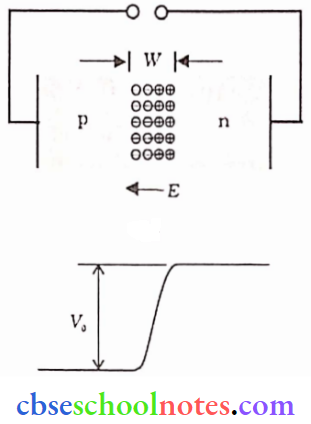
Question 2. Explain the formation of the barrier potential in a p-n junction.

Answer:

The loss of electrons from the n-region and the gain of electrons by the p-region causes a difference in potential across the junction of the two regions.

  • The polarity of this potential is such as to oppose the further flow of earners so that a condition of equilibrium exists.
  • The p-n junction at equilibrium and the potential across the junction. The n-material has lost electrons, and the p-material has acquired electrons. The n-material is thus positive relative to the p-material.

Since this potential tends to prevent the movement of electrons from the n region into the p region, it is often called a barrier potential.

Semiconductor Electronics Barrier Potential In P-n Junction

Question 3.

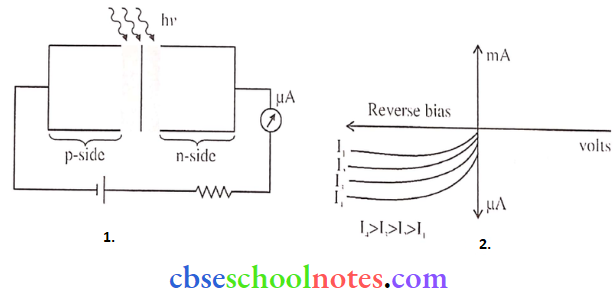
  1. Draw the circuit diagram of an illuminated photodiode and its I-V characteristics.
  2. How can a photodiode be used to measure the light intensity?

Answer:

Semiconductor Electronics Photodiode

2. The photocuring is directly proportional to the intensity of light this can be used for measuring the intensity of incident light.

Question 4.

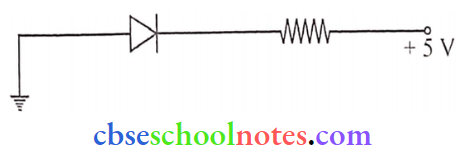
1. In the following diagram, is the junction diode forward-biased or reverse-biased?

Semiconductor Electronics Junction Diode

2. Name two important processes that occur during the formation of a pn junction.

Answer:

1. Reverse biased as the p-side is connected to the lower potential and the n-side to the higher potential.

Two important phenomena occur during the formation of the pn junction:

2. (1) Diffusion: Due to the concentration gradient the majority of charge carriers from the p side (holes) and the majority of charge carriers (electrons) on the n side start diffusing towards their opposite side.

(2) Drift: As electron-hole pairs neutralize near the junction they leave behind immobile ions, these ions create an electric field from the n side to the p side due to which the minority charge carrier starts moving (drifting).

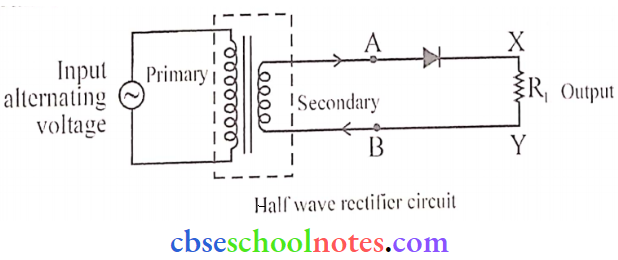
Question 5. Draw the circuit diagram of a half-wave rectifier and explain its working.

Answer:

Working of half wave rectifier: The secondary coil of a transformer supplies the desired alternating voltage across terminals A and B. When the voltage at A is in a positive cycle, the diode is in forward bias and it conducts current.

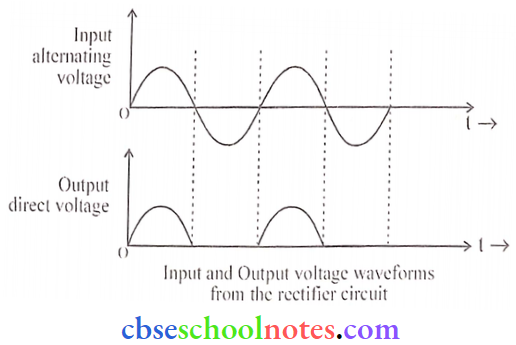
When A is at a negative cycle, the diode is in reverse bias and it does not conduct current only in the positive half-cycle of alternative current (ac), there is a current through the load resistor RL, and we gel output voltage.

Thus, We get a half-wave rectified output. So this circuit is called a half-wave rectifier.

Circuit Diagram:

Semiconductor Electronics Half Wave Rectifier Circuit

Graphy:

Semiconductor Electronics Half Wave Rectifier Graph

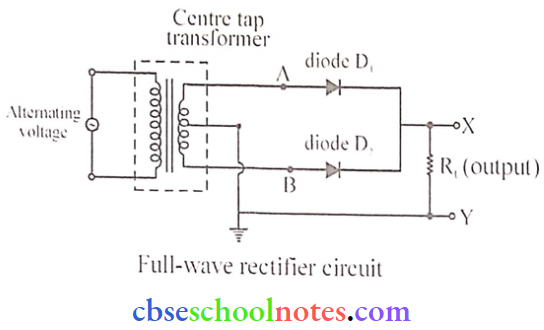
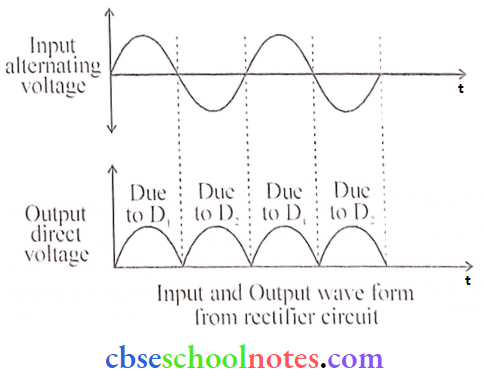
Question 6. Draw the circuit diagram of a full wave rectifier along with the input and output waveforms. Briefly explain how the output voltage/current is unidirectional.

Answer:

Working: When the positive half cycle of input a.c. signal flows through the primary coil, induced emf is set up in the secondary coil due to mutual induction. The direction of induced emf is such that the upper end of the secondary coil becomes positive while the lower end becomes negative.

  • Thus, diode D1 is forward biased and diode D2 is reverse biased, so the current due to diode D1 flows through the circuit. The output voltage which varies per the input half cycle is obtained across the load resistance (RL).
  • During the negative half cycle of input a.c. signal, diode D1 is reverse biased and diode D2 is forward biased. The current due to diode D2 flows through the circuit. The output voltage is obtained across the load resistance (RL ). The input and corresponding output voltage are predicted.

Since both the halves of input a.c. (wave) arc rectified, so the junction diode is called a full wave rectifier.

Circuit Diagram:

Semiconductor Electronics Full Wave Rectifier Circuit

Graph:

Semiconductor Electronics Full Wave Rectifier Graph

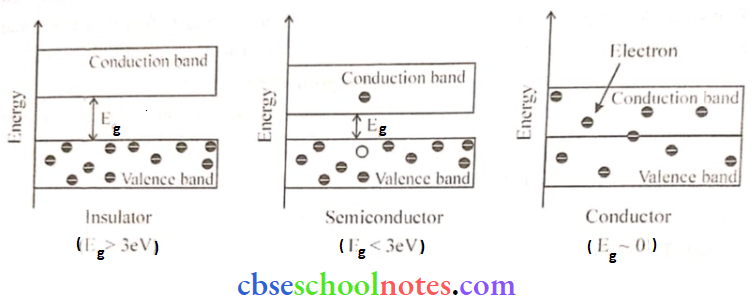
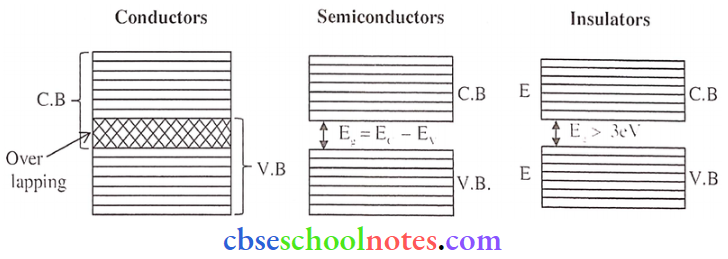
Question 7. Distinguish between a conductor and a semi-conductor based on the energy band diagram.

Semiconductor Electronics Conductor On The Basis Of Energy Band

[Eg = Forbidden Energy gap]

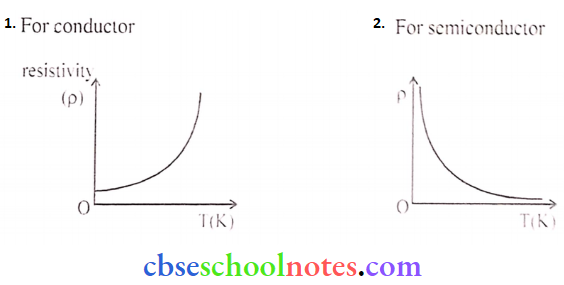
Question 8. Show on a plot, the variation of resistivity of

  1. A conductor, and
  2. A typical semiconductor as a function of temperature.

Using the expression for the resistivity in terms of number density and relaxation time between the collisions, explain how resistivity in the case of a conductor increases while it decreases in a semiconductor, with the rise of temperature.

Answer:

Variation of resistivity With Temperature

Semiconductor Electronics Variation Of Resistivity With Temperature

The resistivity of a material is given by

∴ \(\rho=\frac{m}{n e^2 \tau}\)

n ⇒ Number density

τ ⇒ Relaxation time

On increasing the temperature of the conductor relaxation time decreases while the number density remains constant. Due to this resistivity of the conductor increases.

In the case of semiconductors, on increasing the temperature relaxation time decreases but the number density increases. An increase in the number density is more effective than a decrease in the relaxation time. That’s why the resistivity of semiconductors decreases.

Question 9. Explain with the help of a diagram the formation of depletion region and barrier potential in a p-n junction.

Answer:

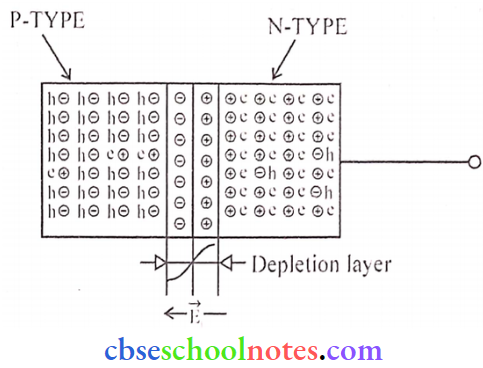
It is clear that the N-type semiconductor has a P-TYPC excess of free electrons and the P-type has an excess of holes therefore joined through a special process, electrons migrate towards the P-side and holes migrate towards the N-side due to concentration gradient.

The departure of an electron from the N-side to the P-side leaves a positive donor ion on the N-side and likewise hole leaves a negative acceptor ion on the P-side resulting in the formation of a depletion layer having widths 10-7m.

Semiconductor Electronics Depletion Region And Barrier Potential In A P-n Junction

Depletion layer: It is the layer near the junction in which electrons arc absent on the n side and holes are absent on the p side.

Potential barrier: Due to the accumulation of immobile ions near the junction an electric potential difference (Vb) develops between the n side and the p side which acts as a barrier for further diffusion of electrons and holes.

Vb = Ei x d (volt)

Question 10. Draw the energy band diagrams for conductors, semiconductors, and insulators. Which band determines the electrical conductivity of a solid? How is the electrical conductivity of a semiconductor affected by the rise in its temperature? Explain.

Answer:

Energy Band Diagram:

Semiconductor Electronics Energy Band

The conduction band determines the electrical conductivity of the solid.

On increasing the temperature of semiconductor electrical conductivity increases. When we increase the temperature, some of the covalent bonds get broken and e-hole pairs are generated.

CBSE Class 12 Physics Chapter 14  Semiconductor Electronics Long Questions And Answers

Question 1. Consider a thin p-type silicon (p-Si) semiconductor wafer. By adding precisely a small quantity of pentavalent impurity, part of the p-Si wafer can be converted into n-Si. There are several processes by which a semiconductor can be formed.

The wafer now contains p-region and nregion and a metallurgical junction between p-, and n- region. Two important processes occur during the formation of a p-n junction: diffusion and drift.

We know that in an n-type semiconductor, the concentration of electrons (number of electrons per unit volume) is more compared to the concentration of holes. Similarly, in a p-type semiconductor, the concentration of holes is more than the concentration of electrons.

During the formation of the p-n junction, and due to the concentration gradient across p-, and n- sides, holes diffuse from p- side to n-sidc (p → n) and electrons diffuse from n-sidc to p-sidc (n → p). This motion of charge carriers gives rise to diffusion current across the junction.

(1). How can a p-type semiconductor be converted into an n-type semiconductor?

  1. Adding pentavalent impurity
  2. Adding trivalent impurity
  3. Not possible
  4. Heavy doping

Answer: 1. Adding pentavalent impurity

(2). Which of the following is true about n-type semiconductors?

  1. The concentration of electrons is less than that of holes.
  2. The concentration of electrons is more than that of holes.
  3. The concentration of electrons is equal to that of holes.
  4. None of the above.

Answer: 2. Concentration of electrons is more than that of holes.

(3). Which of the following is the reason for diffusion current?

  1. Diffusion of holes from p to n
  2. Diffusion of electrons from n to p
  3. Both (1) and (2)
  4. None of these

Answer: 3. Both (1) and (2)

(4). What are the processes that occur during the formation of a p-n junction?

  1. Drift
  2. Diffusion
  3. Both (1) and (2)
  4. None of these

Answer: 3. Both (1) and (2)

Important Questions for CBSE Class 12 Physics Chapter 13 Nuclei

CBSE Class 12 Physics Chapter 13 Nuclei Multiple Choice Questions And Answers

Important Questions for CBSE Class 12 Physics Chapter 13 Nuclei

Question 1. If the radii \({ }_{13}^{27} \mathrm{Zn}\) abd \({ }_{30}^{64} \mathrm{Zn}\) nucleus are R1 and R2 respectively, Then \(\frac{R_1}{R_2}\) = ________.

  1. \(\frac{27}{64}\)
  2. \(\frac{3}{4}\)
  3. \(\frac{9}{16}\)
  4. \(\frac{13}{30}\)

Answer: 2. \(\frac{3}{4}\)

Read and Learn More Important Questions for Class 12 Physics with Answers

⇒ \(R=R_0 A^{\frac{1}{3}}\)

∴ \(\frac{R_1}{R_2}=\left(\frac{A_1}{A_2}\right)^{1 / 3}=\left(\frac{27}{64}\right)^{1 / 3}=\frac{3}{4}\)

Question 2. In the radioactive transformation \({ }_z^A X \rightarrow{ }_{Z-1}^A X_1 \rightarrow{ }_{Z-1}^{A-4} X_2 \rightarrow_Z^{A-4} X_3\) which are the successively emitted radioactive radiations?

  1. β, α, β
  2. α, β, β
  3. β, β, α
  4. α, α, β

Answer: 1. β, α, β

Question 3. Which are the isotone, isobar and isotope nuclei respectively of \({ }_6^{12} \mathrm{C}\) from among \({ }_6^{14} \mathrm{C},{ }_5^{12} \mathrm{~B},{ }_7^{13} \mathrm{~N}\)?

  1. \({ }_5^{12} \text { B, }{ }_6^{14} \mathrm{C,} { }_7^{13} \mathrm{~N}\)
  2. \({ }_6^{14} \mathrm{C},{ }_7^{13} \mathrm{~N},{ }_5^{12} \mathrm{~B}\)
  3. \({ }_7^{13} \text { N, }{ }_5^{12} \mathrm{B,} { }_6^{14} \mathrm{~C}\)
  4. \({ }_6^{14} \mathrm{C},{ }_5^{12} \mathrm{~B,} { }_7^{13} \mathrm{~N}\)

Answer: 3. \({ }_7^{13} \text { N, }{ }_5^{12} \mathrm{B,} { }_6^{14} \mathrm{~C}\)

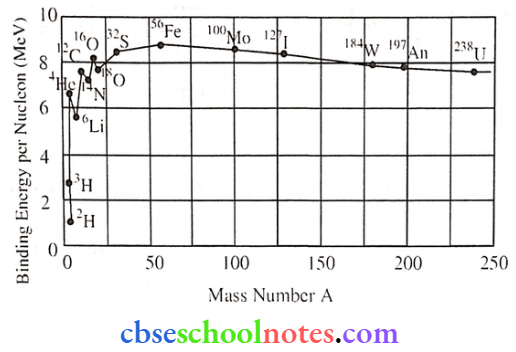
Question 4. The binding energy per nucleon is almost constant for the nuclei having atomic mass number ________.

  1. 30 < A < 240
  2. 30 < A < 170
  3. 170 < A < 230
  4. 156 < A < 192

Answer: 2. 30 < A < 170

Question 5. The energy equivalent to 1 gram (g) substance is _________ J.

  1. 9 x 10⁷
  2. 9 x 10¹⁰
  3. 9 x 10¹³
  4. 9 x 10⁸

Answer: 3. 9 x 10¹³

∴ \(E=m c^2=\frac{1}{1000} \times 9 \times 10^{16}=9 \times 10^{13} \mathrm{~J}\)

Question 6. \({ }_{80}^{198} \mathrm{Hg} \text { and }{ }_{79}^{197} \mathrm{Au}\) are example of __________.

  1. Isotopes
  2. Isomers
  3. Isobars
  4. Isotones

Answer: 4. Isotones

Question 7. In a curve of binding energy per nucleon versus mass number (A), the maximum value of Ebn is 8.75 MeV/nucleon the value of a corresponding atomic mass number is _______.

  1. 56
  2. 235
  3. 238
  4. 171

Answer: 1. 56

Question 8. The saturation property of the nuclear forces is because they are:

  1. Charge independent forces
  2. Non-central forces
  3. Spin-dependent forces
  4. Short-range forces

Answer: 4. Short-range forces

CBSE Class 12 Physics Chapter 13 Nuclei Assertion And Reason

For question numbers 1 to 5 two statements are given-one labelled Assertion (A) and the other labelled Reason (R). Select the correct answer to these questions from the codes (1), (2), (3), and (4) as given below.

  1. Both A and R are true and R is the correct explanation of A
  2. Both A and R are true but R is NOT the collected explanation of A
  3. A is true but R is false
  4. A is false and R is also false

Question 1. Assertion: Energy is released in nuclear fission.

Reason: The total binding energy of the fission fragments is larger than the total binding energy of the parent.

Answer: 1. Both A and R are true and R is the correct explanation of A

Question 2. Assertion: The nucleus may emit negatively charged particles.

Reason: The nucleus contains a negative charge also.

Answer: 3. A is true but R is false

Question 3. Assertion: Nuclear binding energy per nucleon is in the order \({ }_4^9 \mathrm{Be}>{ }_3^7 \mathrm{Li}>{ }_2^4 \mathrm{He}\)

  1. Reason: Binding energy per nucleon increases linearly with differences in several neutrons and protons.
  2. Answer: 4. A is false and R is also false

Question 4. Assertion: Isobars arc the clement having the same mass number but a different atomic number.

Reason: Neutrons and protons are present inside the nucleus.

Answer: 2. Both A and R are true but R is NOT the collected explanation of A

Question 5. Assertion: The density of all the nuclei is the same.

Reason: The radius of the nucleus is directly proportional to the cube roots of the mass number

Answer: 1. Both A and R are true and R is the correct explanation of A

CBSE Class 12 Physics Chapter 13 Nuclei Short Questions And Answers

Question 1. Obtain approximately the ratio of the nuclear radii of the gold isotope \({ }_{79} \mathrm{Au}^{197}\) and silver isotopes \({ }_{47} \mathrm{Ag}^{107}\)

Answer:

A1 = 197 and A2 = 107 R = R0A1/3

⇒ \(\frac{R_1}{R_2}=\left[\frac{A_1}{A_2}\right]^{1 / 3}=\left[\frac{197}{107}\right]^{1 / 3}=1.225\)

Question 2. The relation R = R0 A1/3. where R0 is a constant and A is the mass number of A nucleus, showing that the nuclear matter density is nearly constant. (i.e independent of A)

Answer:

Density of nucleus matter = \(\frac{\text { Mass of nucleus }}{\text { Volume of nucleus }}\)

⇒ \(\rho=\frac{\mathrm{mA}}{\frac{4}{3} \pi \mathrm{R}^3}\) [R = R A1/3]

⇒  \(\rho=\frac{3 \mathrm{~m}}{4 \pi \mathrm{R}_0^3}\) = \(\rho=\frac{\mathrm{A} \times 1.66 \times 10^{27} \mathrm{~kg}}{\frac{4}{3} \times 3.14 \times\left(1.2 \times 10^{-15}\right)^3 \mathrm{~A}} \approx 10^{17} \mathrm{~kg} / \mathrm{m}^3\)

The density of the nucleus is constant.

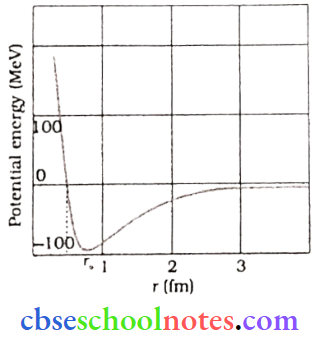
Question 3. Draw a graph showing the variation of the potential energy of a pair of nucleons as a function of their separation to indicate the region in which the nuclear force is (1) Attractive, (2)Repulsive

Answer:

Nuclei Variation Of Potential Energy Of A Pair Of Nucleon

The potential energy is minimum at a distance r() of about 0.8 fm. This means that the force is attractive for distances larger than 0.8 fm and repulsive if they are separated by distances less than 0.8 fm.

Question 4. What is nuclear force? Write its specific properties.

Answer:

Nuclear Force: The nuclear force is the strongest force of nature that holds nucleons in the nucleus of an atom.

Properties: Nuclear forces act between a pair of neutrons, a pair of protons, and a neutron-proton pair with the same strength, i.e. nuclear force is charge-independent.

  1. The nuclear forces are very short-range forces, hence show saturation property.
  2. The nuclear forces are dependent on the spin angular momentum of nucleons.
  3. Nuclear forces arc non-central forces.

Question 5. Differentiate between nuclear fission and fusion. Give an example of each. Which of the above reactions take place in a nuclear reactor?

Answer:

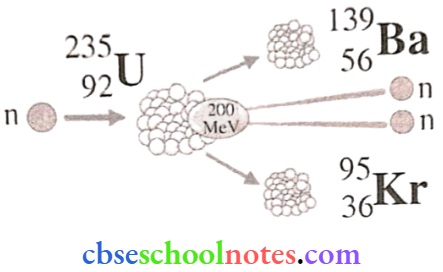
1. Nuclear Fission: Nuclear fission is the phenomenon of splitting a heavy nucleus (usually A > 230) into two or more lighter nuclei.

Example: \({ }_{92} \mathrm{U}^{235}+{ }_0 \mathrm{n}^1 \rightarrow_{92} \mathrm{U}^{236} \rightarrow_{56} \mathrm{Ba}^{141}+{ }_{36} \mathrm{Kr}^{92}+3 { }_0\mathrm{n}^1+\mathrm{Q}\)

2. Nuclear Fission: The process of combining of two lighter nuclei to form one heavy
nucleus is called nuclear fusion.

Example: \(4_1 \mathrm{H}^1 \rightarrow{ }_2 \mathrm{He}^4+2_1 \mathrm{e}^0+2 v+26.7 \mathrm{MeV}\)

A nuclear reactor is based on a controlled chain reaction.

Question 5.

  1. Explain the processes of nuclear fission and fusion using the plot of binding energy per nucleon (BE/A) versus the mass number A.
  2. Why are neutrons preferred as better projectiles in causing nuclear reactions?

Answer:

1. The value of binding energy per nucleon gives a measure of the stability of that nucleus greater the binding energy per nucleon of a nucleus, the more stable the nucleus.

Nuclei Binding Energy Per Nucleon

The above graph shows, the binding energy per nucleon drawn against mass number A. The saturation effect of nuclear forces is properly responsible for the approximate constancy of binding energy in the range 30 < A < 170.

It is clear from the curve that the binding energy per nucleon of the fused nuclei is more than that of the lighter nuclei taking part in nuclear fusion. Hence energy is released in this process.

In nuclear fission, the sum of the masses of the final products is less than the sum of the masses of the reactant components. Hence energy is released in this process.

2. These are uncharged particle

Question 6.

  1. Write the basic nuclear process involved in the emission of β+ in a symbolic form, by a radioactive nucleus.
  2. In the reactions given below:
    1. \({ }_6^{11} \mathrm{C} \rightarrow{ }_y^{z} \mathrm{B}+x+v\)
    2. \({ }_6^{12} \mathrm{C}+{ }_6^{12} \mathrm{C} \rightarrow{ }_{\mathrm{a}}^{20} \mathrm{Ne}+{ }_1^{\mathrm{c}} \mathrm{He}\)

Answer:

1. \({ }_z X^{A} \rightarrow{\beta^+}{ }_{z-1} Y^{A}+{ }_{+1} e^{0}+v+\text { energy }\)

In the emission of β+, mass no. (A) remains the same but atomic no. (Z) decreases by 1 unit.

2. (1). \(x \longrightarrow{ }_{+1} e^0, y \longrightarrow 5, z \longrightarrow 11\)

(2). \(\mathrm{a} \longrightarrow 10, \mathrm{~b} \longrightarrow 2, \mathrm{c} \longrightarrow 4\)

CBSE Class 12 Physics Chapter 13 Nuclei Long Questions And Answers

Question 1. When the nucleus of an atom splits into lighter nuclei through a nuclear reaction the process is termed as nuclear fission. This decay can be natural spontaneous splitting by radioactive decay or can be simulated in a lab by achieving the necessary conditions (bombarding with neutrons). The resulting fragments tend to have a combined mass that is less than the original.

Nuclei The Nucleus Of An Atom Splits Into Lighter Nuclei

(1). This splitting of a nucleus into smaller nuclei is:

  1. Fusion
  2. Fission
  3. Half-life
  4. Gamma-radiation

Answer: 2. Fission

(2). Name the moderator used in the nuclear reactor.

  1. Plutonium
  2. Thorium
  3. Graphite
  4. Berilium

Answer: 3. Graphite

(3). Which isotope of Uranium can sustain the chain reaction?

  1. U-230
  2. U-235
  3. U-245
  4. U-225

Answer: 2.U-235

(4). Which of the following atomic particles has the least mass?

  1. Proton
  2. Electron
  3. Deuleron
  4. Neutron

Answer: 2. Electron

Question 2. Uranium-235 (235U) is an isotope of uranium making up about 0.72 % of natural uranium. It is a fissile material i.c., and it can sustain a fission chain reaction. U-235 has a half-life of 703.8 million years. The main use for uranium today is for fuel in nuclear power plants. Depleted uranium is used in bullets and larger projectiles to make them hard and dense enough to reach through armored targets. Inhaling large concentrations of this radioactive element can cause lung cancer. It is also a toxic chemical, its ingestion can cause damage to kidneys, and its radioactive properties could cause cancers of bones or liver.

(1). A nuclei having the same number of neutrons but a different number of protons/atomic numbers and called:

  1. Isobars
  2. Isomers
  3. Isotones
  4. Isotopes

Answer: 3. Isotones

(2). For a nuclear fission process, suitable nuclei are:

  1. Any nuclei
  2. Heavy nuclei
  3. Lighter nuclei
  4. Nuclei lying in the middle of the periodic table

Answer: 2. Heavy nuclei

(3). Mass-energy equation was propounded by:

  1. Newton
  2. Madam Curie
  3. C.V. Raman
  4. Einstein

Answer: 4. Einstein

(4). Name the antiparticle of electron:

  1. Positro
  2. α-Particle
  3. proton
  4. β- Particle

Answer: 1. Positro

Important Questions for Class 12 Physics Chapter 8 Electromagnetic Waves

Class 12 Physics Chapter 8 Electromagnetic Waves (Emw) Multiple Choice Questions And Answers

Important Questions for Class 12 Physics Chapter 8 Electromagnetic Waves

Class 12 Physics Chapter 8 Question 1. In a certain region electric field \(\vec{E}\) and magnetic field \(\vec{B}\) are perpendicular to each other. An electron enters the region perpendicular to the direction of both E and B and moves undeflected. The speed of the electron is _________.

  1. \({\vec{E}} \cdot {\vec{B}}\)
  2. \(|{\vec{E}} \times {\vec{B}}|\)
  3. \(\frac{|{\vec{E}}|}{|{\vec{B}}|}\)
  4. \(\frac{|{\vec{B}}|}{|{\vec{E}}|}\)

Answer: 1. \({\vec{E}} \cdot {\vec{B}}\)

Read and Learn More Important Questions for Class 12 Physics with Answers

Question 2. Which wave travels with the speed of light _________

  1. Sound wave
  2. Heatwave
  3. Shock wave
  4. Microwave

Answer: 4. Microwave

Question 3. A television network uses _________

  1. Microwaves
  2. High-Frequency Radio waves
  3. Light waves
  4. Sound waves

Answer: 2. High-frequency radio waves

Question 4. Light waves are _______

  1. Longitudinal
  2. Transverse
  3. Both Longitudinal and transverse
  4. Mechanical

Answer: 4. Mechanical

Question 5. An electromagnetic wave passing through the space is given by equations E = E0 sin (ωt – kx), B = B0 sin (ωt- kx) which of the following is true?

  1. E0B0 = ωk
  2. E = B0k
  3. E0k = B
  4. Ek = B0

Answer: 3. E = B0k

Question 6. The wavelength range of Heal waves is __________

  1. 400 nm to 1 nm
  2. 1 mm to 700 nm
  3. 0. 1 m to 1 mm
  4. 700 nm to 400 nm

Answer: 2. 1 mm to 700 nm

Question 7. The maximum value of B in an electromagnetic wave is equal to 6 x 10⁻⁸T. Thus the maximum value of \(\vec{E}\) is __________.

  1. 2 Vm-1
  2. 18 Vm-1
  3. 2.5 Vm-1
  4. 6 Vm-1

Answer: 2. 18 Vm-1

E = cB

E = 3 x 108 x 6 x 10-8

E = 18 Vm-1

Question 8. Two oppositely charged particles oscillate about their mean equilibrium position in free space, with a frequency of 109 Hz. The wavelength of the corresponding electromagnetic wave produced is _______.

  1. 0.3 m
  2. 3 x 10¹⁷ m
  3. 109 m
  4. 3.3 m

Answer: 1. 0.3 m

⇒ \(\lambda=\frac{c}{v}=\frac{3 \times 10^8}{10^9}\)

∴ 0.3 m

Question 9. For a radiation of 6 GHz passing through air, the wave number (number of waves) per 1 m length is _______ (1 GHz = 109 Hz)

  1. 5
  2. 3
  3. 20
  4. 30

Answer: 3. 20

Wave No. \(\bar{v}=\frac{1}{\lambda}\) ∵ \(\left[v=\frac{c}{\lambda}\right]\) \(\left[\frac{c}{v}=\frac{1}{\lambda}\right]\)

∴ \(\bar{v}=\frac{v}{c}=\frac{6 \times 10^9}{3 \times 10^8}=20\)

Question 10. Which one of the following is an equation of magnetic energy density?

  1. \(\frac{B^2}{2 \mu_0}\)
  2. \(\frac{1}{2} \mu_0 B^2\)
  3. \(\frac{2 B^2}{\mu_0}\)
  4. \(\frac{\mathrm{B}^2}{\mu_0}\)

Answer: 1. \(\frac{B^2}{2 \mu_0}\)

Question 11. Dimension of \(\) is same as dimension of ( where μ = magnetic constant, ε = Dielectric constant)

  1. Velocity
  2. Square of velocity
  3. Acceleration
  4. Momentum

Answer: 2. Square of velocity

Class 12 Physics Chapter 8 Electromagnetic Waves Assertion And Reason

For questions numbers 1 to 10 two statements are given labeled Assertion (A) and the other labeled Reason (R). Select the correct answer to these questions from the codes (1), (2), (3), and (4) as given below.

  1. Both (A) and (R) are correct, (R) is the correct explanation of (A).
  2. Both (A) and (R) are correct, (R) is not the correct explanation of (A).
  3. (A) is correct; (R) is incorrect.
  4. (A) is incorrect; (R) is incorrect

Question 1. Assertion: Electromagnetic waves do not require a medium for their propagation.

Reason: They cannot travel in a medium.

Answer: 3. (A) is correct; (R) is incorrect.

Question 2. Assertion: A changing electric field produces a magnetic field.

Reason: A changing magnetic field produces an electric field.

Answer: 2. Both (A) and (R) are correct, (R) is not the correct explanation of (A).

Question 3. Assertion: X-rays travel with the speed of light.

Reason: X-rays are electromagnetic rays.

Answer: 1. Both (A) and (R) are correct, (R) is the correct explanation of (A).

Question 4. Assertion: Environmental damage has increased the amount of ozone in the Atmosphere.

Reason: The increase of ozone increases the amount of ultraviolet radiation on the earth.

Answer: 4. (A) is incorrect; (R) is incorrect

Question 5. Assertion: Electromagnetic Radiation exerts pressure.

Reason: Electromagnetic waves carry both momentum and energy.

Answer: 1. Both (A) and (R) are correct, (R) is the correct explanation of (A).

Question 6. Assertion: The EM waves of shorter wavelengths can travel longer distances than those of longer wavelengths.

Reason: The shorter the wavelength, the larger the velocity of propagation.

Answer: 3. (A) is correct; (R) is incorrect.

Question 7. Assertion: EM waves follow the Superposition principle.

Reason: Differential expression of EM wave is linear.

Answer: 1. Both (A) and (R) are correct, (R) is the correct explanation of (A).

Question 8. Assertion: Sound waves cannot travel in a vacuum, but light waves can.

Reason: Light is an electromagnetic wave – but sound is a mechanical wave.

Answer: 1. Both (A) and (R) are correct, (R) is the correct explanation of (A).

Question 9. Assertion: Microwaves are better carriers of signals than radio waves.

Reason: Electromagnetic waves do not require any medium to propagate.

Answer: 2. Both (A) and (R) are correct, (R) is not the correct explanation of (A).

Question 10. Assertion: Transverse waves are not produced in liquids and gases.

Reason: The shorter the wavelength, the larger the velocity of propagation in air.

Answer: 3. (A) is correct; (R) is incorrect.

Class 12 Physics Chapter 8 Electromagnetic Waves Short Questions And Answers

Question 1. The electric field of an electromagnetic wave is represented as Ex = E0 sin (ωt + kz).

  1. In which direction is the wave propagating?
  2. In which direction does the magnetic field oscillate?

Answer:

  1. Negative z direction
  2. y direction

Question 2.

  1. In which situation is there a displacement current but no conduction current?
  2. Why are Microwaves considered suitable for radar systems used in aircraft navigation?

Answer:

  1. In between the plates of a capacitor, during charging and discharging of a capacitor.
  2. Microwaves have energy more than radio waves, so these can travel up to greater distances.

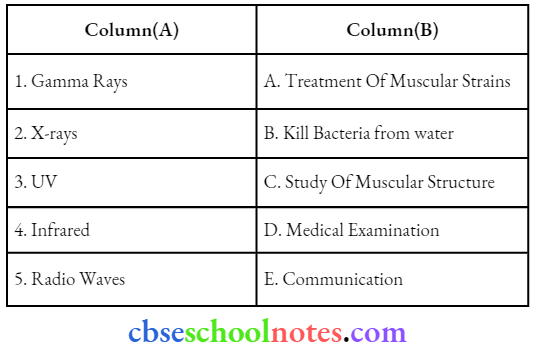
Question 3. Match the column

Electromagnetic Waves Match The Column

Answer: 1-C, 2-D, 3-B, 4-A, 5-E

Question 4.

  1. Suppose that the earth’s atmosphere is absent, will the average temperature on the earth’s surface
    be higher or lower than what it is at present?
  2. What is an electromagnetic constant?

Answer:

  1. The average temperature will be lower due to the absence of the greenhouse effect.
  2. All types of electromagnetic waves move with the same speed c = 3 x 10⁸ m/s in air or vacuum, so ‘c’ is called the electromagnetic constant.

Question 5.

  1. The charging current for a capacitor is 0.25 A. What is the displacement current across its plates?
  2. How are infrared waves produced? Write their one important use.

Answer:

  1. 0.25 A
  2. Infrared waves are produced by hot bodies due to molecular vibrations. These are used to
    treat muscular strain.

Question 6.

  1. Which part of the electromagnetic spectrum is used for eye surgery?
  2. Which part of the electromagnetic spectrum is blocked by protective welding glass?

Answer:

  1. Ultra-violet rays arc used in Lasik Laser, for eye surgery.
  2. Ultra-violet.

Question 7. Slate two properties of electromagnetic waves.

Answer:

  1. All EM waves travel with the same speed c = 3 x 10⁸ m/s in air or vacuum.
  2. EM waves have energy and momentum and these apply radiation pressure, on the surface on which they are made to fall.

Question 8.

  1. The thin Ozone layer on top of the stratosphere is crucial for human survival. Why?
  2. How can we show that em waves carry momentum?

Answer:

Question 9.

  1. Which component of the electromagnetic wave is responsible for producing an optical effect?
  2. Light can travel in a vacuum whereas sound cannot do so. Why?

Answer:

  1. The Electric vector of the em wave is responsible.
  2. Light is electromagnetic while sound is a mechanical wave.

Question 10.

  1. For which wavelength our eyes are most sensitive?
  2. Which of the electromagnetic waves is capable of penetrating layers of dust?

Answer:

  1. 555nm i.e. yellow colour.
  2. Infra-red.

Question 11. Electromagnetic waves of wavelengths λ12, and λ3 are used in radar systems, water purifiers, and in remote switches of TV. respectively.

  1. Identify the electromagnetic waves, and
  2. Write one source for each of them.

Answer:

1. In radar systems ⇒ microwaves

In water purifies ⇒ UVrays

In remote switches in TV ⇒ Infrared rays

2. Microwave arc produced by special vacuum lubes (Klystrons, Magnetrons, and Gunn diodes)

  • UV radiation is produced in welding arc and the sun is an important source of ultraviolet light.
  • Infrared waves are produced by hot bodies and molecules.

Class 12 Physics Chapter 8 Electromagnetic Waves Long Questions And Answers

Question 1. Gamma rays are used in radiotherapy to treat cancer. They are used to spot tumors. They kill the living cells and damage malignant tumors.

Electromagnetic Waves Gamma Knife Machine

(1). What is the source of gamma rays?

  1. Radioactive decay of the nucleus
  2. Accelerated motion of charges in conducting wire
  3. Hot bodies and molecule
  4. Klystron valve

Answer: 1. Radioactive decay of the nucleus

(2). How is the wavelength of gamma rays

  1. Low
  2. High
  3. Infinite
  4. Zero

Answer: 1. Low

(3). Choose the one with the correct penetrating power order of radiation.

  1. Alpha > beta > gamma
  2. Beta > alpha > gamma
  3. Gamma > beta > alpha
  4. Gamma > alpha > beta

Answer: 3. Gamma > beta > alpha

(4). What is the other use of gamma rays?

  1. Used to change white topaz to blue topaz
  2. Used in aircraft navigation
  3. Used to kill microbes
  4. Checking fractures of bone

Answer: 1. Used to change white topaz to blue topaz

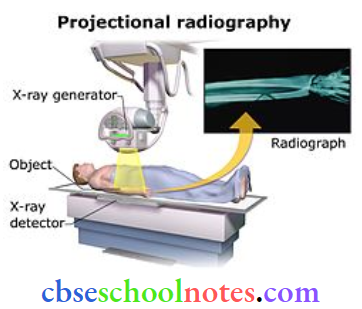
Question 2. X-rays are a form of electromagnetic radiation, similar to visible light. Unlike light, however, x-rays have higher energy and can pass through most of the objects, including the body. Medical x-rays are used to generate images of tissues and structures inside the body

Electromagnetic Waves Projectional Radiography

(1). What is the most common method of preparation of X-rays?

  1. Magnetron valve
  2. Vibration of atoms and molecules
  3. Bombardment of metal by high-energy electrons
  4. Radioactive decay of the nucleus

Answer: 3. Bombardment of metal by high-energy electrons

(2). Which of the following sets of instruments or equipment can detect X-rays

  1. Photocells, photographic film
  2. Thermopiles, bolometer
  3. Photographic film. Geiger tube
  4. Geiger lube, the human eye

Answer: 3. Photographic film. Geiger tube

(3). Where do X-rays fall on the electromagnetic spectrum?

  1. Between the UV region and infrared region
  2. Between gamma rays and UV region
  3. Between infrared and microwaves
  4. Between microwaves and radio waves

Answer: 2. Between gamma rays and UV region

(4). What is the use of rays lying beyond the X-ray region in the electromagnetic spectrum

  1. Used to kill microbes
  2. Used to detect heat loss in insulated systems
  3. Used in standard broadcast radio and television
  4. Used in oncology, to kill cancerous cells.

Answer: 4. Used in oncology, to kill cancerous cells.

Important Questions for Class 12 Physics Chapter 7 Alternating

Class 12 Physics Chapter 7  Alternating Current Multiple Choice Questions And Answers

Important Questions for Class 12 Physics Chapter 7 Alternating

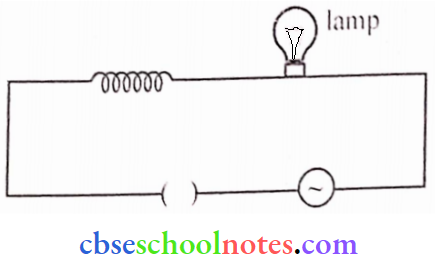
Question 1. A capacitor and an inductor are connected in two different AC circuits with a bulb glowing in each circuit. The bulb glows more brightly when:

  1. The number of turns in the inductor is increased
  2. The separation between the plates of the capacitor is increased
  3. An iron rod is introduced into the inductor
  4. A dielectric is introduced into the gap between the plates of the capacitor

Answer: 4. A dielectric is introduced into the gap between the plates of the capacitor

Read and Learn More Important Questions for Class 12 Physics with Answers

Question 2. A pure inductor of 318mH and a pure resistor of 75 Ω arc connected in series to an AC source of 50 Hz. The voltage across the 75 Ω resistor is found to be 150V. The source voltage is:

  1. 150 V
  2. 175 V
  3. 220 V
  4. 250 V

Answer: 4. 250 V

⇒ \(\cos \phi=\frac{R}{Z}=\frac{V_R}{V} \text { or } V=V_R \times \frac{Z}{R}\)

∴ \(\frac{150}{75} \sqrt{75^2+\left(3.14 \times 318 \times 10^{-3}\right)^2}=2 \sqrt{5625 \times 9970}=2 \times 124.8 \simeq 2.50 \mathrm{~V}\)

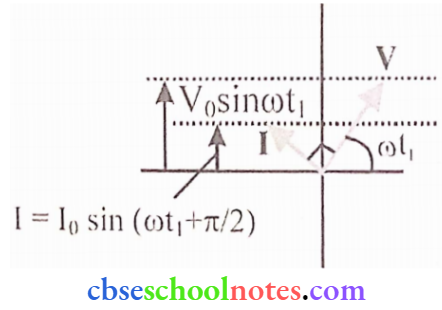
Question 3. In an AC circuit, the applied voltage and resultant current are E = E0 sin ωt and I = I0 sin (ωt + π/2) respectively. The average power consumed in the circuit is:

  1. B0I0
  2. \(\frac{E_0 I_0}{2}\)
  3. \(\frac{E_0 I_0}{\sqrt{2}}\)
  4. Zero

Answer: 4. Zero

∴ \(P_{avg}=E_{rms} I_{rms} \cos 90^{\circ}=0\)

Question 4. In a series LCR circuit, at resonance, the current is equal to_____

  1. \(\frac{\mathrm{V}}{\mathrm{R}}\)
  2. \(\frac{\mathrm{V}}{\mathrm{x}_{\mathrm{c}}}\)
  3. \(\frac{V}{X_{L}-X_C}\)
  4. \(\frac{V}{\sqrt{R^2+\left(X_L+X_C\right)^2}}\)

Answer: 1. \(\frac{\mathrm{V}}{\mathrm{R}}\)

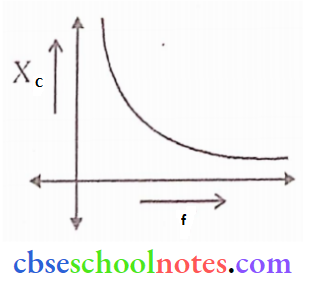
Question 5. The frequency of an AC source for which a 10 μF capacitor has a reactance of 1000 ohm is___

  1. \(\frac{1000}{\pi} \mathrm{Hz}\)
  2. 50 Hz
  3. \(\frac{50}{\pi} \mathrm{Hz}\)
  4. \(\frac{100}{\pi} \mathrm{Hz}\)

Answer: 3. \(\frac{50}{\pi} \mathrm{Hz}\)

⇒ \(X_C=\frac{1}{2 \pi \mathrm{fC}}=1000\)

∴ \(f=\frac{50}{\pi} \mathrm{Hz} \)

Question 6. Which one of the following statements is true:

  1. An inductor has infinite resistance in a DC circuit.
  2. An inductor and a capacitor cannot conduct in a DC circuit
  3. A capacitor can conduct in a DC circuit but not an inductor.
  4. An inductor can conduct in a DC circuit but not a capacitor.

Answer: 4. An inductor can conduct in a DC circuit but not a capacitor.

Question 7. In an A.C. circuit in 1 second current reduces to zero value 120 times. Hence the frequency of A.c current is ___________ Hz.

  1. 50
  2. 100
  3. 60
  4. 120

Answer: 3. 60

Question 8. What is the r.m.s. value of the current for A.C. current I = 100 cos (200 t + 45°)A.

  1. 50√2 A
  2. 100 A
  3. 100√2 A
  4. Zero

Answer: 1. 50√2 A

∴ \(I_{\mathrm{rms}}=\frac{I_0}{\sqrt{2}}=\frac{100}{\sqrt{2}} \times \frac{\sqrt{2}}{\sqrt{2}}=50 \sqrt{2} \mathrm{~A}\)

Question 9. In an R-C circuit when the charge on the plates of the capacitor is increasing, the energy obtained from the sources is stored in ___________.

  1. Electric field
  2. Magnetic field
  3. Gravitational field
  4. Both Magnetic field and gravitational field

Answer: 1. Electric field

Question 10. The output power in a step-up transformer is ___________

  1. Greater than the input power
  2. Equal to the input power
  3. Maintained even during the power cut
  4. Less than the input power

Answer: 4. Less than the input power

Question 11. The power factor for scries L-R A.C. circuit is ________.

  1. \(\frac{\mathrm{R}}{\mathrm{X}_{L}}\)
  2. \(\frac{X_L}{R}\)
  3. \(\frac{R}{\sqrt{R^2+X_L^2}}\)
  4. \(\frac{\sqrt{R^2+X_L^2}}{R}\)

Answer: 3. \(\frac{R}{\sqrt{R^2+X_L^2}}\)

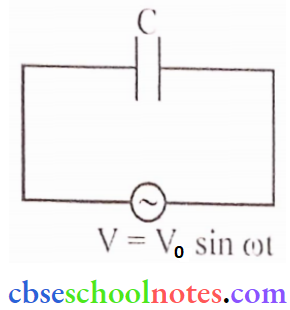
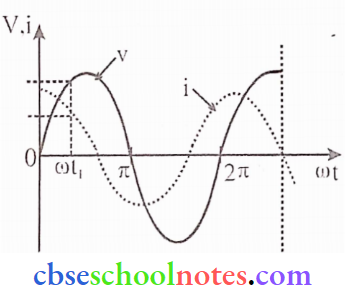
Question 12. An alternating voltage given as V = 200 √2 sin 100 l (V) is applied to a capacitor of 5μF. The current reading of the ammeter will be equal to _________mA.

  1. 80
  2. 20
  3. 40
  4. 100

Answer: 4. 100

⇒ \(I_{\mathrm{rms}}=\frac{V_{\mathrm{rms}}}{X_c}=\frac{V_0 / \sqrt{2}}{1 /\mathrm {\omega}{c}}=20\mathrm{\omega}{c}\)

∴  200 z 100 x 5 x 10-6 = 10-1 A = 100 x 10-3 A = 100 mA

Question 13. The current of \(\frac{50}{\pi}\) frequency is passing through an A.C. circuit having a series combination of resistance R = 100 Ω and inductor L = 1H, then phase difference between voltage and current is __________.

  1. 60°
  2. 45°
  3. 30°
  4. 90°

Answer: 2. 45°

⇒ \(\phi=\tan ^{-1}\left(\frac{x_1}{R}\right)=\tan ^{-1}\left(\frac{2 \pi f L}{R}\right)\)

∴ \(\phi=\tan ^{-1}\left(\frac{2 \times \pi \times\frac{50}{\pi} \times 1}{100}\right)=45^{\circ}\)

Question 14. A coil of inductance L and resistance R is connected to an A.C. source of V volt. If the angular frequency of the A.C. source is equal to co rad s-1, then the current in the circuit will be __________.

  1. \(\frac{\mathrm{V}}{\mathrm{R}}\)
  2. \(\frac{\mathrm{V}}{\mathrm{L}}\)
  3. \(\frac{V}{R+L}\)
  4. \(\frac{V}{\sqrt{R^2+\omega^2 L^2}}\)

Answer: 4. \(\frac{V}{\sqrt{R^2+\omega^2 L^2}}\)

Question 15. In an A.C. circuit current is 2A and voltage is 220 V and power is 44 W power factor is _________.

  1. 0.10
  2. 0.09
  3. 1.80
  4. 0.18

Answer: 1. 0.10

Pvirtual = VI = 220 x 2 = 440 Watt

Pavg = Pvirtual cos Φ

44 = 440 x cos Φ

∴ \(\cos \phi=\frac{1}{10}=0.1\)

Question 16. A 15 μF capacitor is connected to a 220, 50 Hz a.c. source. The value of capacitive reactance is ___________.

  1. 424
  2. 106
  3. 212
  4. 21.2

Answer: 3. 212

⇒ \(X_C=\frac{1}{2 \pi f C}=\frac{1}{2 \times 3.14 \times 50 \times 1.5 \times 10^{-6}}\)

∴ Xc = 212.314

Question 17. A power transmission line feeds input power at 3300 V to a step-down transformer with its primary windings having 2000 turns. What should be the number of turns in the secondary to gel output power at 330 V?

  1. 200
  2. 400
  3. 33
  4. 40

Answer: 1. 200

⇒ \(\frac{V_s}{V_p}=\frac{N_s}{N_p}\)

⇒ \(\frac{330}{3300}=\frac{N_s}{2000}\)

⇒ \(\frac{1}{10}=\frac{N_s}{2000}\)

∴ Ns = 200

Class 12 Physics Chapter 7  Alternating Current Assertion and Reason

For question numbers 1 to 7 two statements are given-one labelled Assertion (A) and the other labelled Reason (R). Select the correct answer to these questions from the codes (1). (2). (3) and (4) as given below.

  1. Both A and R are true and R is the correct explanation of A
  2. Both A and R are true but R is NOT the correct explanation of A
  3. A is true but R is false
  4. A is false and R is also false

Question 1. Assertion: In a Series LCR circuit connected to an AC source, resonance can take place.

Reason: At resonance XL = XC

Answer: 2. Both A and R are true but R is NOT the correct explanation of A

Question 2. Assertion: A transformer is used to increase or decrease AC voltage only.

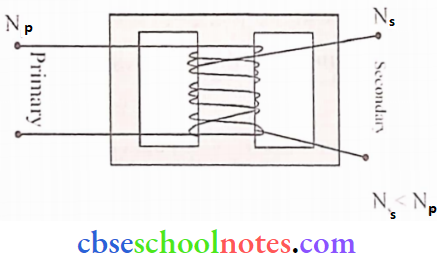
Reason: A transformer works based on mutual Induction.

Answer: 1. Both A and R are true and R is the correct explanation of A

Question 3. Assertion: Average power loss in scries LC circuit is always zero.

Reason: The average value of voltage and current in A.C. is zero.

Answer: 2. Both A and R are true but R is NOT the correct explanation of A

Question 4. Assertion: The capacitor serves as a block for D.C, and offers an easy path to AC.

Reason: Capacitive reactance is inversely proportional to frequency.

Answer: 1. Both A and R are true and R is the correct explanation of A

Question 5. Assertion: When capacitive reactance is smaller than the inductive reactance in the scries LCR
circuit, voltage leads the current.

Reason: In a series LCR circuit inductive reactance is always greater than capacitive reactance.

Answer: 3. A is true but R is false

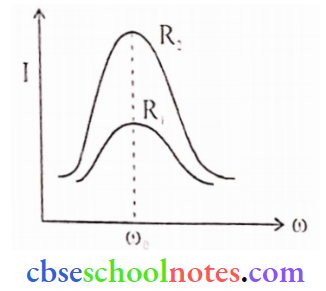
Question 6. Assertion: In the series LCR circuit, the impedance is minimal at resonance.

Reason: The currents in the inductor and capacitor arc same in the scries LCR circuit.

Answer: 2. Both A and R are true but R is NOT the correct explanation of A

Question 7. Assertion: In series LCR circuit phase difference between current and voltage is never zero.

Reason: Voltage and current are never in phase.

Answer: 4. A is false and R is also false

Class 12 Physics Chapter 7  Alternating Current Short Questions And Answers

Question 1. An alternating current I = (10 A) sin (100 πt) is passed through a resistor of 20 Ω. What is the average power consumed by the resistor over a complete cycle?

Answer:

Pavg= Vrms Irms cos = (Irms R) Irms [cosΦ= 1]

So, Pavg = I2rms R-C

⇒ \(\frac{I_{0}^2}{2} \times R\)

⇒ \(\frac{10 \times 10 \times 20}{2}\)

Pavg = 1000 watt

Question 2. Define ‘quality factor’ at resonance in series LCR circuit. What is its SI unit?

Answer:

The Q factor of the series resonant circuit is defined as the ratio of the voltage developed across the inductor or capacitor at resonance to the applied voltage, which is the voltage across R.

⇒ \(Q=\frac{I X_1}{I R}=\frac{{\omega}_0 L}{R}=\frac{{\omega}_1}{{\omega}_2-{\omega}_1}\)

It is dimensionless, hence it has no units. It represents the sharpness of resonance.

Question 3. An a.c. source of voltage V = V0sinωt is connected to an ideal inductor. Draw graphs of voltage V and current 1 versus cot.

Answer:

Alternating Current Voltage And Current

Question 4. Explain why current Hows through an ideal capacitor when it is connected to an a.c. source but not when it is connected to a D.C. source in a steady state.

Answer:

When AC is connected to the capacitor, due to continuous change of polarity of the applied voltage there will be continuous change of polarity of capacitor plates. This causes the charge to flow across the capcitor.

In steady state, the capacitor acts as an open circuit as reactance offered by it to flow of dc (f = 0) is infinite, As \(X_c=\frac{1}{2 \pi f C}=\infty\)

Question 5.

An LCR series circuit is connected to an AC source. If the angular resonant frequency of the circuit is coo, will the current lead or lag or be in phase with the voltage when to ω < ω0  and why?

  1. We cannot step up the DC voltage using a transformer. Why?
  2. On what principle does a metal detector work?

Answer:

1. at ω < ω0

XL< XC

so current leads the voltage

2. For d.c f = 0

So. there is no mutual induction and the transformer works on the principle of mutual induction.

3. The metal detector works on the principle of resonance in AC circuits.

Question 6.

  1. In an LCR series circuit connected to an AC source, the voltage and the current are in the same phase. If the capacitor is filled with a dielectric, will the current lead or lag or remain in phase with the voltage? Explain.
  2. In the circuit, why is the rms value of net voltage not equal to the sum of voltage drops
    across individual elements?
  3. Draw a graph showing variation of the impedance of the circuit with the frequency of the
    applied voltage.

Answer:

1. Given in question capacitor is filled with a dielectric slab, So new capacity increases as

⇒ \(C=\frac{\varepsilon_1 \varepsilon_0 A}{d}\)

So, C increase then XC decreases

So, XL > XC

Current lag voltage, as the circuit is inductive.

2. Voltage across R, L, and C are at different phase angles. So. we must do vector addition of voltages then we get Net voltage.

3. Alternating Current Variation Of The Impendence Of The Circuit

Question 7. A capacitor of unknown capacitance, a resistor of 100 Ω, and an inductor of self-inductance l, = (4/π2) henry are connected in series to an AC source of 200 V and 50 Hz. Calculate the value of the capacitance and impedance of the circuit when the current is in phase with the voltage. Calculate the power dissipated in the circuit.

Answer:

Current in phase with voltage means the angle between cmf and current is zero. This is a resonance condition. So

Inductive reactance = Capacitive Reactance

⇒ \(X_L=X_C \Rightarrow \omega L=\frac{1}{\omega C}\)

⇒ \(\mathrm{C}=\frac{1}{{\omega}^2 \mathrm{~L}} \text {, given } \mathrm{L}=4 / \pi^2 \quad f=50 \mathrm{~Hz}, \mathrm{~V}=200 \mathrm{~V}\)

So \(C=\frac{1 \times \pi^2}{(2 \pi)^2 \times 4 \times(50)^2} \Rightarrow C=25 \mu \mathrm{F}\)

Power dissipated \(P=V^2 / R=\frac{200 \times 200}{100}\)

∴ P = 400 W

Question 8. A series LCR circuit connected to a variable frequency 230 V source.

Alternating Current LCR Circuit

  1. Determine the source frequency which drives the circuit in resonance.
  2. Calculate the impedance of the circuit and amplitude of current at resonance.
  3. Show that potential drop across LC combination is zero at resonating frequency.

Answer:

1. At Resonance

⇒ \(X_L=X_C \Rightarrow \omega_{\mathrm{r}} L=\frac{1}{\omega_{\mathrm{r}} \mathrm{C}}\)

⇒ \(f_r=\frac{1}{2 \pi \sqrt{L C}} \Rightarrow f_r=\frac{1}{2 \pi \sqrt{5 \times 80 \times 10^{-6}}}\)

⇒ \(f_r=\frac{1}{2 \pi \times 20 \times 10^{-3}}\)

∴ \(\mathrm{f}_{\mathrm{r}}=\frac{25}{\pi} \mathrm{Hz}\)

Alternating Current Source Frequency

2. Impedance of the circuit at resonance

Z = R = Z = 40 Ω

Amplitude of current at resonance

⇒ \(V_{\mathrm{rms}}=I_{\mathrm{rm}} \mathrm{Z} \Rightarrow I_{\mathrm{rms}}=\frac{230}{40} \mathrm{A}\)

∴ \(I_{\mathrm{rms}}=\frac{23}{4} \mathrm{~A}\)

Amplitude, I0 = √2 Irms

∴ I0 = 8.1 A

3. Potential drop across LC combination

VLC = VL-VC

= I(XL-XC)

At resonance XL = XC => XL– XC = 0

VC= 0

Question 9.

  1. When an AC source is connected to an ideal capacitor, show that the average power
    supplied by the source over a complete cycle is zero.
  2. A bulb is connected in series with a variable capacitor and an A.C. source as shown. What happens to the brightness of the bulb when the key is plugged in and the capacitance of the capacitor is gradually reduced?

Alternating Current A Bulb Is Connected In Series With A Variable Capacitor

Answer:

1. Given V = V0 sin t

q = CV

q = CV0 sin t

Alternating Current Ideal Capacitor

⇒ \(\frac{\mathrm{dq}}{\mathrm{dt}}=\mathrm{CV}_0 \quad \frac{\mathrm{d}}{\mathrm{dt}} \sin \omega t\)

I = CV0 (cos ω t)

⇒ [\atex]\left.I=\frac{V_0}{\left(\begin{array}{c}\frac
{1}{\omega c}
\end{array}\right)} \cos {\omega} t \Rightarrow I=\frac{V_0}{X_c} \sin ({\omega} t+\pi / 2\right)[/latex]

Here, \(X_C=\frac{1}{{\omega} C} \text { and } \mathrm{I}_0=\frac{V_0}{X_C}\)

Average power

⇒ \(P_{a v}=\int_0^1 V I d t=\frac{V_0^2}{X_C} \int_0^1(\sin {\omega} t)(\sin {\omega} t+\pi / 2) d t=\frac{V_0^2}{X_c} \int_0^1(\sin \omega t)(\cos {\omega}t) d t\)

⇒ \(P_{\mathrm{av}}=\frac{\mathrm{V}_0^2}{2 X_C} \int_0^{\mathrm{T}} \sin (2{\omega} t) d t \quad\left\{\int_0^{\mathrm{T}} \sin (2{\omega} t) d t=0\right.\)

Pav = 0

2. When the AC source is connected, the capacitor offers capacitive reactance XC = 1/Cω. The
current flows in the circuit and the lamp glows. On reducing C, XC increases and currently
reduces, Therefore, the bulb’s glow reduces.

Question 10. A capacitor (C) and resistor (R) are connected in series with an AC source of voltage of frequency 50 Hz. The potential difference across C and R are 120 V and 90 V respectively, and the circuit’s current is 3 A. Calculate

  1. The impedance of the circuit
  2. The value of the inductance, which when connected in series with C and R will make the power factor of the circuit unity.

Answer:

Given: f = 50 Hz, I = 3A, VC = 120 V and VR = 90 V

1. Impedance of the circuit:

⇒ \(\mathrm{Z}=\frac{\mathrm{V}}{\mathrm{I}} \Rightarrow \mathrm{Z}=\frac{\sqrt{\mathrm{V}_{\mathrm{c}}^2+\mathrm{V}_{\mathrm{R}}^2}}{\mathrm{I}}\)

⇒ \(Z=\frac{\sqrt{(120)^2+(90)^2}}{3}\)

Z = 50

2. Power factor (cos Φ) = l. This is the condition of resonance. Let inductance (L) is connected in series with C and R. At resonance.

XL = XC

VC = IXC

120 = 3 XC

XC = 40

XL = 40 Ω ⇒ ωL = 40 Ω ⇒ 2πfL = 40

π \(\mathrm{L}=\frac{40}{2 \pi f}=\frac{40}{2 \pi \times 50}=\frac{0.4}{\pi} \mathrm{H}\)

Question 11.

  1. When an AC source is connected to an ideal inductor show that the average power supplied
    by the source over a complete cycle is zero.
  2. A lamp is connected in series with an inductor and an AC source. What happens to the lamp’s brightness when the key is plugged in and an iron rod is inserted inside the inductor? Explain.

Alternating Current A Lamp Is Connected In Series With An Inductor And An Ac Source

Answer:

1. Given

Alternating Current Ac Source Is Connected To An Ideal Inductor

V = V0 sinωt

⇒ \(\mathrm{V}=\mathrm{L} \frac{\mathrm{d} \mathrm{I}}{\mathrm{dt}}\) (induced emf)

⇒ \(\mathrm{dI}=\frac{\mathrm{V}}{\mathrm{L}} \mathrm{dt}\)

⇒ \(\mathrm{dI}=\frac{\mathrm{V}_0}{\mathrm{~L}} \sin \omega t \mathrm{dt}\)

By integration \(I=\frac{-V_0}{{\omega}} \cos {\omega} t\)

∴ \(I=-\frac{V_0}{\omega L} \sin \left[\frac{\pi}{2}-\omega t\right] \Rightarrow I_0 \sin \left[\omega t-\frac{\pi}{2}\right]\)

where \(I_0=\frac{V_0}{{\omega} \mathrm{L}}\)

Average power

⇒ \(P_{\mathrm{av}}=\int_0^{\mathrm{T}} V I \mathrm{dt}\)

⇒ \(-\frac{V_0^2}{\omega L} \int_0^T \sin {\omega} t \cos {\omega}t dt\)

⇒ \(-\frac{V_0^2}{2 \omega L} \int_0^{\mathrm{T}} \sin (2 \omega \mathrm{t}) \mathrm{dt} \quad\left\{\int_0^{\mathrm{T}} \sin (2 \omega t) \mathrm{d} t=0\right.\)

= 0

2. When an iron rod is inserted into the inductor, the self-inductance of the inductor increases. On increasing L. XL increases and current reduces. Therefore glow of the bulb reduces.

Class 12 Physics Chapter 7  Alternating Current Long Questions And Answers

Question 1. When a pure resistance R, pure inductor L, and an ideal capacitor of capacitance C are connected in series to a source of alternating e.m.f., then-current at any instant through the three elements has the same amplitude and is represented as I = I0 sin ωt.

However, the voltage across each element has a different phase relationship with the current as shown in the graph. The effective resistance of the RLC circuit is called the impedance (Z) of the circuit and the voltage leads the current by a phase angle Φ.

A resistor of 12Ω a capacitor of reactance 14Ω and a pure inductor of inductance 0.1 H are joined in series and placed across 200 V, 50 Hz a.c. supply.

Alternating Current A Pure Resistance

(1). What is the value of inductive reactance?

Answer:

XL = 2πfL = 2 x 3.14 x 50 x 0.1 = 31.4 Ω

(2). What is the value of impedance?

Answer:

∴ \(Z=\sqrt{R^2+\left(X_{L}-X_C\right)^2}=\sqrt{(12)^2+(31.4-14)^2}=21.13 \Omega\)

(3). What is the value of current in the circuit?

Answer:

∴ \(I=\frac{e}{Z}=\frac{200}{21.13}=9.46 \mathrm{~A}\)

(4). What is the value of the phase angle between current and voltage?

Answer:

∴ \(\tan \phi=\frac{X_L-X_C}{R}=\frac{31.4-14}{12}=1.45 \Rightarrow \phi=\tan ^{-1}(1.45)\)

Question 2. The power averaged over one full cycle of a.c. is known as average power. It is also known as true power \(P_{\mathrm{av}}=V_{\mathrm{rms}} I_{\mathrm{rms}} \cos \phi=\frac{V_0 I_0}{2} \cos \phi\)

Root mean square or simply rms watts refer to continuous power.

A circuit containing an 80 mH inductor and a 60 μF capacitor in series is connected to a 230V, 50 Hz supply. The resistance of the circuit is negligible.

Alternating Current The Resistance Of The Circuit

(1). What is the average power transferred to the inductor?

Answer:

Zero

(2). What is the total average power absorbed by the circuit?

Answer:

This is an LC circuit so the average power absorbed by the circuit is zero.

(3). Find the value of current amplitude.

Answer:

⇒ \(I=\frac{e}{Z}=\frac{c}{X_L-X_c}\)

e = 230 V0

XL = L = 2πfL

= 2 x 3.14 x 50 x 80 x 10-3 = 25.120 Ω

⇒ \(X_C=\frac{1}{{\omega} C}=\frac{1}{2 \pi fC}\)

∴  \(\frac{1}{2 \times 3.14 \times 50 \times 60 \times 10^{-6}}=53 \Omega\)

So, \(I=\frac{230}{53-25.120}=8.249 \mathrm{~A}\)

I0 = √2Irms

= 2 x 8.249 = 11.6 A

(4). Find the rms value of current.

Answer:

⇒ \(I=\frac{e}{Z}=\frac{e}{X_L-X_C}\)

e = 230 V0

xL = L = 2πfL

= 2 x 3.14 x 50 80 x 10-3 = 25. 120

⇒\(X_C=\frac{1}{\omega C}=\frac{1}{2 \pi f C}\)

⇒ \(\frac{1}{2 \times 3.14 \times 50 \times 60 \times 10^{-6}}=53 \Omega\)

So, \(I=\frac{230}{53-25.120}=8.249 \mathrm{~A}\)

Question 3.

  1. In a series LCR circuit connected to an a.c. source of voltage V = Vm sinωt, use phasor diagram to derive an expression for the current in the circuit. Hence obtain the expression tor the power dissipated in the circuit. Show that power dissipated at resonance is maximum.
  2. In a series LR circuit, XL = R, and the power factor of the circuit is P1. When a capacitor with capacitance C such that XL = XC is put in series, the power factor becomes P2. Calculate P1/P2.

Answer:

1. Suppose OA, OB, and OC represent the magnitude of phasor VR, VL, and VC respectively. In the case of VL > VC, the resultant of (VR) and (VL-VC), is represented by OE. Thus from ΔOAE

⇒ \(\mathrm{OE}=\sqrt{\mathrm{OA}^2+\mathrm{AE}^2}\)

⇒ \(V=\sqrt{V_R^2+\left(V_L-V_C\right)^2}\)

Substituting the value of VR, VL, and VC we have

⇒ \(V=\sqrt{(I R)^2+\left(I X_L-I X_C\right)^2}\)

or \(I=\frac{V}{\sqrt{(R)^2+\left(X_L-X_C\right)^2}}\)

Alternating Current Phasor

The effective opposition offered by L, C, R to a.c. supply is called the impedance of the LCR circuit and is represented by Z.

∴ \(I=\frac{V}{Z}\)

So, comparing \(Z=\sqrt{R^2+\left(\omega L-\frac{1}{\omega C}\right)^2}\)

Also from ΔOAE

⇒ \(\tan \phi=\frac{A E}{O A}=\frac{V_L-V_c}{V_R}\)

or \(\tan \phi=\left(X_L-X_C\right) / R\)

or \(\phi=\tan ^{-1} \frac{\left(X_L-X_C\right)}{R}\)

Power dissipation in LCR circuit:

The instantaneous power supplied by the source is

P = VI

⇒ \(P=\left(V_m \sin \omega t\right) \times i_m \sin (\omega t+\phi) = \frac{V_m i_m}{2}[\cos \phi-\cos (2 \omega t+\phi)]\)

[2sinAsinB = cos(A-B)-cos(A+B)]

For Average power, the second term becomes zero in the complete cycle.

So \(P_{a v}=\frac{V_m i_m}{2} \cos \phi \quad \int_0^{\mathrm{T}} \cos (2 \omega t+\phi) d t=0\)

So \(P_{\mathrm{av}}=\frac{V_{\mathrm{m}}}{\sqrt{2}} \frac{i_{\mathrm{m}}}{\sqrt{2}} \cos \phi=V_{\mathrm{rms}} i_{\mathrm{rms}} \cos \phi\)

So \(\mathrm{P}_{\mathrm{av}}=\mathrm{V}_{\mathrm{rms}} \mathrm{i}_{\mathrm{rms}} \cos \phi\)

At resonance condition, cosΦ = 1 (because Φ) = 0), R becomes the effective impedance of a circuit. So power dissipated is maximum at resonance condition

2. In series LCR circuit impedance

⇒ \(Z=\sqrt{R^2+\left(X_L-X_C\right)^2}\) and power factor p = R/Zero

case 1: In LR circuit When XL = R, So Z = (2R2)1/2

Z = √2R = Now \(P_1=\frac{R}{Z}=\frac{R}{\sqrt{2} R} \Rightarrow P_1=\frac{1}{\sqrt{2}}\)

Case 2: XL = XC, Z=R, So power factor P2 becomes equal to 1

P2 = 1

So ration \(\frac{P_1}{P_2}=\frac{1}{\sqrt{2}}: \frac{1}{1} \Rightarrow \frac{P_1}{P_2}=\frac{1}{\sqrt{2}}\)

Question 4. A 2 μF capacitor, 100 Ω resistors, and 8 H inductor are connected in series with an AC source.

  1. What should be the frequency of the source such that the current drawn in the circuit is maximum, What is this frequency called?
  2. If the peak value of c.m.f. of the source is 200 V, find the maximum current.
  3. Draw a graph showing the variation of amplitude of circuit current with changing frequency of applied voltage in a series LCR circuit for two different values of resistance R1 and R2 (R1 > R2).
  4. Define the term ‘Sharpness of Resonance’. Under what conditions, does a circuit become
    more selective?

Answer:

1. Source frequency, when current is maximum is given by

⇒ \(f=\frac{1}{2 \pi \sqrt{L C}}=\frac{1}{2 \pi \sqrt{8 \times 2 \times 10^{-6}}}\) [L = 8H and C = 2μF]

∴ \(f=\frac{1}{2 \pi \times 4 \times 10^{-3}}\)

f = 39.80 Hz

The frequency at which the current maximum, is called resonant frequency.

2. Given E0 = 200V, R= 100Ω

∴ \(I_{\max }=\frac{E_0}{R}=\frac{200}{100}=2 \mathrm{~A}\)

3. Alternating Current Variation Of Amplitude Of Circuit Current

4. The sharpness of resonance is given by the quality factor (Q factor) of a resonant circuit. It is defined as the ratio of the voltage drop across the inductor (or capacitor) to the applied voltage. Sharper the curve, the circuit will be more selective. For resistant R2, the circuit is more selective.

Question 5.

  1. Draw a labeled diagram of a step-down transformer. State the principle and its working.
  2. Express the turn ratio in terms of voltages.
  3. Find the ratio of primary and secondary currents in terms of turn ratio in an ideal
    transformer.
  4. How much current is drawn by the primary of a transformer connected to a 220 V supply when it delivers power to a 1 10 V- 550 W refrigerator?

Answer:

1. Alternating Current Step-Dowm Transformer

Principle: The Transformer works on the principle of mutual induction, in which an EMF is induced in the secondary coil by changing the magnetic flux in the primary coil.

Working: When an alternating current source is connected to the ends of the primary coil, the current changes continuously in the primary coil, due to which magnetic flux linked with the secondary coil changes continuously. Therefore, the alternating emf of the same frequency is developed across the secondary terminals.

2. \(\frac{N_s}{N_p}=\frac{V_s}{V_p} \quad\left\{\frac{N_s}{N_p}=\right.\text { turn ratio }\)

3. For ideal transformer

Output power = Input power

VSIS = VPIP

⇒ \(\frac{V_S}{V_p}=\frac{I_p}{I_S} \quad\left\{\frac{V_s}{V_p}=\frac{N_s}{N_p}\right.\)

∴ \(\frac{N_s}{N_p}=\frac{I_p}{I_s}\)

4. Given VP = 220 V, VS = 1 1 0 V. P = 550 W. IP = ?

⇒ \(I_p=\frac{\text { Power }}{\text { Primary Voltage }}=\frac{P}{V_p}\)

∴ \(\mathrm{I}_{\mathrm{P}}=\frac{550}{220}=2.5 \mathrm{~A}\)

Question 6. A device ‘X’ is connected to an AC source V = V0 sin ωt. The variation of voltage, current, and power in one cycle is shown in the following graph:

Alternating Current Power Of One Cycle

  1. Identify the device ‘X’.
  2. Which of the curves A, B, and C represent the voltage, current, and power consumed in the circuit? Justify your answer.
  3. How does its impedance vary with the frequency of the AC source? Show graphically.
  4. Obtain an expression for the current in the circuit and its phase relation with AC voltage.

Answer:

1. Capacitor

2. Curve: A represents power because in a pure capacitive AC circuit, power consumed in one cycle is zero and the frequency of power is twice the frequency of voltage (or current). CurvcB represents voltage. Curve-C represents current because in a pure capacitive AC circuit, current leads the voltage by π/2.

3. \(Z=X_C \Rightarrow Z=\frac{1}{2 \pi f C}\)

Alternating Current Frequency Of The Ac Source

4. We know, \(V=\frac{q}{C} \text { or } q=C V\)

Also, q = CV0 sin t

or \(\frac{\mathrm{dq}}{\mathrm{dt}}=C \mathrm{~V}_0 \frac{\mathrm{d}}{\mathrm{dt}}(\sin {\omega} \mathrm{t})\)

I = CV0(cos ωt)

∴ \(I=\frac{V_0}{\left(\begin{array}{c}
\frac1{\omega C}
\end{array}\right)} \cos \omega t\)

Alternating Current Phase Relation With Ac Voltage

\(I=\frac{V_0}{X_c} \cos {\omega} t\) (\(x_C=\frac{1}{\omega C}\))

\(I=I_0 \sin (\omega t+\pi / 2)\)     \(\left[I_0=\frac{V_0}{X_C}\right]\)

∴ Leads by (π/2) with voltage.

Question 7. A device X is connected across an AC source of voltage V = V0 sinωt. The current through X is given as \(I=I_0 \sin \left(\omega t +\frac{\pi}{2}\right)\)

  1. Identify the device X and write the expression for its reactance.
  2. Draw graphs showing the variation of voltage and current with lime over one cycle of ac, for X.
  3. How does the reactance of device X vary with the frequency of the AC? Show this variation
    graphically.
  4. Draw the phasor diagram for the device X.

Answer:

1. X: Capacitor

Reactance \(X_C=\frac{1}{\omega C}=\frac{1}{2 \pi f C}\)

2. Alternating Current Variation Of Voltage And CUrrent

3. Reactance of the capacitor varies in inverse proportion to the frequency i.e \(x_c \propto \frac{1}{f}\)

Alternating Current Reactance Of The Capacitor

4. Alternating Current Phasor For The Device

Class 12 Physics Previous Years Important Questions for Electric Charges and Fields

Class 12 Physics Electric Charges And Fields Multiple Choice Questions And Answers
Class 12 Physics Previous Years Important Questions for Electric Charges and Fields

Question 1. An electric dipole placed in a non-uniform electric field will experience:

  1. Only a force
  2. Only a torque
  3. Both force and torque
  4. Neither force nor torque

Answer: 3. Both force and torque

Read and Learn More Important Questions for Class 12 Physics with Answers

Question 2. Let N1 be the number of electric field lines going out of an imaginary cube of side a that encloses an isolated point charge 2q and N2, be the corresponding number for an imaginary sphere of radius a that encloses an isolated point charge 3q Then (N1/N2) is :

  1. 1/π
  2. 2/3
  3. 9/4
  4. 5/3

Answer: 2. 2/3

∴ \(\phi=\frac{q}{\varepsilon_0}\)

So, \( N_1 =\frac{2 q}{\varepsilon_0} \)

∴ \(N_2 =\frac{3 q}{\varepsilon_0} \Rightarrow \frac{N_1}{N_2}=\frac{2}{3}\)

Question 3. Let F1 be the magnitude of the force between two small spheres, charged to a constant potential In free space, and F2, be the magnitude of the force between them in a medium of dielectric constant K. Then (F1/F2) is:

  1. \(\frac{1}{K}\)
  2. K
  3. K2
  4. \(\frac{1}{\mathrm{~K}^2}\)

Answer: 2. k

⇒ \( F_m=\frac{F_0}{K} \)

⇒ \( F_2=\frac{F_1}{K}\)

So, \( $\frac{F_1}{F_2}=K\)

Physics Class 12 Chapter 1 Important Questions Pdf

Question 4. A charge Q is placed at the center of the line joining two charges q and The system of the three charges will be in equilibrium if Q is :

  1. \(+\frac{q}{3}\)
  2. \(-\frac{q}{3}\)
  3. \(+\frac{q}{4}\)
  4. \(-\frac{q}{4}\)

Answer: 4. \(-\frac{q}{4}\)
Electric Charges And Fields Equilibrium

According to question

Fnet = 0

According to q at AB

FAC = FAB

⇒ \(\frac{\mathrm{kqQ}}{\left(\frac{\mathrm{d}}{2}\right)^2}=\frac{\mathrm{kqq}}{\mathrm{d}^2}\)

4Q = q

⇒ \(\mathrm{Q}=\frac{\mathrm{q}}{4}\)

Q must be negative

so, \(\mathrm{Q}=\frac{\mathrm{-q}}{4}\)

Question 5. Electric flux of an electric field E through an area d\(\vec{A}\) is given by :

  1. \({\vec{E}} \times \mathrm{d} \vec{A}\)
  2. \(\frac{\vec{E} \times \mathrm{d} \overrightarrow{\vec{A}}}{\varepsilon_0}\)
  3. \({\vec{E}} \cdot \mathrm{d}{\vec{A}}\)
  4. \(\frac{\vec{E} \cdot d \vec{A}}{\varepsilon_0}\)

Answer: 3. \({\vec{E}} \cdot \mathrm{d}{\vec{A}}\)

Question 6. Two point charges +16 q and -4 q are located at x = 0, and x = L. The location of the point on the x-axis at which the resultant electric field due to these charges is zero is:

  1. 8L
  2. 6L
  3. 4L
  4. 2L

Answer: 4. 2L

Physics Class 12 Chapter 1 Important Questions Pdf

Question 7. An electric dipole of dipole moment 4 x 10⁻⁵C-m, kept in a uniform electric field of 10-3 NC-1 experiences a torque of 2 x 10⁻⁸ Nm. The angle that the dipole makes with the electric field is:

  1. 30°
  2. 45°
  3. 60°
  4. 90°

Answer: 1. 30°

τ = pE sin θ

Question 8. Three identical charges arc placed at the x-axis from left to right with adjacent charges separated by a distance d. The magnitude of the force on a charge from its nearest neighbor charge is F. Let \(\hat{i}\) be the unit vector along + x-axis. then the net force on each charge from left to right is :

  1. \((2 F \hat{i},-2 F \hat{i}, 2 F \hat{i})\)
  2. \((\mathrm{F} \hat{\imath}, 0, \mathrm{~F} \hat{\imath})\)
  3. \((-5 / 4 F \hat{\imath}, 0,+5 / 4 F \hat{\imath})\)
  4. \((2 F \hat{\imath}, 0,2 F \hat{\imath})\)

Answer: 3. \((-5 / 4 F \hat{\imath}, 0,+5 / 4 F \hat{\imath})\)

Question 9. A lest charge of 1.6 x 10⁻¹⁹C is moving with a velocity \({\vec{v}}=(4 \hat{\mathrm{i}}+3 \hat{\mathrm{k}}) \mathrm{ms}^{-1}\) in a magnetic field \({\vec{B}}=(3 \hat{\mathrm{k}}+4 \hat{\mathrm{i}}) \mathrm{T}\) The force on this lest charge is:

  1. \(24 \hat{j} \mathrm{~N}\)
  2. \(-24 \hat{i} \mathrm{~N}\)
  3. \(24 \hat{k} \mathrm{~N}\)
  4. 0

Answer: 4. 0

Question 10. If a charge is moved against a coulomb force of an electric field, then the

  1. The intensity of the electric field increases
  2. The intensity of the electric field decreases
  3. Work is done by the electric field
  4. Work is done by the external source

Answer: 4. Work is done by the external source

Question 11. A charge Q is located at the center of a circle of radius r. The work done in moving a test charge q0 from point A to point B (at opposite ends of diameter AB) to complete a semicircle is \(\left[k=\frac{1}{4 \pi \varepsilon_0}\right]\)

  1. \(k \frac{q_0 Q}{r}\)
  2. \(k \frac{q_0 Q}{r^2}\)
  3. kq0Qr
  4. Zero

Answer: 4. Zero

Physics Class 12 Chapter 1 Important Questions Pdf

Question 12. Two charged spheres A and B having their radii in ratio 1: 2 are connected with a conducting wire, the ratio of their surface charge densities (σA/ σB) will be:

  1. \(\frac{1}{2}\)
  2. 2
  3. \(\frac{1}{4}\)
  4. 4

Answer: 2. 2

Question 13. The force acting between two point charges kept at a certain distance is 5 N. Now the magnitudes of charges arc doubled and the distance between them is halved, the force acting between them is _______ N.

  1. 5
  2. 20
  3. 40
  4. 80

Answer: 4. 80

\(F=\frac{k q \cdot q}{r^2}=5 \)

Now, \(F=\frac{k(2 q)(2 q)}{\left(\begin{array}{l}
r \\
2
\end{array}\right)^2}\) = 16 x 5 = 80 N

Question 14. When an electron and a proton are placed in an electric field _________.

  1. The electric forces acting on them are equal in magnitude as well as direction.
  2. Only the magnitudes of forces are the same.
  3. Accelerations produced in them are the same
  4. The magnitudes of accelerations produced in them are the same

Answer: 2. Only the magnitudes of forces are the same.

Question 15. Two spheres carrying charges q arc hanging from, the same point of suspension with the threads of length 2 m, in space free from gravity. The distance between them will be, ______ m.

  1. 0
  2. 1.0
  3. 4.0
  4. 2.0

Answer: 3. 4.0

Electric Charges And Fields Two Spheres Carrying Charges

Question 16. When two spheres having 2Q and -Q are placed at a certain distance. The force acting between them is F. Now these are connected by a conducting wire and again separated from each other. How much, force will act between them if the separation, now is the same as before?

  1. F
  2. \(\frac{F}{2}\)
  3. \(\frac{F}{4}\)
  4. \(\frac{F}{8}\)

Answer: 4. \(\frac{F}{8}\)
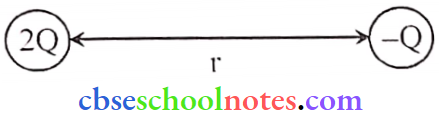
Electric Charges And Fields Two Spheres

⇒ \(\mathrm{F}=\frac{2 \mathrm{k} \mathrm{Q}^2}{\mathrm{r}^2}\) →(1)

These are connected after the separation
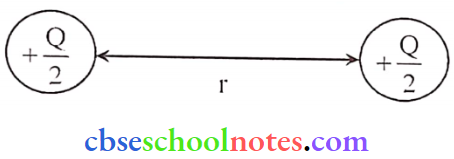
Electric Charges And Fields Two Spheres

⇒ \(\mathrm{F}^{\prime}=\frac{\mathrm{k}\left(\frac{\mathrm{Q}}{2}\right)\left(\frac{\mathrm{Q}}{2}\right)}{\mathrm{r}^2}=\frac{\mathrm{kQ}^2}{4 \mathrm{r}^2}\) →(2)

Equation (2)÷(1)

∴ \(\frac{F^{\prime}}{F}=\frac{1}{8} \Rightarrow F^{\prime}=\frac{F}{8}\)

Physics Class 12 Chapter 1 Important Questions Pdf

Question 17. When a 10 μC charge is enclosed by a closed surface, the flux passing through the surface is Φ. Now another -5μC charge is placed inside the same closed surface, then the flux passing through the surface is ________.

  1. Φ/2
  2. Φ
  3. Zero

Answer: 2. Φ/2

Question 18. An electric dipole is placed in a uniform electric field. The resultant force acting on it is _________.

  1. Always zero
  2. Never zero
  3. Depends on the relative position
  4. Depends upon the dipole moment

Answer: 1. Always zero

Question 19. Electric field due to a dipole at a large distance (r) falls off as ________.

  1. \(\frac{1}{r}\)
  2. \(\frac{1}{r^2}\)
  3. \(\frac{1}{r^3}\)
  4. \(\frac{1}{r^4}\)

Answer: 3. \(\frac{1}{r^3}\)

⇒ \(E=\frac{2 k p}{r^3}\) (On axis)

∴ \(\mathrm{E}=\frac{\mathrm{kp}}{\mathrm{r}^3}\) (on equator for large distance)

Question 20. The resultant force and resultant torque acting on an electric dipole kept in a uniform electric Held (θ ≠ 0° or 180°) are \(\vec{F}\) and \(\vec{\tau}\) then:

  1. \({\vec{F}} \neq 0 ; \quad \vec{\tau}=0 \)
  2. \({\vec{F}}=0 ; \quad \vec{\tau} \neq 0\)
  3. \({\vec{F}}=0 ; \vec{\tau}=0\)
  4. \(\dot{\vec{F}} \neq 0 ; \vec{\tau} \neq 0\)

Answer: 2. \({\vec{F}}=0 ; \quad \vec{\tau} \neq 0\)

Question 21. The liquid drop of mass ‘m’ has a charge ‘q’. What should be the magnitude of electric field E to balance this drop?

  1. \(\frac{E}{m}\)
  2. \(\frac{\mathrm{mg}}{\mathrm{q}}\)
  3. mgq
  4. \(\frac{\mathrm{mq}}{\mathrm{g}}\)

Answer: 2. \(\frac{\mathrm{mg}}{\mathrm{q}}\)

∴ mg = qE

Question 22. The number of electric field lines that emerged from 1 mC charge is _____.

  1. 1.13×10²
  2. 9×10⁹
  3. 1.13×10¹¹
  4. 9×10⁻⁹

Answer: 1. 1.13×10²

∴ \(\phi=\frac{\mathrm{q}}{\varepsilon_0}=\frac{1 \mathrm{mC}}{8.85 \times 10^{-12}}=1.13 \times 10^8 \frac{\mathrm{N}}{\mathrm{C}} \times \mathrm{m}^2\)

Physics Class 12 Chapter 1 Important Questions Pdf

Question 23. A charge Q is enclosed by a Gaussian spherical surface of radius R. If the radius is doubled, the outward electric flux will:

  1. Increase four times
  2. Be reduced to half
  3. Remains The same
  4. Be doubled

Answer: 3. Remains The same

Physics Class 12 Chapter 1 Important Questions Assertion And Reason

For questions numbers 1 to 4 two statements are given-one labeled Assertion (A) and the other labeled Reason (R). Select the correct answer to these questions from the codes (1), (2), (3), and (4) as given below.

  1. Both A and R are true and R is the correct explanation of A
  2. Both A and R are true but R is NOT the correct explanation of A
  3. A is true but R is false
  4. A is false and R is also false

Question 1. Assertion: In electrostatics, electrostatic field lines can never be closed loops.

Reason: The number of electric field lines originating from or terminating on a charge is
proportional to the magnitude of the charge.

Answer: 2. A is true but R is false

Question 2. Assertion: Under electrostatic conditions net electric field inside a solid conductor will be zero.

Reason: Under electrostatics conditions, there will be no free electrons inside a conductor.

Answer: 3. Both A and R are true but R is NOT the correct explanation of A

Question 3. Assertion: Gauss law shows diversion when inverse square law is not obeyed.

Reason: Gauss law is a consequence of conservation of charge.

Answer: 3. A is true but R is false

Question 4. Assertion: The electrostatic force between two charges is a nonconservative force.

Reason: Electric force between two charges proportional to the square of distance between the two.

Answer: 4. A is false and R is also false

Question 5. Assertion: Electrostatic field lines are perpendicular to the surface of the conductor.

Reason: The surface of a conductor is equipotential.

Answer: 1. Both A and R are true and R is the correct explanation of A

Physics Class 12 Chapter 1 Short Questions And Answers

Question 1. Derive an expression for the work done in rotating a dipole from the angle θ0 to θ1, in a uniform electric field.

Answer:
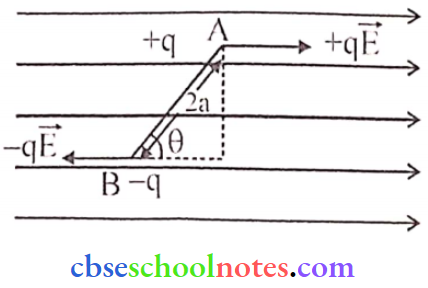
Electric Charges And Fields Unform Electric Field

As we know, when a dipole is placed in a uniform electric field, the net force on the dipole is zero but it experiences a torque, which can be given as, \(\vec{\tau}=\vec{p} \times \vec{E}\)

This torque rotates the dipole unless it is placed parallel or anti-parallel to the external field. If we apply an external and opposite torque, it neutralizes the effect of this torque given by τext and it rotates the dipole from the angle θ0 to an angle θ1 at an infinitesimal angular speed without any angular acceleration.

The amount of work done by the external torque can be given by

∴ \(\mathrm{W}=\int_{0_{0}}^{0_1} \tau_{\mathrm{cxt}} \mathrm{d} 0=\int_{0_0}^{0_1} p E \sin 0 \mathrm{~d} 0=p \mathrm{E}\left(\cos \theta_0-\cos \theta_1\right)\)

Question 2.

  1. Draw the pattern of electric field lines due to an electric dipole.
  2. Write any two properties of electric field lines.

Answer:

1.  Electric Charges And Fields Electric Field Lines
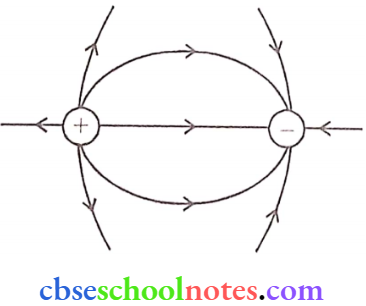
2. Field lines of the electrostatic field have the following properties:

  • Never intersect each other.
  • Electrostatic field lines never form closed loops.

Question 3. A system has two charges qA = 2.5 x 10⁻⁷C and qB = – 2.5 x 10⁻⁷C located at points A : (0, 0, -15 cm) and B : (0, 0, +15 cm), respectively. What is the total charge and electric dipole moment of the system?

Answer:

Total charge = 2.5 x 10⁻⁷– 2.5 x 10-7 = 0

Electric dipole moment is \(\overrightarrow{\mathrm{p}}=\mathrm{q}(2 \overrightarrow{\mathrm{a}})\)

= 2.5×10-7x (0.15+0.15) C-m

= 7.5×10⁸ C-m

The direction of the dipole moment is along the Z-axis.

Question 4. Find the expression for torque experienced by an electric dipole in a uniform electric field.

Answer:

Torque on an electric dipole in a uniform electric field
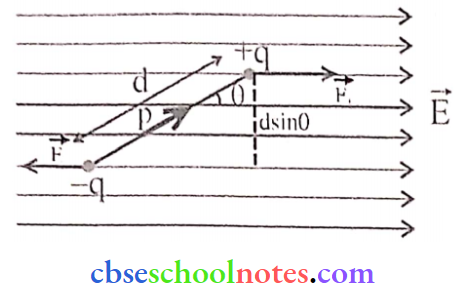
Electric Charges And Fields Uniform Electric Field

We consider a dipole with charges +q and -q which are at a distance d away from each other. Let it be placed in a uniform electric field of strength E such that the axis of the dipole forms an angle 0 with the electric field.

The force on the charges is

F+q = +qE → towards the direction of the electric field

F-q = -qE → opposite to the direction of the electric field

Since the magnitudes of forces are equal and they are separated by a distance d,

The torque on the dipole is given by :

Torque (τ) = Force x perpendicular distance between both forces

τ = F.d sin 0

or τ = qEdsinO

So τ = pE .sin 0 (p = qd)

or \(\vec{\tau}=\vec{p} \times \vec{E}\) [in vector form]

Question 5.

  1. Define electric flux Write its SI Unit.
  2. How does the electric flux due to a point charge enclosed by a spherical Gaussian surface get affected when its radius is increased?

Answer:

1. Electric flux is proportional to the number of electric field lines passing through a given area.

It is numerically equal to the dot product of the electric field and area vector.

Φ = A (Ecosθ)

⇒ \(\phi={\vec{E}} \cdot {\vec{A}}\)

The electric flux through an area is the dot product of the magnitude of \(\vec{E}\) and \(\vec{A}\).

The S.I. unit of ‘electric flux’ is N-m2C-1 or V-m.
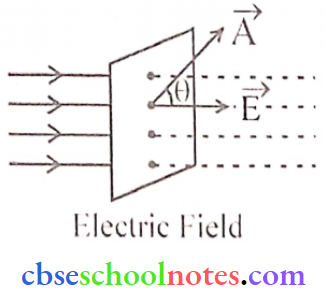
Electric Charges And Fields Electric Flux

2. Wc knows that flux through the Gaussian surface is given by \(\phi=q / \varepsilon_0\)

As flux is independent of radius, it is not affected by changing the radius.

Question 6.

1. A uniformly charged large plane sheet has charge density \(\sigma=\left(\frac{1}{18 \pi}\right) \times 10^{-15} \mathrm{C} / \mathrm{m}^2\). Find the electric field at point A which is 50 cm from the sheet. Consider a straight line with three points P. Q and R, placed 50 cm from the charged sheet on the right side as shown in the figure. At which of these points, does the magnitude of the electric field due to the sheet remain the same as that at point A and why?
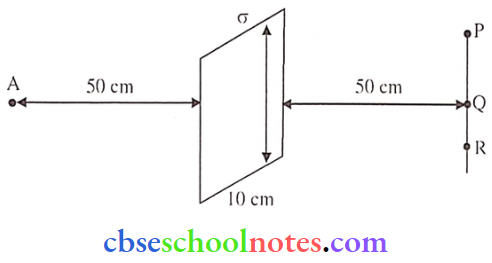
Electric Charges And Fields Magnitude Of The Electric Field Due To The Sheet

2. Two small identical conducting spheres carrying charge 10 μC and- 20μC when separated by a distance r, experience a force F each. If they are brought in contact and then separated to a distance of \(\frac{r}{2}\), what is the new force between them in terms of F?

Answer:

1. \(E=\frac{\sigma}{2 \varepsilon_0}=\frac{1}{18 \pi} \times \frac{10^{-15}}{2 \times 1} \times 4 \pi \mathrm{k}\)  (\(k=\frac{1}{4 \pi \varepsilon_0}\))

= \(\frac{1}{9} \times 10^{-15} \times 9 \times 10^9\)

= 10-6 V/m

Point →Q, Because at 50 cm, the charge sheet acts as a finite sheet, and thus the magnitude
remains the same towards the middle region of the planar sheet.

2. Electric Charges And Fields Two Small Identical Conducting Spheres
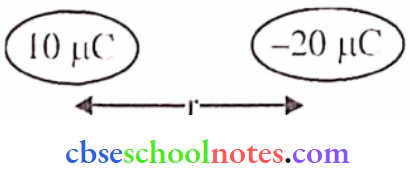
According to Coulomb’s Law

⇒ \(\mathrm{F}=\frac{\mathrm{k}(10 \mu \mathrm{C})(20 \mu \mathrm{C})}{\mathrm{r}^2}\)

⇒ \(\mathrm{F}=\frac{2 \times 9 \times 10^9 \times 100 \times 10^{-12}}{\mathrm{r}^2}\)

⇒ \(F=\frac{1.8}{r^2}\) →(1)

After contact
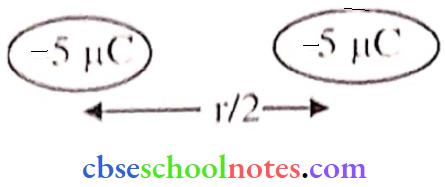
Electric Charges And Fields Two Small Identical Conducting Spheres.

⇒ \(F^{\prime}=\frac{k(-.5 \mu C)(-.5 \mu C)}{\left(\begin{array}{l}
r{\prime} \\
2\end{array}\right)^2}\)

⇒ \(F^{\prime}=\frac{4 \times 9 \times 10^{11} \times 2.5 \times 10^{-12}}{r^2}\)

∴ \(F^{\prime}=\frac{0.9}{r^2}\) →(2)

So, \(F^{\prime}=\frac{F}{2}\)

Question 7. A charge is distributed uniformly over a ring of radius ‘a’. Obtain an expression for the electric intensity \(\vec{E}\) at a point on the axis of the ring. Hence shows that for points at a large distance from the ring, it behaves like a point charge.

Answer:
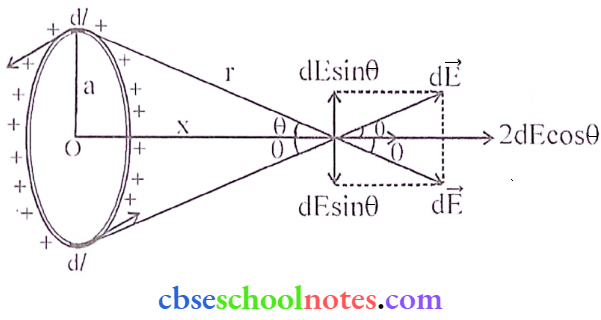
Electric Charges And Fields A Charge Is Distributed Uniformly Over A Ring Of Radius

Suppose that the ring is placed with its plane perpendicular to the x-axis. as shown in the above diagram. We consider a small element dl of the ring. So the charge dq on the element dl is

⇒ \(\mathrm{dq}=\frac{\mathrm{q}}{2 \pi \mathrm{a}} \mathrm{d} l\) [∵ \(\lambda=\frac{\mathrm{q}}{2 \pi \mathrm{a}}\)] = charge per unit length

∴ The magnitude of the field de has two components:

  1. The axial component ⇒ dEcosθ
  2. The perpendicular component ⇒ dEsinθ

Since the perpendicular components of any two diametrically opposite elements are equal and opposite, they all cancel out in pairs. Only the axial components will add up to produce the resultant field at point P, which is given by,

⇒ \(\mathrm{E}=\int_0^{2 \pi \mathrm{a}} \mathrm{d} \mathrm{E} \cos \theta\)

⇒ \(\mathrm{E}=\int_0^{2 \pi \mathrm{a}} \frac{\mathrm{kq}}{2 \pi \mathrm{a}} \frac{\mathrm{d}
l}{\mathrm{r}^2}\left(\frac{\mathrm{x}}{\mathrm{r}}\right)=\frac{\mathrm{kqx}}{2 \pi \mathrm{ar}^3} \int_0^{2 \pi \mathrm{a}} \mathrm{d} l\) [∵ \(\cos \theta=\frac{x}{r}\)]

∴ \(\mathrm{E}=\frac{\mathrm{kqx}}{2 \pi \mathrm{ar}^3}[l]_0^{2 \pi \mathrm{a}}=\frac{\mathrm{kqx}}{2 \pi \mathrm{a}} \frac{1}{\left(\mathrm{x}^2+\mathrm{a}^2\right)^{3 / 2}}(2 \pi \mathrm{a}) \quad\left[\mathrm{as}^2=\mathrm{x}^2+\mathrm{a}^2\right]\)

or \(\mathrm{E}=\frac{\mathrm{kqx}}{\left(\mathrm{x}^2+\mathrm{a}^2\right)^{3 / 2}}=\frac{1}{4 \pi \varepsilon_0} \frac{\mathrm{qx}}{\left(\mathrm{x}^2+\mathrm{a}^2\right)^{3 / 2}}\)

Special case: For points at large distance from the ring x >> a

∴ \(E=\frac{k q}{x^2}=\frac{1}{4 \pi \varepsilon_0} \frac{q}{x^2}\)

Tins are the same as the field due to a point charge, indicating that for far-off axial points, the charged ring behaves as a point charge.

Question 8. Two large, thin metal plates are parallel and close to each other. On their inner faces, the plates have surface charge densities of opposite signs and of magnitude 17.0 x 10⁻²² C/m2. What is electric field intensity:

  1. In the outer region of the first plate.
  2. In the outer region of the second plate, and
  3. Between the plates?

Answer:

Electric Charges And Fields Electric Field Intensity

Where. EP = Electric field due to Plate P

EQ = Electric field due to Plate Q

1. In the outer region of the first plate

⇒ \(E_1=E_P-E_Q=\frac{\sigma_P-\sigma_Q}{2 \varepsilon_0}\)

= \(\frac{17 \times 10^{-22}-17 \times 10^{-22}}{2 \varepsilon_0}\) = E1 = 0 (i.e Electric field is zero)

2. Similarly, the electric field is zero in this case also E11 = EP– EQ = 0

3. Between the plates

⇒ \(\mathrm{E}_{\mathrm{3}}=\mathrm{E}_{\mathrm{P}}+\mathrm{E}_{\mathrm{Q}}=\frac{\sigma_{\mathrm{P}}+\sigma_{\mathrm{Q}}}{2 \varepsilon_0}\)

= \(\frac{17 \times 10^{-22}+17 \times 10^{-22}}{2 \varepsilon_0}\)

∴ \(\mathrm{E}_{3}=\frac{34 \times 10^{-22}}{2 \times 8.854 \times 10^{-12}}=1.92 \times 10^{-10} \mathrm{NC}^{-1}\)

Question 9. Derive an expression for the electric field intensity at a point on the equatorial line of an electric dipole of dipole moment \(\vec{P}\) and length 2a. What is the direction of this field?

Answer:
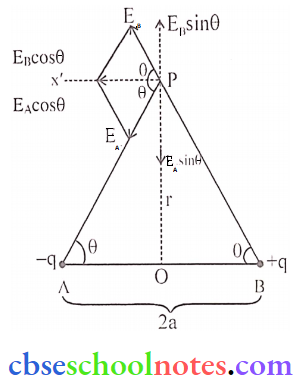
Electric Charges And Fields Equatorial Line Of An Electric Dipole

We consider a dipole consisting of -q and +q separated by a distance 2a. Let P be a point on the equatorial line.

⇒ \({\vec{E}}_{\mathrm{A}}=\frac{\mathrm{l}}{4 \pi \varepsilon_0} \frac{\mathrm{q}}{(\mathrm{AP})^2} \text { along } \vec{PA}\)

⇒ \(E_A=\frac{1}{4 \pi \varepsilon_0} \frac{q}{\left(r^2+a^2\right)}\)

⇒ \({\vec{E}}_{\mathrm{B}}=\frac{1}{4 \pi \varepsilon_0} \frac{\mathrm{q}}{(\mathrm{BP})^2} \text { along } \vec{BP}\)

∴ \(E_B=\frac{1}{4 \pi \varepsilon_0} \frac{q}{\left(r^2+a^2\right)}\)

The resultant intensity is the vector sum of the intensities along PA and BP. EA and EB can be resolved into vertical and horizontal components. The vertical components of EA and EB cancel each other as they are equal and oppositely directed. So the horizontal components add up to the resultant field.

E = EA cos θ + EB cos θ

E = 2EAcosθ , as EA = EB

Substituting, \(\cos \theta=\frac{a}{\left(r^2+a^2\right)^{\frac{1}{2}}}\) in the above equation

⇒ \(E=2 E_A \cos \theta=\frac{2}{4 \pi \varepsilon_0} \frac{q}{\left(r^2+a^2\right)} \frac{a}{\left(r^2+a^2\right)^{\frac{1}{2}}}\)

∴ \(\mathrm{E}=\frac{\mathrm{kp}}{\left(\mathrm{r}^2+\mathrm{a}^2\right)^{\frac{3}{2}}}\)along \(\overrightarrow{\mathrm{BA}}\) (As p+qx2a)

As a special case,

If a2<<r2 then, \(E=\frac{k p}{r^3}\) along \(\overrightarrow{\mathrm{BA}}\)

Electric field intensity at an axial point is twice the electric field intensity on the equatorial line.

The direction of the field will be against the direction of the dipole moment.

Question 10. Four point charges Q, q, Q, and q are placed at the corners of a square of side ‘a’ as shown in the figure.
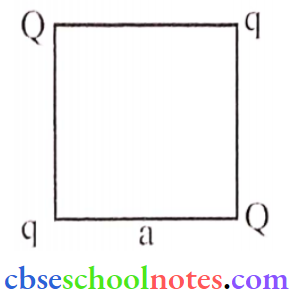
Electric Charges And Fields Four Point Charges

Find the resultant electric force on a charge Q

Answer:

Let us find the force on the charge Q at the point C. Force due to the other charge Q

∴ \(\mathrm{F}_1=\frac{1}{4 \pi \varepsilon_0} \frac{\mathrm{Q}^2}{(\mathrm{a} \sqrt{2})^2}=\frac{1}{4 \pi \varepsilon_0}\left(\frac{\mathrm{Q}^2}{2 \mathrm{a}^2}\right)\) (along AC)
Electric Charges And Fields Resultant Of These Two Equal Forces

Force due to the charge q placed at B

⇒ \(\mathrm{F}_2=\frac{1}{4 \pi \varepsilon_0} \frac{\mathrm{qQ}}{\mathrm{a}^2} \text { along } \mathrm{BC}\)

Force due to the charge q placed at D

⇒ \(F_3=\frac{1}{4 \pi \varepsilon_0} \frac{\mathrm{qQ}}{\mathrm{a}^2} \text { along } \mathrm{DC}\) along DC

Resultant of these two equal forces F2 and F3

⇒ \(\mathrm{F}_{23}=\frac{1}{4 \pi \varepsilon_0} \frac{\mathrm{qQ}(\sqrt{2})}{\mathrm{a}^2} \text { (along } \mathrm{AC} \text { ) }\)

∴ The net force on charge Q (at point C)

⇒ \(F=F_1+F_{23}=\frac{1}{4 \pi \varepsilon_0} \frac{Q}{\mathrm{a}^2}\left[\frac{Q}{2}+\sqrt{2} \mathrm{q}\right]\)

This force is directed along the AC

(For the charge Q, at the point A, the force will have the same magnitude but will be directed along CA)

Physics Class 12 Chapter 1 Important Long Questions And Answers

Question 1. When an electric dipole is placed in a uniform electric field, its two charges experience equal and opposite forces, which cancel each other and hence net force on the electric dipole in a uniform electric field is zero. However, these forces are not collinear, so they give rise to some torque on the dipole. Since the net force on an electric dipole in a uniform electric field is zero. So no work is done in moving the electric dipole in a uniform electric field. However, some work is done in rotating the dipole against the torque acting on it.

  1. The dipole moment of a dipole in a uniform external field \(\vec{E}\) is \(\vec{p}\). Write the expression of torque acting on the dipole.
  2. An electric dipole consists of two opposite charges, each of magnitude 1.0 μC separated by a distance of 2.0 cm. The dipole is placed in an external field of 105 NC-1. Find the value of max Torque.
  3. Write the value of angle θ, when τ is minimum.
  4. When an electric dipole is held at an angle θ (θ ≠ 0° or 180°) in a uniform electric field Write the value of net force \(\vec{F}\) and torque \(\vec{\tau}\)?

Answer:

1. \(\vec{\tau}=\vec{p} \times \vec{E}\)

2. \(\tau=P E \sin 90^{\circ}=p E=1 \times 10^{-6} \times 2 \times 10^{-2} \times 10^5=10^{-3} \mathrm{~N} . \mathrm{m}\)

3. 0° or 180° or nπ

4. F = 0, τ ≠ 0

Question 2. Concept of Electric field

An electric field is an elegant way of characterizing the electrical environment of a system of charges. An electric field at a point in the space around a system of charges tells you the force a unit-positive test charge would experience if placed at that point (without disturbing the system). The electric field is a characteristic of the system of charges and is independent of the last charge that you place at a point to determine the field

  1. Write one property of electric field lines
  2. Define electric field intensity.
  3. The SI unit of the electric field is_______
  4. A proton of mass ‘m’ placed in the electric field region remains stationary in the air. What is the magnitude of the electric field?

Answer:

  1. The electric field line starts from +ve charge and ends at -ve charge.
  2. It is defined as the electric force experienced per unit positive test charge is known as electric field intensity.
  3. N/C and V/m
  4. mg = eE
    E = mg/c

Question 3.

  1. Use Gauss’ law to derive the expression for the electric field \((\vec{E})\) due to a straight uniformly charged infinite line of charge density λ C/m.
  2. Draw a graph to show the variation of E with perpendicular distance r from the line of
    charge.
  3. Find the work done in bringing a charge q at a perpendicular distance from co-long charged
    wire r1, to r2, (r2 > r1).

Answer:

1. To calculate the electric field, imagine a cylindrical Gaussian surface, since the field is everywhere radial, flux through two ends of the cylindrical Gaussian surface is zero. At the cylindrical part of the surface electric field E is normal to the surface at every point and its magnitude is constant. Therefore flux through the Gaussian surface.

= Flux through the curved cylindrical part of the surface.

= E x 2πl → (1)
Electric Charges And Fields Gauss Law

Applying Gauss’s Law

⇒ \(\text { Flux } \phi=\frac{q_{\text {enclosed }}}{\varepsilon_0}\)

Total charge enclosed

= Linear charge density x l = xl

∴ \(\phi=\frac{\lambda l}{\varepsilon_0}\) → (2)

Using Equations (1) and (2)

∴ \(\mathrm{E} \times 2 \pi \mathrm{r} l=\frac{\lambda l}{\varepsilon_0} \Rightarrow \overrightarrow{\mathrm{E}}=\frac{\lambda}{2 \pi \varepsilon_0 \mathrm{r}} \hat{\mathrm{n}}\)

(where \(\hat{n}\) is a unit vector normal to the line charge)

2. The required graph is as shown :
Electric Charges And Fields Variation Of E With Perpendicular Distance From The Line Of Charge

3. Work done in moving a charge q with displacement ‘dr’

⇒ \(\mathrm{dW}=\overrightarrow{\mathrm{F}} \cdot \mathrm{d} \overrightarrow{\mathrm{r}}\)

⇒ \(\mathrm{dW}=\mathrm{q} \overrightarrow{\mathrm{E}} \cdot \mathrm{d} \overrightarrow{\mathrm{r}}=\mathrm{q} \mathrm{Edr} \cos θ\)

⇒ \(\mathrm{dW}=\mathrm{q} \times \frac{\lambda}{2 \pi \varepsilon_0 \mathrm{r}} \mathrm{dr} \)

Work done in moving the given charge from r1 to r2 (r2 > r1)

⇒ \(\int_{r_1}^{r_2} d W=\int_{r_1}^{r_2} \frac{\lambda q d r}{2 \pi \varepsilon_0 r}\)

⇒ \(\mathrm{W}=\frac{\lambda \mathrm{q}}{2 \pi \varepsilon_0}\left[\log _{\mathrm{e}} \mathrm{r}_2-\log _{\mathrm{e}} \mathrm{r}_1\right]\)

∴ \(\mathrm{W}=\frac{\lambda \mathrm{q}}{2 \pi \varepsilon_0}\left[\log _{\mathrm{e}} \frac{\mathrm{r}_2}{\mathrm{r}_1}\right]\)

Question 4. Define electric flux. Is it a scalar or a vector quantity?

1. A point charge q is at a distance of d/2 directly above the center of a square of side d, as shown in the figure. Use Gauss’ law to obtain the expression for the electric flux through the square.
Electric Charges And Fields Scalar Or A Vector Quantity

2. If the point charge is now moved to a distance ‘d’ from the center of the square and the side of the square is doubled, explain how the electric flux will be affected.

Answer:

1. Electric flux through a given surface is defined as the dot product of the electric field and area vector over that surface.

Alternatively \(\phi=\int \vec{E} \cdot d \vec{S}\)

Also, accept

Electric flux, through a surface, equals the surface integral of the electric field over a closed surface. It is a scalar quantity.
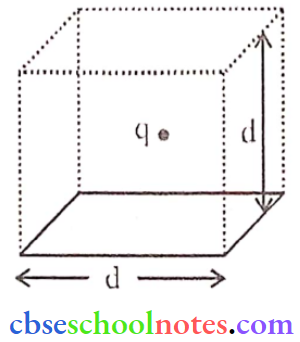
Electric Charges And Fields Scalar Quantity

Constructing a cube of side ‘d’ so that charge ‘q’ is placed within this cube (Gaussian surface)

According to Gauss’ law the Electric flux \(\phi=\frac{\text { charge enclosed }}{\varepsilon_0}=\frac{\mathrm{q}}{\varepsilon_0}\)

This is the total flux. through all the six faces of the cube.

Hence electric flux through the square \(\frac{1}{6} \times \frac{q}{\varepsilon_0}=\frac{q}{6 \varepsilon_0}\)

2. If the charge is moved to distance d and the side of the square is doubled even then the total charge enclosed in it will remain the same. Hence the total flux will remain the same as before.

Question 5.

  1. Derive an expression for the electric field E due to a dipole of length ‘2a’ at a point distant r from the center of the dipole on the axial line.
  2. Draw a graph of E versus r for r >> a.
  3. If this dipole were kept in a uniform external electric field E0, with the help of a diagram represent the position of the dipole in stable and unstable equilibrium and write the
    expressions for the torque acting on the dipole in both cases.

Answer:

1. Let’s consider a dipole system,
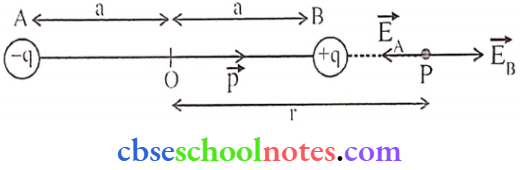
Electric Charges And Fields Dipole system

Here, AO = OB = a

OP = r

BP = r-a

AP = r + a

Elec, field (\(\overrightarrow{\mathrm{E}}_{\mathrm{B}}\)), due to the charge at point ‘B’ being towards ‘P’

Elec, field (\(\overrightarrow{\mathrm{E}}_{\mathrm{A}}\)), due to the charge at point ‘A’ being opposite to ‘P’

Now, according to the superposition principle,

⇒ \(\overrightarrow{\mathrm{E}}_{\mathrm{p}}=\overrightarrow{\mathrm{E}}_{\mathrm{ix} \mathrm{axial}}=\overrightarrow{\mathrm{E}}_{\Lambda}+\overrightarrow{\mathrm{E}}_{\mathrm{B}}\)

EP = EB-EA

⇒ \(E_p=\frac{-k q}{(r+a)^2}+\frac{k q}{(r-a)^2}=k q\left[\frac{1}{(r-a)^2}-\frac{1}{(r+a)^2}\right]=k q\left[\frac{(r+a+r-a)(r+a-r+a)}{(r-a)^2(r+a)^2}\right]\)

=\(\frac{k q(2 r)(2 a)}{\left(r^2-a^2\right)^2}\)

⇒ \(E_{a x i a l}=\frac{2 r k(2 a)(q)}{\left(r^2-a^2\right)^2}\) [∵ \(|\overrightarrow{\mathrm{p}}|=2 \mathrm{a} \times \mathrm{q}\)] = \(\frac{2 \mathrm{kpr}}{r^{4}}\)

if a2 << r2 then \(\dot{\vec{E}}_{\mathrm{axial}}=\frac{2 \mathrm{k} {\vec{p}}}{\mathrm{r}^3}\)

It will be directed in the direction of electric dipole moment, \(\vec{P}\).

2. Electric Charges And Fields Graphy Of E Versus
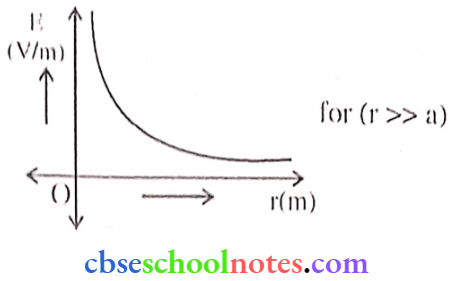
3. (1). Stable equilibrium

Electric Charges And Fields Stable Equilibrium

Torque (τ) = pEsinθ

= pE x sinθ° = 0 (vsinθ° = 0)

(2). Unstable equilibrium
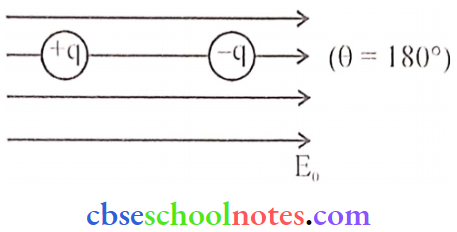
Electric Charges And Fields Unstable Equilibrium

Torque (τ) = pE sinθ

= pE sin 180°

= pE x 0 = 0 (∵ sin 180° = 0)

Question 6.

  1. Use Gauss’ theorem to find the electric field due to a uniformly charged infinitely large plane thin sheet with surface charge density σ.
  2. An infinitely large thin plane sheet has a uniform surface charge density +σ. Obtain the expression for the amount of work done in bringing a point charge q from infinity to a point distant r, in front of the charged plane sheet.

Answer:

1. Electric Charges And Fields Cylindrical Gaussian Surface
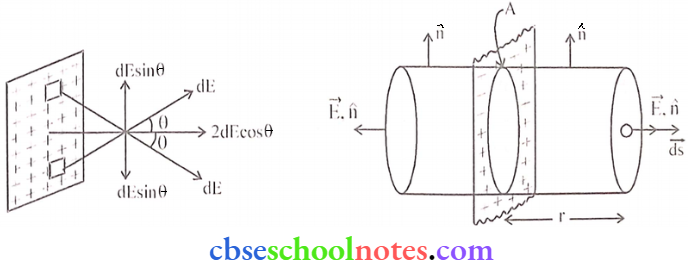
As shown in the figure, considering a cylindrical Gaussian surface of cross-section A

Flux through the curved surface :

∴ \(\phi=\int \overrightarrow{\vec{E}} \cdot \mathrm{d} {\vec{S}}=\int \mathrm{Eds} \cos 90^{\circ}=0\)

At the points on the curved surface, the field vector E and area vector dS make an angle of 90° with each other. Therefore, curved surfaces do not contribute to the flux.

Flux through end caps :

∴ \(\phi=\oint \vec{E} \cdot \mathrm{dS}=\oint \mathrm{EdS} \cos 0^{\circ}=\mathrm{EA}\)

Hence, the total flux through the closed surface is :

Φ = Flux through both end caps + flux through curved surface

or Φ = EA + EA + 0 = 2EA → (1)

Now according to Gauss’ law for electrostatics

⇒ \(\phi=q / \varepsilon_0\) → (2)

Comparing equations (1) and (2), we get

2EA = q/ε0

E = q/2ε0A → (3)

The area of the sheet enclosed in the Gaussian cylinder is also A. Therefore, the charge contained in the cylinder, q = σA as a (surface charge density) = q/A.

Substituting this value of q in equation (3), we get

E = σA/2ε0A

or E = σ/2ε0

This is the relation for the electric field due to an infinite plane sheet of charge. The field is uniform and does not depend on the distance from the plane sheet of charge.

2. \(V=\frac{W}{c}=\int_{\infty}^r \vec{E} \cdot d \vec{r}\)

⇒ \(\mathrm{W}=\mathrm{c} \int_{\infty}^{\mathrm{r}}(-\mathrm{Edr})\)

⇒ \(W=-q \int_{\infty}^r \frac{\sigma}{2 c_0} d r\)

∴ \(W=\frac{q \sigma}{2 \varepsilon_0}(\infty-r)\) W = ∞

Gland Of Eyelid Notes

Eye Eyelid Lacrimal Gland Eye

The eye is the organ of vision. It is spherical and has the following three coats:

  • Fibrous coat – Sclera and cornea
  • Vascular coat – Choroid, ciliary body and iris
  • Nervous coat – Retina

The transparent structures in the path of light are the cornea, aqueous humour (of the anterior chamber), the lens and the vitreous body (a gel-like substance in the posterior chamber).

Eye Eyelid Lacrimal Gland Sagittal Section Of Eye Showing Its Gross Structure

  1. The sagittal section of the eye shows Its gross structure.
  2. Schematic diagram showing sclerocorneal Junction, ciliary body and process, Iris and lens.

Fibrous Coat

Sclera

The sclera is a tough, fibrous connective tissue layer. It consists of irregularly arranged dense connective tissue, i.e., flat bundles of type 1 collagen fibres, a network of elastic fibres and fibroblasts. Its thickness ranges from 0.6 mm to 1 mm.

Cornea

The cornea is located at the front of the eye and is continuous with the sclera at the limbus. It is a transparent portion of the eye, hence, avascular.

It is about 1 mm thick and consists of five layers. From superficial to deep these are:

Eye Eyelid Lacrimal Gland Structure Of Cornea

  1. Section of the human cornea showing various layers.
  2. Section of the cornea at low magnification.
  3. Photomicrograph at high magnification.

Corneal epithelium: It consists of stratified squamous, non-keratinized epithelium. Sensory nerves supply it. The cornea is very sensitive and any irritation or injury causes severe pain, excessive lacrimation, photophobia and blinking of eyelids.

Bowman’s membrane: It is about 10-12 mm thick, structureless, homogeneous lamina consisting of randomly oriented thin fibrils of collagen.

  • This layer is also known as an anterior limiting membrane. It acts as a barrier to the spread of infection. It is believed that Bowman’s membrane is synthesized by both the corneal epithelium and underlying stroma.
  • If damaged, it cannot regenerate. It heals by the formation opaque scar, which interferes with vision.

Corneal stroma: It constitutes the bulk of the cornea (90% of thickness). It is made up of thin lamellae of mostly type I collagen fibres, which are arranged in many layers.

  • The bundles of collagen fibres, within a lamella, are highly ordered. In the adjacent lamellae, the bundle of collagen fibrils are arranged at a right angle to each other.
  • The cornea is transparent because of the orderly arrangement of collagen fibrils. The flattened fibroblasts are located between the lamellae.
  • The canal of Schlemm is present at the sclerocomeal junction (limbus). It is the site of the outflow of the aqueous humour from the anterior chamber of the eye into the venous system.

Descentet’s membrane: This layer is also known as a posterior limiting membrane. It is an acellular, homogeneous basement membrane consisting of interwoven meshwork of collagen fibrils. It is a product of endothelium.

Endothelium: It is a single layer of squamous or low cuboidal cells on the posterior surface of the cornea, resting on Descemet’s membrane.

  • All the metabolic exchange between the cornea and aqueous humour takes place through the endothelium. It is responsible for the synthesis of proteins, which are necessary for maintaining Descemet’s membrane.
  • It also reabsorbs excessive fluid from the stroma to keep it relatively dehydrated, which helps in the refractive quality of the cornea.

Fibrous Coat Remember

The cornea is a transparent avascular membrane. It consists of two noncellular layers (Bowman’s membrane and Descemet’s membrane) and three cellular layers (corneal epithelium, corneal stroma and endothelium).

If Bowman’s membrane is damaged, it cannot regenerate. It heals by the formation of an opaque scar, which interferes with vision. Descemet’s membrane is an unusually thick basement membrane for a very thin endothelial lining.

Fibrous Coat Clinical Applications

Corneal Transplants

  • If a person has a defective cornea (presence of opacity), it interferes with normal vision. This cornea may be removed and a normal cornea obtained from a dead person (through eye donation) can be transplanted.
  • Corneal transplants are the most common and successful organ transplants. This is because the cornea is an avascular tissue.
  • Hence, antibodies that may cause rejection of transplanted cornea do not enter the transplanted tissue.

Glaucoma

The failure of drainage of aqueous humour from the anterior chamber of the eye leads to a prolonged increase in the intraocular pressure. The condition is known as glaucoma. It is an important cause of blindness.

Vascular Coat

The vascular coat consists of a choroid, ciliary body and iris.

Choroid

The choroid is the posterior portion of the middle coat of the eyeball. It is the thin, highly vascular layer that lies between the sclera and retina. It consists of four layers:

  • Suprachoroid layer: This layer consists of fine collagenous fibres, elastic fibres and pigment cells (chromatophores).
  • Vascular layer: This layer consists of large blood vessels between loose connective tissue and pigment cells.
  • Chorio-capillary layer: This layer consists of a capillary network, which is essential for the nutrition of the retina.
  • Bruch’s membrane: This membrane separates the choroid from the retina. It is a thin (1-4 mm) refractile membrane. It also acts as the basal lamina for the pigment cell layer of the retina.

Vascular Coat Remember

The choroid is a pigmented vascular layer, which lies between the sclera and the retina. It is separated from the retina by Bruch’s membrane.

Eye Eyelid Lacrimal Gland Diagrammatic Representation Of Sclera, Choroid And Pigmented Epithelial Layer Of Retina

Ciliary Body

The ciliary body is made up of ciliary muscle (smooth muscle) and ciliary process. The smooth muscle of the ciliary body is oriented in longitudinal, radial and circular directions.

  • The ciliary muscle alters the shape of the lens for near and far vision. From the ciliary body, there come out 60-70 short ciliary processes with suspensory ligaments of the lens.
  • The ciliary processes are covered by bi-laminar epithelium and have a core of loose connective tissue and blood vessels.
  • The outer cell layer is the non-pigmented columnar epithelium, whereas the inner cell layer is composed of a pigmented simple columnar epithelium. The ciliary epithelium produces aqueous humour.

Ciliary Body Remember

The ciliary body is the anterior part of the vascular coat. It is located between the iris and the choroid. The ciliary body is made up of ciliary muscle (smooth muscle) and ciliary process.

The smooth muscle of the ciliary body is oriented in longitudinal, radial and circular directions.

Iris

The iris arises from the ciliary body and lies between the cornea and the lens. It consists of smooth muscle fibres in the connective tissue stroma (fine collagen fibres), melanocytes and blood vessels.

  • It has no epithelium on its anterior surface, but the posterior surface of the iris is lined by ciliary epithelium. This layer is heavily pigmented and the colour of the eye depends on its pigmentation.
  • The smooth muscle of the iris is arranged in two layers, i.e., dilator pupillae and sphincter pupillae. The dilator pupillae fibres are radially oriented.
  • While sphincter pupillae are oriented circumferentially near the pupil. Iris acts as a diaphragm, which controls the amount of light entering the eye.

Iris Remember

The iris is the anterior extension of the vascular coat. It acts as a diaphragm, which controls the amount of light entering the eye.

Nervous Coat

Retina

This is the inner coat of the eyeball and lines its posterior surface. The retina contains photoreceptors (rods and cones), which are essential for vision. The retina has a specialized area where vision is most acute, the fovea centralis or macula.

  • This area contains only cones, which are essentially bare (the overlying layers are pushed to the side). The retina also has a ‘blind spot,’ the optic disc.
  • Where the optic nerve leaves the eye and there are no photoreceptor cells. The retina has several layers from the outside in the following.


Eye Eyelid Lacrimal Gland Structure Of Retina

  1. The microscopic structure of the retina.
  2. Diagrammatic representation of principal cell types of the retina and their connections.
  3. Photomicrograph of the retina at high magnification.

Pigment Epithelium

It is the outermost layer of the retina, which is separated from the choroid by Bruch’s membrane. This epithelium consists of low cuboidal cells, which contain melanin granules.

  • Epithelial cells have long apical processes that occupy spaces between the outer segment of rods and cones.
  • The melanin pigment of epithelium absorbs light, thus preventing its reflection from the outer coats of the eye. The pigment epithelium also phagocytizes the tip of rod and cone cell processes.

Layer of Rod and Cone Cell Processes

This layer consists of outer segments of rod and cone cells. The processes of rod cells are cylindrical and cones are thicker, cone-shaped. This layer is a photoreceptor in function.

  • Rods and cones are photoreceptor cells. They transfer the light energy into receptor potential. Both types of cells are long slender cells but the outer segments of rods are cylindrical or rodshaped
  • Whereas those of cones are tapered or cone-shaped. The rod cells are much more in number [120 million] compared to cone cells [6 to 7 million]. The parts of rod and cone cells are shown.
  • The rod consists of the outer segment, inner segment, inner fibre and spherule. The parts of the cone cell are almost the same except the terminal part is called the pedicle, instead of the spherule.

Outer Nuclear Layer

This layer consists of nuclei belonging to rods and cones. The nuclei of these cells are arranged in several layers. This layer is darkly stained.

  • Between the second and third layers, there is the presence of a pink linear marking called an outer limiting membrane or lamina.
  • This results because of zonula adherens of the glial cells (Muller cells) with the cell bodies of photoreceptor cells.
  • The Muller cells are supporting cells of the retina. They have long slender bodies that are radially oriented in the retina.

Outer Plexiform Layer

This layer stains lightly. The layer contains synapses between rods and cones with the dendritic processes of bipolar cells and horizontal cells.

Inner Nuclear Layer

It consists of cell bodies and nuclei of bipolar cells, horizontal cells, amacrine cells and Muller’s cells. The bipolar cells are oriented perpendicular to the layers of the retina.

  • They have synaptic contact with rod or cone cells at the outer (dendritic) end and with ganglion cells at the inner (axonal) end. The horizontal cells are oriented parallel to the layers of the retina.
  • Their processes form synaptic contact with rod and cone cells in the outer plexiform layer.
  • The amacrine cells are situated in the inner portion of this layer and have synaptic contact with axonal processes of bipolar cells and dendrites of ganglion cells in the inner plexiform layer.

Inner Plexiform Layer

In this layer, the axons of bipolar cells synapse with dendrites of ganglion cells and amacrine cells.

Ganglion Cell Layer

Mainly consists of the body and nuclei of large multipolar neurons (ganglion cells). They receive input from bipolar cells and their axons form optic nerve.

Nerve Fibre Layer

It consists of central processes (axons) of ganglion cells, which gather at the optic papilla (disc) and leave the eye as the optic nerve. As soon as these fibres leave the eyeball, they become myelinated.

The blood vessels of the retina are present only in the nerve fibre layer. However, sometimes they may reach as deep as the outer nuclear layer.

Nerve Fibre Layer Remember

The retina consists of ten layers of cells and their processes. Road and cone cells of the retina are specialized photoreceptors. Roads are specialized to perceive dim light, while cone cells perceive bright light and colour.

Nerve Fibre Layer Clinical Application

Detachment of Retina

As the apical ends of rods and cone cells are not firmly attached to the pigment epithelium, the retina may get separated from the pigment epithelium. This condition is called detachment of the retina.

  • This is a common but serious condition. It may be treated by laser surgery. If it remains untreated, rods and cones are damaged, leading to blindness.
  • This is because rod and cone cells get their nutrition from a chorio-capillary layer of choroid.

Lens

The lens is a transparent, flexible, biconvex disc. The lens is involved in near and distant vision, which is achieved by changing its curvature. The lens consists of a lens capsule, anterior epithelium and lens substance.

Lens Capsule

The lens is covered by a lens capsule, which is a homogeneous basal lamina coat. The capsule is made up of type 4 collagen and proteoglycans.

Anterior Epithelium

Beneath the capsule, simple cuboidal epithelium covers the anterior surface of the lens.

Lens Substance

The anterior epithelial cells toward the equator become columnar. The columnar cells of the equatorial region further elongate to form long fibres.

  • These long fibres are about 7-10 mm in length, 8-12 pm wide and 2 pm thick. In the cross-section, their shape is like a hexagon.
  • Although these fibres are called lens fibres, they are in a true sense modified elongated epithelial cells. The younger fibres are nucleated, whereas old fibres lose their nuclei.

Lens Substance Clinical Application

  • Cataract
    • The entire lens substance consists of transparent lens fibres. However, with increasing age or metabolic disorders (diabetes), the lens may become opaque.
    • This interferes with clear vision. This condition is called a cataract. In this condition, the lens is removed from its capsule and replaced with a plastic lens.
  • Presbyopia
    • The lens is highly elastic. However, the elasticity of the lens is gradually lost due to increasing age. This leads to difficulty in accommodation for near objects (reading, etc).
    • This is usually observed after 40-45 years of age. The condition (presbyopia) is corrected by wearing glasses with a convex lens.

Eyelid

The eyelids protect the eye. From external to internal surface eyelid consists of many layers, i.e., skin, loose connective tissue, orbicularis oculi muscle, tarsal plate and palpebral conjunctiva.

  • The skin of the eyelid is thin, loose and elastic.
  • The loose connective tissue is present deep in the skin, which is devoid of fat.
  • The third layer of the eyelid is formed by bundles of skeletal muscle (orbicularis oculi). The tarsal plate is made up of dense connective tissue and forms the skeleton of the eyelid.
  • The inner surface of the lid is lined by palpebral conjunctiva. The palpebral conjunctiva consists of stratified columnar epithelium with goblet cells.

There are three types of glands present in eyelids.

  • Tarsal glands (Meibomian glands) are long sebaceous glands, which are present in the tarsal plate.
  • They produce sebaceous secretion, which forms an oily layer on the surface of the ear, thus preventing an early evaporation of tears.
  • Glands of Zeis (sebaceous gland of the eyelid) are small modified sebaceous glands, which are connected with the follicles of eyelashes.
  • Glands of Moll are small sweat glands that pour their secretion into eyelashes. They are simple spiral tubular glands.

Eye Eyelid Lacrimal Gland Histological Structure Of Eyelid

  1. Histological structure of eyelid.
  2. Section of eyelid.

Eyelid Remember

The main function of eyelid is to protect the eye. On its outer surface, it is covered by skin and its inner surface is covered by palpebral conjunctiva. Three types of glands are present in the eyelid.

Lacrimal Gland

The lacrimal gland is a compound tubuloacinar serous gland. It consists of many separate lobes, which pour their secretion (tears) in the superior conjunctival fornix through small ducts.

  • The lacrimal gland acini has the features of a serous salivary gland. These acini are lined by light-staining low columnar cells.
  • The acini are large and have a wider lumen compared to the serous salivary gland.

Myoepithelial cells are located within the lamina of acini and help in the release of tears.

Eye Eyelid Lacrimal Gland Microscopic Structure Of Lacrimal Gland

  1. Section of lacrimal gland.
  2. Lacrimal gland as seen under low magnification.
  3. Magnified view of lacrimal gland

Central and Peripheral Nervous Systems Notes

The Central Nervous System

The central nervous system consists of the brain and spinal cord. The cut surface of any part of the central nervous system consists of grey matter and white matter.

  • The cerebrum and cerebellum have a cortical layer of grey matter on the surface deep to which is white matter. However, in the spinal cord, grey matter is inside, surrounded by white matter.
  • Out of the various parts of the brain, we should study only the cerebral cortex and cerebellar cortex which are of histological significance.

Some Important Definitions

  • Grey matter: It is a collection of neurons, neuroglial cells, the processes of these cells lying adjacent to the cell body, and blood vessels inside the central nervous system (brain and spinal cord).
  • White matter: It consists of bundles of nerve fibers; such as sociated neuroglial cells and blood vessels. The Myelin sheath that surrounds the nerve fibers gives it a white appearance.
  • Nuclei: These are islands of grey matter situated deep inside the cerebrum, cerebellum brain stem, and spinal cord For Example., the thalamus, basal nuclei, etc.
  • Ganglion: These are collections of nerve cells (grey matter) outside the brain and spinal cord For Example., dorsal root ganglia and sympathetic trunk ganglia.

Cerebral Cortex

Most of the cerebral cortex (except the cortex of hippocampal formation and piriform lobe) is described as having six layers. However, the distinction between these layers is not well-marked.

  • These layers are distinguished based on the predominance of cell type and arrangement of fibers.
  • The arrangement of fibers can be visualized only by special stains and not by H and E. From superficial to deep, the following are the layers of the cerebral cortex.

Nervous System Structure Of Cerebral Cortex

  1. In a section of the cerebral cortex, it is difficult to distinguish various layers.
  2. Schematic diagram to show neurons in various layers of the cerebral cortex.
  3. Section of the cerebral cortex. Six layers of the cerebral cortex are ill-defined as they merge.

Molecularor Plexiform Layer

This layer is situated just beneath the pia mater. It consists predominantly of fibers and neuroglial cells. A few horizontal cells of Cajal are also present.

  • The peripheral portion consists largely of fibers, which travel parallel to the surface. In its deeper part lie the horizontal cells of Cajal.
  • Their cell body and processes are disposed of horizontally. This layer shows the blood capillaries and many nuclei of neuroglial cells.

External Granular Layer

This layer consists of two types of neurons, i.e., small pyramidal and granular or stellate cells. Their apical dendrites extend in the first layer and the axon ends in the deeper layer.

External Granular Layer Further Details

Pyramidal Neurons

These are triangular and their size ranges from 10 to 120 μm. Their apical dendritic end faces the surface of the cerebral cortex.

  • Dendrites take origin from all three angles and synapse with the fibers in other layers. The axon is given off from the base of the cell and extends to deeper layers.
  • The large pyramidal cells (Betz cells) are seen in the motor cortex and their axons form pyramidal (corticospinal) fibers.
  • The stellate or granular cells are star-shaped small neurons (8 μm). Their processes extend only into neighboring areas.

External Pyramidal Layer

The layer consists of medium pyramidal cells. This layer also consists of a few stellate cells and cells of Martinotti. The axons ofpyramidal cells form association and commissural fibres.

The Martinotti cells are small, triangular, or polygonal cells seen almost in all the layers of the cortex. Their axons travel toward the surface of the cortex.

Internal Granular Layer

This layer consists of densely packed granular cells with a white horizontal fiber layer called the external band of Baillarger. This layer provides connections between neurons of different layers.

Internal Pyramidalor Ganglionic Layer

This layer consists of large pyramidal cells (cells of Betz) and a few cells of Martinotti. The horizontal fibers in the deeper part are called the internal band of Baillarger.

Fusiform Layeror Layer of Polymorphic Cells

This layer predominantly contains spindle-shaped fusiform cells and a few stellate and Martinotti cells. The fusiform cells are located in the deeper layer of the cerebral cortex.

These cells lie perpendicular to the surface with axons coming out from the center of the cell and dendrites from both ends. Deep in the sixth layer of the cerebral cortex lies white matter.

Fusiform Layeror Layer of Polymorphic Cells Remember

The cerebral cortex is composed of 14-16 billion nerve cells approximately. The cortex consists of 6 layers of cells. The two principal neurons are pyramidal cells and granular (stellate) cells. Large-sized pyramidal cells may measure up to 120 μm.

Fusiform Layeror Layer of Polymorphic Cells Clinical Application

Alzheimer’s Disease

The disease is of unknown cause and occurs in old people. To begin with, they suffer from loss of memory, but later all their intellectual capabilities are also lost (dementia).

In this disease, the neurons of the cerebral cortex accumulate late tangled masses of filaments in the cytoplasm and later degenerate. The motor system remains unaffected.

Fusiform Layeror Layer of Polymorphic Cells Further Details

Histologically, one can differentiate motor and sensory cortex. The motor cortex consists predominantly of pyramidal cells in layers 3 and 5. These pyramidal cells are densely packed and large.

On the other hand, the sensory cortex shows very few pyramidal cells in layers 3 and 5 and most of the layers contain small granular cells.

Cerebellar Cortex

The histological structure of the cerebellar cortex is uniform throughout the cerebellum. It consists of three layers, i.e., molecular layer, Purkinje cell layer, and granular layer. The molecular layer is situated just beneath the pia mater.

Nervous System Structure Of Cerebellum

Nervous System Photomicrograph Of Cerebellar Cortex At Low Magnification Cortex Is Folded And Present Fissures And Folla

  1. The structure of two adjacent cerebellar folia shows outer grey and inner white matter.
  2. The grey matter of the cerebellar cortex consists of three layers, i.e., molecular, Purkinje, and granular layer.
  3. Photomicrograph of cerebellar cortex at low magnification, cerebellar cortex is folded and presents fissures and folia.
  4. Photomicrograph of cerebellar cortex showing three layers, i.e., molecular layer, Purkinje cell layer, and granular cell layer.

Molecular Layer

It stains lightly with eosin and is featureless as it consists of a few cells and more myelinated and unmyelinated fibers.

  • This layer consists of a few scattered stellate cells in the superficial part and a few basket cells in the deeper part.
  • However, the dendritic processes of Purkinje cells and the axonal processes of granular cells (that run parallel to the surface of the cortex) occupy most of the molecular layer.
  • The axons of granular cells come in synaptic contact with the dendrites of several Purkinje cells and basket cells. The molecular layer also contains the terminal part of climbing fibers.

Purkinje Cell Layer

These cells are arranged in a single row between molecular and granular layers. Purkinje cell (Golgi type F) is the large pyriform or flask-shaped neuron, that sends numerous dendrites into the molecular layer.

These dendrites synapse with axons of granular cells and climbing fibers. Purkinje cells give a single thin axon, which passes through a granular layer to end in deeper nuclei of the cerebellum.

Granular Layer

The granular layer stains deeply with the hematoxylin because it is densely packed with granular cells. Granular cells are small neurons with round nuclei surrounded by a thin rim of cytoplasm.

  • These cells receive impulses from various parts of the CNS through Mossy fibers. The Mossy fibers in the granular layer end as the dilated terminal.
  • On which the dendrites of granule cells and axons of Golgi cells (type 2) synapse to form light-stained areas called glomeruli.
  • Granular cells send their axons into the molecular layer where they branch in the form of T and come in synaptic contact with dendrites of various Purkinje cells and basket cells.
  • At the junction of molecular and granular layers, Golgi type 2 cells are found. Their vesicular nuclei are larger than granule cells. They contain chromophil substances present in the molecular layer.
  • However, their axons form synaptic contact with glomeruli in the granular layer. Deep to the granular layer the cerebellar cortex lies in contact with white matter.

Granular Layer Remember

The cerebellar cortex consists of three layers, i.e., the molecular layer, the Purkinje cell layer, and the granular layer. The histological structure of the cerebellar cortex is uniform throughout the cerebellum.

Purkinje cells are large pyriform or flask-shaped neurons arranged in a single row between the molecular and granular layers.

Granular Layer Further Details

Neuronal Circuit of Cerebellum

  • The input to the cerebellum is from different parts of CNS and is in the form of Mossy and climbing fibers
  • The climbing fibers ascend to the molecular layer where they form synaptic contact with the dendritic arborization of Purkinje cells.
  • The Mossy fibers end in glomeruli and form synaptic contact with granular cells in the granular layer.
  • The granular cells convey the impulse received by Mossy fibers to the dendrites of Purkinje cells.
  • The output of the cerebellum is in the form of axons of Purkinje cells, which synapse with the intracerebellar nuclei.
  • The other neurons like Golgi cells, basket cells, and stellate cells interconnect the intracortical circuit to modify the outgoing impulses.

Nervous System Various Types Of Neurons And Afferent And Efferent Fibers Of Cerebellar Cortex

Spinal Cord

The human spinal cord is about 45 cm long and has cervical, thoracic, and lumbosacral parts. A cross-section of the spinal cord shows a central canal lined by ependyma made up of simple ciliated columnar cells.

  • The central canal is surrounded by grey matter, which contains neurons, nerve fibers, neuroglial cells, and blood vessels.
  • The grey matter is surrounded by white matter, which consists of bundles of nerve fibers and neuroglial cells. The surface of the spinal cord is covered with pia mater.

Grey Matter

The grey matter of the spinal cord appears roughly in the form of an H. It has anterior and posterior grey columns or horns. The anterior grey column contains large-size multipolar motor neurons.

  • The nucleus of the motor cell is a large, spherical, light-staining structure with intensely staining nucleolus. The cytoplasm contains clumps of dark staining basophilic Nissl substance.
  • The Nissl substance extends into the dendritic processes neuron but not into the axon. The axons of motor cells form the ventral spinal root.
  • The neurons of the posterior grey column are much smaller than the anterior horn cells. Within the grey matter, besides the sensory and motor nerve cells, there are numerous neuroglial cells and blood vessels.

Nervous System Structure Of Spinal Cord

  1. Drawing to show the arrangement of the grey and white matter of the thoracic spinal cord (transverse section).
  2. The section of a part of the spinal cord shows the motor neurons in the anterior grey column and fibers in adjacent white matter.
  3. Section of spinal cord (at low magnification) showing centrally placed grey matter and peripherally placed white matter.

White Matter

The white matter is composed primarily of myelinated nerve fibers, but also neuroglial cells and blood vessels. The nerve fibers are comprised of ascending and descending tracts.

  • Nerve fibers are surrounded by a myelin sheath, which in turn is surrounded by a fine connective tissue sheath called epineurium. As the myelin sheath gets dissolved during the preparation of H and E sections.
  • The dark-staining axons (in a transverse section of the spinal cord) are surrounded by a clear space, which had been occupied by myelin.

White Matter Remember

A cross-section of the spinal cord shows a central canal surrounded by grey matter. The grey matter is surrounded by white matter. The grey matter of the spinal cord is in the form of an H and has anterior and posterior grey columns or horns.

  • The anterior grey column contains large-size multipolar motor neurons, while neurons of the posterior grey column are much smaller than anterior horn cells and are sensory neurons.
  • The white matter of the spinal cord consists of ascending and descending nerve fibers, which are mostly myelinated.

White Matter Clinical Application

Multiple Sclerosis

It is the most common disorder of the nervous system affecting young adults. In this condition, myelinated nerve fibers of the brain and spinal cord are progressively damaged due to the destruction of the myelin sheath.

  • This affects the sensation, movements, body functions, and balance. Damage to the optic nerve may cause blurred vision. If nerve fibers in the spinal cord are affected.
  • It may cause weakness or heaviness in the limbs. Damage to the fibers in the brain stem may affect balance. The demyelination is thought to result from an autoimmune disease with inflammatory features.

Guillain-barre syndrome

ln this disease, there occurs the demyelination of peripheral nerves and motor nerves arising from the ventral roots. The person suffers from muscle weakness and difficulty in respiration.

Peripheral Nervous System

All nervous tissues other than the brain and spinal cord are classified as the peripheral nervous system. The peripheral nervous system consists of nerves (made up of bundles of nerve fibers) and ganglia (collection of neurons and nerve fibers outside CNS).

Nerve

A nerve is defined as the collection of nerve fibers, which may be myelinated and or unmyelinated, and held together by connective tissue.

  • A nerve consists of nerve fibers (axons or dendrites), supporting neuroglial cells (Schwann cells) and connective tissue.
  • A nerve fiber is first surrounded by Schwann cells (which may form the myelin sheath around it), then it is surrounded by a thin layer of connective tissue called endoneurium.
  • The endoneurium is made up of delicate collagen fibers and a few fibroblasts.
  • At the light microscopic level, the endoneurium shows the nuclei of fibroblasts, which are difficult to distinguish from the nuclei of Schwann cells.
  • Numerous fibers are held together to form a bundle of nerve fibers, which is surrounded by a sheath, called perineurium.

The perineurium is a cellular sheath made up of 3-4 layers of squamous-shaped cells and extracellular material. These cells show basal lamina and are contractile.

Nervous System Transverse Section Of A Pheripheral Nerve

  1. A part of a transverse section of a nerve showing nerve fibers (axons) arranged in bundles and covered by a connective tissue sheath (perineurium).
  2. A drawing of the transverse section of a few nerve fibers is shown in an enlarged view.
  3. Under microscope.

Nervous System Longitudinal Section Of Nerve

Nervous System Photograph Of Longitudinal Section Of Nerve At High Magnification

  1. At low magnification.
  2. At medium magnification
  3. Photograph of a longitudinal section of nerve at high magnification.
  4. Micrograph of a longitudinal section of nerve fibers (Sliver Stain).

Differences between dorsal root ganglion and sympathetic ganglion

Nervous System Difference Between Dorsal Root Ganglion And Sympathetic Ganglion

The perineurium forms a semi-permeable barrier. Thus, the cells of perineurium are not in true sense connective tissue cells, which comprise epineurium and endoneurium.

  • These cells are more like an epithelioid tissue. Many bundles of nerve fibers are finally covered by a dense connective tissue sheath called epineurium.
  • The epineurium not only forms the outermost covering of a nerve, but it also goes inside between perineurial bundles, to bind them together. The epineurium contains blood vessels and adipose tissue.
  • The fine branches of blood vessels after penetrating the perineurium reach the endoneurium to supply it and nerve fibers.

Nerve Remember

Peripheral nerves are covered by three different connective tissue sheathes, i.e., epineurium, perineurium, and endoneurium.

Dorsal Root Ganglion

It is also known as sensory ganglion. This ganglion is the collection of sensory neurons on the dorsal root of the spinal nerves.

  • Each ganglion is surrounded by a connective tissue capsule, which is the epineurium of the dorsal root. Beneath the capsule, the ganglion contains large cell bodies arranged in groups.
  • Also, between and around the groups of neurons there are bundles of myelinated nerve fibers. Most nerve fiber bundles are seen in the central part of the ganglion and groups of nerve cells are seen in the peripheral part.
  • The neurons of the dorsal root ganglion have large, spherical bodies with large pale-staining euchromatic nuclei and dark-staining nucleoli. Each neuron is surrounded by the satellite cells.
  • The satellite cells, which form a sheath around the neuron, are much smaller compared to neurons. They are flattened or low cuboidal neuroglial cells and form an inner capsule around each neuron.
  • The fibroblast and fibers form an outer capsule surrounding the inner capsule formed by satellite cells. The satellite cells prevent unwanted depolarization of sensory neurons.

Nervous System Relationship Of Sympathetic Trunk With The Spinal Cord

Dorsal Root Ganglion Remember

The dorsal root (sensory) ganglion is a collection of pseudo-unipolar, rounded sensory neurons on the dorsal root of the spinal nerve.

Nervous System Structure Of Dorsal Root Ganglion

Nervous System Structure Of Dorsal Root Ganglion.

  1. Section of dorsal root ganglion (spinal ganglion) showing spherical nerve cells with euchromatic nuclei and prominent nucleolus.
  2. Section of dorsal root ganglion (at low magnification) consisting of large-size pseudo-unipolar neurons.
  3. Photomicrograph at high magnification.

Sympathetic Trunk Ganglion

The sympathetic ganglion is the ganglion of the autonomic nervous system and lies along the sympathetic trunk. They contain cell bodies of postsynaptic motor neurons of the autonomic nervous system.

  • The ganglion is covered with a thin capsule of connective tissue. It consists of small, irregular neurons dispersed between the nerve fibers. Cells are multipolar and, therefore appear irregular in shape.
  • They contain eccentrically placed nuclei with prominent nucleoli. The cytoplasm contains small Nissl bodies. The satellite cells are less in number than in dorsal root ganglion cells.
  • In between nerve cells, there is supportive connective tissue, blood vessels, and bundles of nerve fibers (both myelinated preganglionic and unmyelinated postganglionic).

Sympathetic Trunk Ganglion Remember

Autonomic ganglion houses cell bodies of postganglionic autonomic nerves.

Nervous System Section Of Sympathetic Ganglion Showing Small Irregular Nerve Cells

  1. Section of sympathetic ganglion showing small irregular (multipolar) nerve cells
  2. Photomicrograph of sympathetic ganglion showing multipolar neurons, scattered between nerve fibers.

Types Of Epithelial Tissue Notes

Epithelium Tissue

What is Histology?

The subject of histology deals with the microscopic and ultramicroscopic structure of cells, tissues and organs of the body.

  • An aggregation of similar types of cells (and material surrounding them) is defined as tissue (For Example., epithelial tissue, connective tissue, muscular tissue and nervous tissue).
  • All the cells of a tissue work in a collective manner to perform a particular function. Various tissues combine to form an organ of the body (For Example., the intestine, kidney, liver, etc).
  • The intestine is formed by the combination of various types of tissues like epithelial (epithelium lines the mucous membrane), connective (forms lamina propria, submucosa and serosa), muscular (forms muscularis mucosae and muscle coats) and nervous (forms Meissner’s and myenteric nerve plexus).
  • Similarly, various organs of our body aggregate to form a system of the body (For Example., the urinary system is formed by the kidney, ureter, bladder and urethra).

A system of the body consists of related organs that have a common function. All the systems of the body function synchronously to form one living person.

Epithelium Tissue Histological Organization From Cell To Organ System

  1. Cells aggregate to form various kinds of tissues (epithelial and
    muscular tissue)
  2. Various tissues aggregate to form organs (kidney and ureter)
  3. Various organs form an organ system (urinary system).

Epithelium

The epithelium is the basic tissue of the body. It consists of cells arranged as continuous sheets, in either single or multiple layers. Cells forming epithelium, on their lateral surfaces, are in close apposition with one another and are held tightly together by various kinds of cell junctions.

One of the surfaces of epithelial cells is a free surface that is exposed to the body cavity, lumen of an internal organ or external surface of the body. The basal surface adheres to a thin, continuous, supporting layer called basal lamina or basement membrane.

Epithelium Remember

The epithelium is defined as a tightly bound continuous sheet of cells, covering the free surface (inner or outer surface) of the body.

What are epithelioid tissues?

At certain places in the body, cells are found aggregated in close apposition with one another like epithelial cells but do not present a free surface. These kinds of issues are called epithelioid tissues.

For Example., parenchyma of the adrenal gland, Leydig cells of the testis, islets of the Langerhans, pituitary gland, parathyroid gland and luteal cells in the ovary.

epithelioid tissues Remember

Epithelial cells when showing the absence of a free surface are called epithelioid tissue.

  • Epithelial tissue is avascular but derives its nutrition from capillaries present in the connective tissue layer beneath the basement membrane. Although epithelial tissue is devoid of blood supply, it is supplied by nerves.
  • Epithelial tissue is subjected to constant wear and tear and, hence has a high capability to regenerate. The secretory portion of glands and cells lining the ducts are epithelial as the glands are epithelial in origin.

Functions Of Epithelium

  • Protection: As epithelial tissue forms a boundary layer between the body and external environment (epithelium of skin), and lines the body cavities, it is protective.
  • Absorption: The epithelia of organs like kidneys and intestines are absorptive.
  • Acts as barrier: Epithelium may also act as a barrier, as in the skin and urinary bladder, which resists the absorption of water and toxic substances.
  • Excretion: Epithelium of a certain portion of the nephron of the kidney is involved in the excretion of harmful metabolites.
  • Secretion: Epithelium may also act as secretory as in intestine, For Example., goblet cells, and gastric and intestinal glands.
  • Detection of sensations: Epithelial tissue may combine with nervous tissue to form special organs of sense, For Example., organs of hearing, smell and vision.

Classification Of Epithelia

Epithelia are classified according to the number of cell layers, the shape of cells, the arrangement and the specialization of their free surface.

  • Epithelium with a single layer of cells is called as simple. While epithelium consisting of multiple layers of cells is called stratified.
  • A third type of epithelium that has the appearance of being stratified is classified as pseudo-stratified.
  • The fourth class of epithelium is called transitional because it can change its shape when stretched.

Epithelia Remember

Classification of epithelia is based on the shape and arrangement of the epithelial cells.

Classification Of Epithelia

  • Simple (single layer of cells)
    • Squamous
    • Cuboidal
    • Columnar
  • stratified (multiple layers of cells)
    • St. squamous
    • St. cuboidal
    • St. columnar
  • Pseudostratified (epithelium appears as if stratified)
  • Transitional (shape of epithelium is not fixed)

Based on the shape of the cells, simple epithelium is further classified as simple squamous, simple cuboidal and simple columnar.

Similarly, the stratified epithelium is further classified as stratified squamous, stratified cuboidal and stratified columnar depending on the shape of the cells on its uppermost layer (free surface).

Simple Epithelium

Simple Epithelium Squamous

Squamous Description

  • Consists of a single layer of fat cells.
  • The nucleus is oval or flat, situated in the centre of the cell.
  • On the surface view, cells appear to be arranged like floor tiles.

Squamous Location

  • It lines the heart, blood vessels and lymphatics. Here, it is called the endothelium.
  • It also lines the serous membranes of body cavities and the surface of viscera. Here, it is called mesothelioma.
  • It is present in lung alveoli, a parietal layer of Bowman’s capsule, certain tubules of the kidney and at certain places on the inner aspect of the tympanic membrane.

Squamous Functions

It helps in rapid transport of substances, filtration of fluids, diffusion of gases and osmosis.

Epithelium Tissue Simple Squamous Epithelium

  1. Three-dimensional arrangement.
  2. Sectional view.
  3. Squamous epithelium lining the lumen of blood vessels.
  4. Section of a venule lined with simple squamous epithelium called endothelium (arrowheads). Few blood cells are seen in the lumen of the vessel (arrows).
  5. Endothelium of arteriole.
  6. Squamous epithelium lining the parietal layer of Bowman’s capsule.

Simple Epithelium Cuboidal

Cuboidal Description

  • In sectional view, cells appear cuboidal in shape.
  • Nuclei are round and centrally placed. All nuclei are arranged at the same level.
  • When viewed from the top, cells are hexagonal

Cuboidal Location

  • Epithelium lining the follicles of the thyroid gland
  • Ducts of exocrine glands
  • Pigmented epithelium of the retina
  • Lens capsule
  • Surface of ovary
  • Certain ducts and tubules of the kidney

Cuboidal Function

Secretion and absorption.

Epithelium Tissue Simple Cuboidal Epithelium

  1. Three-dimensional view.
  2. As seen in sectional view.
  3. This epithelium is present in the thyroid gland.
  4. Collecting ducts of the kidney lined by simple cuboidal epithelium.
  5. Lining the thyroid follicles.
  6. Lining the duct of a glands

Simple Epithelium Columnar

Columnar Description

  • Cells of the epithelium are much taller compared to their width.
  • Nuclei are elongated and located in the lower half of the cells. All nuclei are placed at the same level in neighbouring cells).
  • On their free surface, modifications like microvilli or cilia may be seen. When viewed from the top, cells look hexagonal.
  • It may also contain goblet cells.

Columnar Location

Epithelium lining gall bladder, ducts of glands, gastrointestinal tract (from the stomach to anus), uterine tube, uterine cavity, cervical canal and central canal of the spinal cord.

Columnar Function

  • Secretion and absorption.
  • Ciliary action moves mucus in the respiratory tract and ovum in the uterine tube.

Epithelium Tissue Simple Columnar Epithelium

  1. Three-dimensional view.
  2. Simple columnar (without any modification on their apical surface, Example., stomach).
  3. With microvilli, Example., small intestine.
  4. With cilia.
  5. The simple columnar epithelium with cilia is seen in the uterine tube.
  6. Simple columnar epithelium from the intestine.
  7. Photomicrograph showing simple columnar epithelium with microvilli taken from the lining of the gall bladder.

Simple Epithelium Remember

In cross-section, the cells of the simple cuboidal and simple columnar epithelia are shaped like hexagonal solids.

Stratified Epithelium

Stratified epithelium is named based on the shape of the cells lining the topmost layer (free surface).

Stratified Squamous (non-keratinized) Description

  • Cells are arranged in many layers.
  • The basal layer is attached to the basement membrane and is usually columnar, cuboidal or rounded in shape.
  • Intermediate cells are irregularly polyhedral in shape and become increasingly flattened as they move towards the superficial layer.
  • The superficial layer consists of thin squamous cells.
  • Basal cells replace surface cells as they are shed off.

StratifiedSquamous (non-keratinized) Location

  • Epithelium lining the oral cavity, tongue, part of epiglottis, oesophagus and vagina.
  • StratifiedSquamous (non-keratinized) Functions
  • Protection of deeper tissue.

Epithelium Tissue Stratified Squamous Non-Keratinized Epithelium Three-Dimenstional, Sectional Views And Muscosal Lining Of Vagina

Epithelium Tissue Stratified Squamous Non-Keratinized Epithelium Taken From The Linling Of Oesophagus

Epithelium Tissue Para-Keratinized Epithelium From Tongue

Epithelium Tissue The Stratified Squamous Keratinized Epithelium From The Epidermis Of The Skin

  1. Three-dimensional view.
  2. Sectional view.
  3. As seen in the mucosal lining of the vagina.
  4. Stratified squamous non-keratinized epithelium taken from the lining of the oesophagus.
  5. Para-keratinized epithelium from the tongue. Parakeratin is an intermediate stage between non-keratinized to keratinized epithelium.
  6. The photomicrograph shows the stratified squamous keratinized epithelium from the epidermis of the skin.

Stratified Squamous (keratinized) Description

  • In this type of epithelium, superficial cells become dead, dehydrated andnon-nucleated like scales.
  • These dead cells become hard (comified) as they are filled with keratin.
  • Stratified Squamous (keratinized) Location
  • Epithelium of the skin

Stratified Squamous (keratinized) Functions

  • Protection of deeper structure.
  • It prevents the absorption of water.
  • Keratin prevents dehydration of underlying tissue.

Stratified Squamous (keratinized) Remember

In keratinized epithelium, cells lining the free surface are dead and filled with keratin. Nuclei are also absent in these superficial cells.

Stratified Cuboidal Description

  • The epithelium consists of two or more layers of cells.
  • Cells of the superficial layer are cuboidal in shape

Stratified Cuboidal Location

  • Ducts of sweat glands.

Stratified Cuboidal Functions

  • Provides passage to the secretion and acts as a barrier.

Epithelium Tissue Stratified Cuboidal Epithelium

  1. Three-dimensional view.
  2. Sectional view.
  3. As seen in the duct of the sweat gland.
  4. The stratified cuboidal epithelium is present in the excretory duct of an exocrine gland.

Stratified Columnar Description

  • Two or more layers of cells.
  • Cells of the superficial layer are columnar

Stratified Columnar Location

Epithelium lining large ducts of some glands, fornix of the conjunctiva and cavernous urethra.

Stratified Columnar Functions

Provides passage to the secretion and acts as a barrier.

Stratified Columnar Remember

The stratified epithelium is composed of more than one layer. It is classified based on the shape of cells forming the uppermost layer (surface layer).

Epithelium Tissue Stratified Columnar Epithelium

Epithelium Tissue Duct Of Pancreas And Epithelium Lining The Duct Of Serious Salivary Gland

  1. Three-dimensional view.
  2. Sectional view.
  3. As seen in the duct of the salivary gland.
  4. image
  5. The Duct of the pancreas,
  6. Epithelium lining the duct of the serous salivary gland.

Pseudostratified Epithelium

Columnar Description

  • It is not a true stratified epithelium but appears to be stratified.
  • All cells are attached to the basement membrane but are of different heights. Hence, not all reach the apical surface. Because of this, the nuclei of cells are at different levels.
  • The epithelium may be ciliated or non-ciliated and may contain goblet cells.

Columnar Location

  • The non-ciliated epithelium is found in the large excretory ducts, auditory tube and male urethra.
  • The ciliated epithelium is found in the upper respiratory tract.

Columnar Function

  • Protection of underlying tissue.
  • Ciliary movements remove mucus, while goblet cells secrete mucus.
  • Pseudostratified Epithelium Remember
  • Although pseudostratified epithelium looks as if cells are arranged in many layers all the cells of this epithelium are attached to basal lamina.

Epithelium Tissue Psudostratified Ciliated Columnar Epithelium

  1. Three-dimensional view
  2. Sectional view
  3. Trachea
  4. The Pseudostratified Ciliated Columnar epithelium is taken from the lining of an intrapulmonary bronchus.

Transitional Epithelium (urothelium) Description

  • The appearance of epithelium varies during stretched and relaxed conditions. When this epithelium is stretched then it looks like stratified squamous epithelium.
  • But when the epithelium is in a relaxed condition, it appears stratified cuboidal. Due to this apparent change in the shape this epithelium is called transitional epithelium.
  • This stratified epithelium is made up of 2-3 layers of cells as seen in a distended urinary bladder. However, when the bladder is relaxed many layers of cells are seen due to the folding of epithelial cells.
  • These changes in shape are confined to the urinary bladder only and not observed at any other place in the urinary tract. The deeper cells are cuboidal or polyhedral, while superficial cells are large and have rounded free surfaces (domeshaped or umbrella-shaped cells).
  • The apical surface of dome-shaped cells is thickened and more eosinophilic. This is due to the presence of plaques of intramembranous glycoprotein particles. Some cells of superficial cells may show two nuclei.

Transitional Epithelium (urothelium) Location

Epithelium lining the urinary tract.

Transitional Epithelium (urothelium) Functions

  • The presence of occluding junctions and intramembranous plaques forms an effective barrier, i.e., prevents the absorption of toxic substances in urine.
  • Distention

Transitional Epithelium (urothelium) Remember

Transitional and pseudostratified epithelia are a special class of epithelium.

Epithelium Tissue Transitional Epithelium

  1. Transitional epithelium
  2. Sectional view.
  3. Urinary bladder.
  4. The transitional epithelium is taken from the urinary bladder.

The Basement Membrane

The basement membrane is the thin supporting layer placed between the basal surface of the epithelium and underlying connective tissue.

  • This membrane is not seen very clearly in most of the organs in H and E (haematoxylin and eosin) preparations. However, when stained with the PAS (periodic acid Schiff) technique.
  • It appears as a well-defined magenta(pink) layer. This colour reaction is due to the presence of carbohydrates (sugar)in the basement membrane.

The Basement Membrane Structure

When seen under an electron microscope, the basement membrane appears to be made up of two layers, i.e., basal lamina and reticular lamina.

The basal lamina is associated closely with the basal layer of the cell surface and the reticular lamina is near the connective tissue layer. The reticular lamina consists of reticular fibres.

Basal Lamina

The basal lamina is further divided into lamina lucida and lamina densa. The lamina lucida is a layer of very low density and lies immediately beneath the epithelium.

  • The lamina densa is the outer layer of greater density, facing the underlying reticular lamina. Lamina lucida is almost featureless while lamina densa contains a network of extremely fine (3-4 nm) filaments (type 4 collagen) in an amorphous matrix.
  • Anchoring fibrils are type 7 collagen, which links basal lamina to reticular lamina. Chemically the basal lamina consists of proteoglycans, laminin and typeIV collagen.
  • Lamina lucida consists of molecules of glycoproteins and aminin while a network of type 4 collagen is Present in lamina densa. The type 4 collagen of basal lamina is produced by epithelial cells.
  • The basal lamina and basement membrane are sometimes used as interchangeable terms. However, the term basement membrane is mostly used in light microscopy and basal lamina in electron microscopy. Basal lamina in non-epithelial cells is known as external lamina.

Reticular Lamina

It is placed between the basal lamina and underlying connective tissue. It is manufactured by fibroblasts and is composed of type 1 and type 3 collagen.

These collagen fibres are bound to anchoring fibrils (type 7 collagen) of the lamina reticularis.

Epithelium Tissue Basement Membrane

The Basement Membrane Remember

Basement membrane, as seen by a light microscope, is made up of two layers, i.e., basal lamina and lamina reticularis.

The Basement Membrane Functions

  • It provides support to the epithelium.
  • The epithelium is attached to the underlying connective tissue with the help of basal lamina.
  • It provides support to the epithelium.
  • The epithelium is attached to the underlying connective tissue with the help of basal lamina.
  • It acts as a mechanical barrier preventing malignant cells from invading deeper tissues.
  • It provides a selective filtration barrier. Molecules of certain shapes, sizes and electrostatic charges only are allowed to pass through the basal lamina.
  • In some diseases of the kidney, the basal lamina of glomerular capillaries is thickened.

Intercellular Contacts

The cells of epithelia on their lateral surfaces are in contact with each other. These contacts provide adhesion and communication between adjoining cells.

  • The plasma membranes of two adjacent cells are usually separated from each other by a 15-20 nm gap. This gap is occupied by cell adhesion molecules (CAM), which are glycoproteins in nature.
  • Besides these adhesion molecules, opposing membranes also show some specialization for intercellular contacts that are called junctional complexes (cell junction). The following four junctional complexes are described.

Epithelium Tissue A Schematic Diagram To Show Various Types Of Intercellular Contacts

Zonula Occludens (Tight Junction)

This junction is located near the apical part of cells of tissues that line the body cavities. It is in the form of a circumferential (belt-like) band or ring that encircles the entire circumference of the cell.

In this junction, surrounding each cell near its apex, the outer surfaces of adjacent plasma membranes arc fused by a web-like strip of proteins. These transmembrane junctional proteins are called claudins and occludins.

Epithelium Tissue Zonula Occludens

Zonula Occludens (Tight Junction) Remember

The zonula occludens is present near the apical end of epithelial cells. This intercellular cell junction consists of localized sealing of the plasma membrane of adjacent epithelial cells.

Zonula Occludens (Tight Junction) Functions

It is a barrier device. As the adjacent plasma membranes are fused, it prevent the passage of large and small water-soluble molecules between cells.

  • It also prevents the leak of contents of organs into the blood or surrounding tissues, For Example., urine from the urinary bladder.
  • This kind of junctional complex is common in kidney tubules, intestines and urinary bladder.

Zonula Adherens

This junctional complex is present immediately below the zonula occludens. This complex also completely encircles the cell. There is a gap of 15-20 nm between opposing cell membranes.

  • In this complex, the electron-dense material is found along the cytoplasmic side of the membrane of each cell. The microfilaments (actin) are seen embedded in this electron-dense area.
  • These actin microfilaments are continuous with the filaments of the terminal web situated near the apex of the cell.
  • A specific glycoprotein i.e., the cell adhesion molecule (CAM) is present in the gap between two opposing membranes. This helps membranes to maintain their adherence to one another.

Zonula adherens Functions

It provides strong adhesion between adjacent cells. It gives stability to the terminal web of the cell. Terminal webs of adjacent cells are interconnected by zonula adherens.

Zonula Adherens Remember

Zonula adherens is present below occludentes and provides encircling band-like lateral adhesion between epithelial cells.

Epithelium Tissue Terminal Web As Seen In A Cell Enlarged View Of The Actin Filaments In Terminal Web And Microvilli

Terminal Web

The terminal web is a network of actin filaments present horizontally in the apical part of the cytoplasm just beneath the microvilli. The actin filaments of the terminal web are cross-linked and contractile.

  • On the periphery, this network is attached to the intracellular density of zonula adherens. The terminal web also gives attachment to the actin filaments of microvilli.
  • The contraction of the terminal web causes the microvilli to spread apart, thus increasing the space between microvilli thereby exposing more surface for absorption.

Desmosomes (Macula Adherens)

This type of junctional complex is not in the form of an entire cling band but is in the form of discs scattered over the lateral surface of cells. The opposing membranes are separated from each other by 30 nm distance.

  • This junction shows the presence of a dense disc (attachment plaque) on the cytoplasmic side of opposing membranes. The intermediate filaments of the cytoplasm converge and terminate on this dense disc.
  • The transmembrane linker proteins extend between opposing dense discs across the intercellular space. These linkerproteins are cadherins, For Example., desmogleins, desmocollins, etc.
  • Desmosomes are predominantly present in epithelia that are subjected to abrasion and physical stress (For Example., stratified squamous epithelium of epidermis).

Desmosomes (Macula Adherens) Functions

  • It provides stability to epithelium as a whole by linking cytoskeletons of adjacent cells.
  • It provides strong adhesion between cells.

Desmosomes (Macula Adherens) Remember

The desmosomes are spot-like (disc-like) junctions between epithelial cells, while hemidesmosomes are cell junctions between the basal cell membrane and underlying basal lamina.

Epithelium Tissue The Desmosome Or Macula Adherens Is A Disc-Like Junction Between Adjoining Cells

Hemidesmosomes

It looks like half a desmosome and connects cells to the basal lamina. Thus, they are found at the basal surface of cells. The basal lamina that faces the hemidesmosome is usually thick and connecting strands (integrins) extend between it and the plasma membrane.

Gap Junction (nexus)

Gap junctions allow ions and small molecules to pass from the cytosol of one cell to another. The two adjacent plasma membranes come close to each other and a gap of 3 nm is observed between the two.

  • These intercellular gaps are bridged by transmembrane protein channels called connexons. These six rod-like protein subunits (connexins) are so arranged around a central pore that they form a minute fluid-filled tunnel.
  • The diameter of this tunnel (central pore) is about 1.5-2 nm. The connexons of opposite membranes face each other and project 1.5 nm into the intercellular gap where they are linked end to end. Channels thus formed connect the cytoplasm of neighbouring cells.
  • The opening and closing of gap junction is regulated. An increase in calcium concentration or decrease in cytoplasmic pH closes gap junctions. While channels are open when there is a decrease in Ca+ concentration or an increase in pH in the cytoplasm.

Gap Junction Functions

  1. It coordinates the activities of cells in the epithelium, heart and smooth muscles.
  2. Gap junctions enable nerve or muscle impulses to spread rapidly between cells.
  3. It coordinates the activities in embryonic cells by distributing signalling molecules throughout the cell mass.

Gap Junction Remember

The nexus or gap junctions allow communication between adjacent epithelial cells by allowing the passage of small molecules, ions, hormones, amino acids and vitamins

Epithelium Tissue Enlarged View Of Gap Junction

Gap Junction Clinical Applications

Tumours of Epithelial Cells

  • A tumour is a swelling that results due to excessive proliferation of cells. Epithelial cells can give origin to both benign (harmless, non-cancerous) and malignant (cancerous) tumours.
  • Epithelial cells are a common site of origin of malignant tumours (cancers) and are called carcinomas. Cancers derived from glandular epithelial tissues are called adenocarcinomas.

Specialization Of The Free Surface Of Cell

Following modifications may occur on the free surface of epithelial cells to perform duties related to tissue function:

  • Microvilli
  • Stereocilia
  • Cilia

Microvilli

Under the light microscope, the epithelia lining the tubules of the kidney and intestine show fine vertical striations near their free surface.

  • This surface modification in intestinal absorptive cells is called a striated border and brush border for kidney tubule cells.
  • Under an electron microscope, this border is found to consist of cytoplasmic finger-like protrusions from the apical cell surface.
  • These cell processes arc closely packed and measure about 1-2 pm in length and about 80-90 ran in diameter. These processes are called microvilli. Microvilli are covered by a fuzzy coat called glycocalyx.
  • Each microvillus contains a bundle of 25-35 actin filaments. These actin filaments at one end arc attached to the terminal web in the apical cytoplasm and at the other end to the membrane at the tip of the microvillus.
  • In epithelia not involved in absorption, microvilli are few and lack actin filament.

Specialization Of The Free Surface Of Cell Functions

The formation of microvilli is a special modification of the cell surface to increase the surface area of the membrane. It achieves a 15-30-fold increase in the area.

  • Increased surface area is an adaptation to increase the capability for absorption. Microvilli are non-motile processes.
  • However, in some microvilli oscillatory, contractile movements may be seen due to the presence of actin filaments. This helps in the process of absorption.
  • Microvilli are small finger-like cytoplasmic projections from the free cell surface. It contains the core of actin filaments.

Epithelium Tissue Microvilli On The Apical Surface Of Cells.

  1. Seen as a brush or striated border under a light microscope.
  2. Seen as small projections in an enlarged view.
  3. Simple columnar epithelium showing striated border (microvilli).
  4. Electron micrograph of microvi li from the apical surface of cell lining intestinal villi. The microvilli are finger-like protrusions measuring about 1 to 2 pm.

Stereocilia

Stereocilia are found on the apical surface of the epithelium lining epididymis, ductus deferens and on the sensory hair cells of the cochlea of the inner ear.

  • Stereocilia are long, non-motile cytoplasmic processes measuring about 100-120 pm in length. Their structure resembles that of microvilli and is therefore called a large microvilli.
  • Their function is not known exactly. It is believed that they increase cell surface area and serve as an absorptive device. In the hair cells of the ear, they probably function in signal generation.

Stereocilia Remember

Stereocilia are very long non-motile microvilli. Their core consists of actin filaments.

Epithelium Tissue Stereocilia On The Epithelium Lining The Ductus Deferens

Cilia

Cilia are structural modifications of the cell surface that are capable of rapid, regular and synchronous to-and-fro movements. Cilia covering the epithelium move as waves in a grass field.

  • Cilia are short (5-10 pm in length, 0.3 pm in diameter), fine, hair-like structures arranged in rows on the apical cell surface. The shaft of each cilium is covered by the cell membrane.
  • The core of it consists of a central pair of microtubules (which are separated from each other) with nine pairs of evenly spaced microtubules around them, The outer pairs of tubules are connected to the central pair.
  • At the base of cilia are basal bodies that are believed to have originated from the centriole. Each basal body is similar in structure to a centriole and is made up of nine triplet microtubules around the periphery.
  • The 9+2 microtubules of cilia extend between the tip of the cilium to its base where the basal body is situated. Each of the paired microtubules of the cilium is continuous with the two inner microtubules of the triplet of the basal body.

Epithelium Tissue Cilia

  1. Under the light microscope, cilia are seen as hair-like structures.
  2. In an enlarged view, they are seen as finger-like projections.
  3. Photomicrograph shows the ciliated cells of the respiratory epithelium (trachea). A single cell may have up to 300 cilia.

Cilia Remember

Cilia are hair-like motile structures arranged on the api¬ cal surface of the cell. The core of cilium contains longitudinal microtubules arranged in a 9+2 organization called the axoneme.

Cilia Functions

  • The wave-like (rapid back-and-forth) movements of cilia on the surface of bronchial and tracheal epithelium help to move the mucus in one direction (towards the pharynx).
  • Cilia are responsible for the movements of ova in the oviduct.

Epithelium Tissue Cross Section Of A Cilium

  1. Schematic diagram showing cross-section of a cilium.
  2. To one of the peripheral microtubules, protein dynein is attached.
  3. Electron micrograph showing a cross-section of the cilium.

Glandular Epithelia

A gland is an organ that consists of specialized secretory cells. The material secreted by the gland is usually a liquid (enzyme, hormone, mucus or fat).

Glands are epithelial in origin. They may be unicellular and multicellular. The unicellular gland consists of a single cell distributed among non-secretory cells, For Example., the goblet cells.

The multicellular glands are formed by the invagination of surface epithelium in deeper tissue. These are classified into the following two types depending on how their secretion is released.

Exocrine glands – These types of glands remain in contact with the surface epithelium by the ducts and pour their secretions on its surface.

Endocrine glands – On the other hand, some glands lose their epithelial contact because of the disappearance of ducts. These types of glands pour their secretion directly into the blood.

They secrete hormones that act on target cells, which are usually situated some distance away from the gland.

Glandular Epithelia Remember

Exocrine glands secrete their product through a duct. Endocrine glands are ductless and secrete directly into the blood bloodstream or lymphatic system. Paracrine gland secretion remains locally and affects the surrounding cells.

Epithelium Tissue Formation Of Exocrine Gland

  1. Formation of exocrine gland.
  2. Formation of the endocrine gland.

Exocrine Glands

Classification of Exocrine Glands

1. Classification based on the shape and branching pattern of the duct

The classification of exocrine glands is based on the shape of secretory units (tubular or alveolar) and the branching pattern of their ducts. If the ductofa gland is unbranched, it is called as simple while glands with branched ducts are called compound.

  • Simple Glands: Simple tubular (For Example., crypt of Lieberkuhn); simple coiled tubular(For Example., sweat glands); simple branched tubular (where only the secretory part is branched,
    • For Example., fundic glands stomach); simple alveolar (mucous glands of the urethra); simple branched alveolar (where only secretory units are branched, For Example., meibomian gland).
  • Compound Glands: Compound tubular (Brunner glands); compound alveolar (For Example., mammary gland); compound tubulo-alveolar (submandibular gland).

Epithelium Tissue Types Of Glands

  1. Various types of simple glands were duct unbranched.
  2. Various types of compound glands

2. Classification based on the mode of release of their product

Exocrine glands secrete their products by three different methods.

  • Merocrine: Secretion is released by the exocytosis of secretory granules (For Example., pancreas and parotid gland. Here, neither cell membrane nor cytoplasm becomes part of the secretion).
  • Apocrine: In this process of secretion, the apical portion of the cell along with the secretory product is pinched off (For Example., the lipid component of milk from the mammary gland is secreted by this method. However, the protein component of milk is secreted by merocrine method).
  • Holocrine: In this process of secretion, the whole cell is shed along with secretory products (For Example., the sebaceous gland). As the secretory cell matures, it dies and becomes the secretory product.

Epithelium Tissue Methods Of Secretion Of Exocrine Glands

  1. Merocrine (secretion through exocytosis).
  2. Apocrine (an apical portion of the cell is pinched off).
  3. Holocrine (cell dies and becomes secretory product)

3. Classification based on the nature of their secretion

  • Mucous Glands: Mucous glands secrete mucus.
  • Serous Glands: They secrete thin watery secretion rich in enzymes.
  • Mixed Glands: They contain both mucous and serous secretory units. Sometimes, most of the secretory units are mucous acini and serous cells form crescentic caps on the acini. These crescentic caps are called serous demilunes.

Epithelium Tissue Mucous Secreting Unicellular Hland

Epithelium Tissue Mucous Secreting Salivary Gland

Epithelium Tissue Serous Gland-Acini Are Small And Dark Stained

Epithelium Tissue Mixed Salivary Gland

Epithelium Tissue The Theoretical And Realistic View Of Various Types Of Epithelia

  1. Simple squamous
  2. Simple cuboidal
  3. Simple columnar
  4. Pseudostratified columnar
  5. Stratified squamous and
  6. Transitional.