CBSE Class 8 English Chapter 9 Verbs – Non Finites

CBSE Class 8 English Class 8 Chapter 9 Verbs – Non-Finites

1. You have already learnt that verbs can be divided into two forms :

Finite Verbs and Non-Finite Verbs.

Finite Verb: The verb has a subject which is limited by number and person.

Example: He always succeeds in business.

The verb succeeds has a subject ‘He’.

Example: He tries to succeed in business.

To succeed has no subject and hence it is not limited by number or person. It only names the action denoted by the Verb ‘tries’.

Hence it is a Non-Finite Verb. Non-Finites can be divided into three groups.

1. The Infinitive: They are called to-verbs: to work, to write, to sing (present infinitive).

    1. I want to work.
    2. He is going to write a letter to his father.
    3. I want to sing in the school campus.

Note: Infinitives can be used without ‘to’ also. Verbs like bid, make, let, see, hear,need, dare take the infinitive after them without ‘to’.

Examples:   I made her confess that she had stolen the book.
He dare not do it. You need not go.

2. Participles: They are Verb-Adjectives ending in -ing.

Examples: working, singing, crying.

Gerunds: They are Verb-Nouns, ending in –‘ing’.

Example: Singing is an art.

Remember

Both Participles and Gerunds end in ing, but their functions are different. The Participles are like Adjectives and Gerunds like Nouns.

Example: Hoarding money is his hobby.

Here hoarding describes the Noun money. It is functioning like an adjective, so it is a Participle.

Example: Hoarding and black marketing has become his second nature.

Here hoarding as well as black marketing are the subject of the verb has become.

They are functioning as Nouns, so they are Gerunds.

Infinitives

Exercise – 1

Complete the following sentences by using infinitives

Verb + Infinitive

Example: Is it proper to use this room?

Question 1. Is it safe ______

Answer: to swim here

Question 2. It was a pleasure________

Answer: to meet you

Question 3. Everybody hopes_________

Answer: to succeed

Question 4. The book is_________

Answer: to read

Question 5. It was impossible ____________

Answer: to finish on time

Exercise – 2

Complete the exercise by using: Verb + Object + Infinitive.

Example: He wanted us to go and meet the Principal.

Question 1. He advised_________ ____________a seat well in advance for the show.

Answer: me to, book

Question 2. I would like ___________ _____________ harder in future.

Answer: you to , work

Question 3. The Director invited_________ _____________round the factory and see how it functioned.

Answer: us to , walk

Question 4. I was permitted by_________ _____________ early and visit my ailing father.

Answer: the manager to, leave

Question 5. She warned _______ not ________to strangers on the road.

Answer: me,to talk

Question 6. He promised__________ _______________the officer in the evening.

Answer: me to , meet

Question 7. The Principal did not allow________ ________________ on leave.

Answer: them to go

Question 8. I ordered _______ not _________TV but play games with his friends instead.

Answer: him, to watch

2. Read the following sentences :

  • To advise others is easy.
  • To live without air is impossible.
  • These sentences would look better if ‘It’ is used as a subject in each case.
  • Examples: It is easy to advise others.
  • It is impossible to live without air.

Exercise -3

Rewrite the following sentences using ‘It ’

Question 1. To tell lies is wrong.

Answer: Telling lies is wrong

Question 2. To reject this offer will be foolish.

Answer: Rejecting this offer will be foolish

Question 3. To be present at your party will be a pleasure.

Answer: Being present at your party will be a pleasure.

Question 4. To play on the road is unsafe for children.

Answer: playing on the road is unsafe for children.

Question 5. To grab all the presents was very selfish on her part.

Answer: Grabbing all the presents was very selfish on her part.

Question 3. The Infinitive is often used with Adjectives and Participles. They can be modified by ‘too’.

Examples:

  • He is so weak that he cannot run fast.
  • He is too weak to run fast.

Exercise -4

Rewrite the following sentences by using the Adverb too (Remember to place it before an adjective) + an infinitive

Question 1. It was so hot today that we could not work.

Answer: It was too hot to work today.

Question 2. She was so frightened that she could not speak for a few minutes.

Answer: She was too frightened to speak for a few minutes.

Question 3. This news is so good that I can’t believe it.

Answer: This news is too good to believe.

Question 4. The room was so noisy that I could not hear what my friend said.

Answer: The room was too noisy to hear what my friend said.

Question 5. His clothes were so shabby that he was not allowed to enter the club.

Answer: His clothes were too shabby to be allowed into the club.

Exercise -5

Join the following sentences by using ‘enough ’ + an infinitive.

Examples: The boy was not tall. He would not reach the shelf.

The boy was not tall enough to reach the shelf.

Question 1. She was not very smart. She could not solve the puzzle in time.

Answer: She was not smart enough to solve the puzzle in time.

Question 2. He wasted all his wealth. He was very foolish.

Answer: He was foolish enough to waste his wealth.

Question 3. He is quite honest. He can face any temptation.

Answer: He is honest enough to face any temptation.

Question 4. He never complained about his work. He was patient.

Answer: He was patient enough never to complain about this work.

Question 5. Martin was not a strong boy. He could not lift heavy objects.

Answer: Martin was not strong enough to lift heavy objects.

Question 4. Remember the infinitive is used without to after certain verbs. We drop to before infinitive in negative sentences.

Examples: bid, make, let, see, hear, need.

The above verbs do not need ‘to’ to form an infinitive.

  • I bid her do this.
  • I saw her run away.
  • I made her confess.
  • I heard him weep.
  • You need not go.
  • He dare not do it.

Exercise -6

Fill in the blanks with the Infinitive with or without to. Take the help of the words given in the brackets:-

Question 1. The landlord had____________ the lock and occupy the house. (break)

Answer: to break

Question 2. You had better______________your Income Tax before 30th July. (pay)

Answer: pay

Question 3. You need not __________for me at the station,I may be late.(wait)

Answer: wait

Question 4. He did nothing at home but____________TV all the time.(watch)

Answer: watch

Question 5. Very few people dare_______ the might of the Don in Mumbai. (challenge)

Answer: to challenge

Question 6. We made them ________ the exercise before going home. (complete)

Answer: complete

Question 7. The foolish boy tried_____________ his parents’ room at night without being caught. (enter)

Answer: to enter

Question 8. Bid the policemen____________ quickly and arrest the culprit. (action)

Answer: act

Question 9. I heard the woman__________ out in terror but couldn’t help her. (cry)

Answer: cry

Question 10. You need ______ for longer hours before you can think of entering the inter-school competition. (practice)

Answer: to practice

Participles

Participles are Verb + Adjective.

Example: Walking on the road. Hari met his friend.

Walking qualifies the Noun ‘Hari’ as an Adjective does. It is formed from the Verb ‘walk’, and given an object.

Therefore, the word walking is both like a Verb and an Adjective.

Participles are of two kinds :

1. The Present Participle shows that the action is going on or is incomplete.

  1. I can hear the girls singing on the stage.
  2. Do you see the boy riding a pony?

2. The Past Participle denotes an action which is completed and hence is no longer in progress.

Examples:

  • Driven by fury, he fired the shot.
  • Terrified, the girl hid behind the thick bushes.

Important: We use Participles to join sentences.

Examples:

  • I saw an old man. He was walking very slowly on the road.
  • I saw an old man walking very slowly on the road.
  • The weather was fine. I went out.
  • The weather being fine, we went out.

Exercise – 7

Combine the pair of sentences using a Participle

Question 1. I was in the hotel. I was waiting for my friend to arrive.

Answer: Being in the hotel, I was waiting for my friend to arrive.

Question 2. The little boy saw a monkey. He began to cry.

Answer: Seeing a monkey, the little boy began to cry.

Question 3. Ramesh picked up the mobile phone. He rang up his mother.

Answer: Picking up the mobile phone, Ramesh rang up his mother.

Question 4. His friend seized his arm. He led him away from the party.

Answer: Seizing his arm, his friend led him away from the party.

Question 5. The crow stole a piece of cheese. He flew to his nest to enjoy it.

Answer: Stealing a piece of cheese, the crow flew to his nest to enjoy it.

Question 6. He seized his stick. He rushed out to chase the thief.

Answer: Seizing his stick, he rushed out to chase the thief.

Question 7. I met Abid on the road. He was carrying a load of books in his bag.

Answer: Meeting Abid on the road, I noticed he was carrying a load of books.

Question 8. The enemy was beaten thoroughly. The enemy ran away from the field.

Answer: Thoroughly beaten, the enemy ran away from the field.

Question 9. He was elected President. The people gave their full support.

Answer: Elected President, he received the people’s full support.

Question 10. The master was absent for a long time. The business was badly neglected.

Answer:

The business,(having been) neglected for a long time, suffered due to the master’s absence.

Exercise-8

Pick out the Participles in the following sentences and state whether they are Present or Past Participles

Question 1. The enemy, beaten at every point,fled from the field.

Answer: beaten – Past participle

Question 2. Seeing the sunshine we decided to go for a picnic.

Answer: Seeing – Present participle

Question 3. The hungry fox saw some grapes hanging from the vines.

Answer: hanging – Present participle

Question 4. She kept us waiting outside her office for two hours.

Answer: waiting – Present participle

Question 5. We saw a car driven at full speed crash against a bus.

Answer: driven – Past participle

Question 6. Encouraged by his success, he expanded his business.

Answer: Encouraged -Past participle

Question 7. Dissatisfied with his present job he resigned and left.

Answer: Dissatisfied – Past participle

Question 8. Displeased by his servant’s actions he ordered him to leave at once.

Answer: Displeased – Past participle

Question 9. Charmed by her presence, they offered her a role in their next picture.

Answer: Charmed – Past participle

Question 10. Walking up to the front door he rang the bell loudly.

Answer: Walking – Present participle

Gerunds

Read the following sentence.

  • Swimming is a very good exercise.
  • The word swimming is formed by joining the base verb ‘swim’ with –ing. So it is like a verb.
  • Swimming is also the name of an action and also the subject of a sentence hence it does the work of a Noun.
  • The word swimming is both like a Verb and a Noun. It is therefore, a Verb Noun, and is called a Gerund.

Remember:

Participles also end in ‘ing’ but they are Verbal Adjectives.

Swimming across the river, he was chased by a crocodile. (Participle) The word ‘swimming’ here describes the Noun ‘he’. It is a participle.

Important Note: The only part of a verb that can follow a Preposition is a Gerund.

Examples:

CBSE Class 8 English Part 1 Functional Grammar And Correct Usage Chapter 9

Exercise – 9

Match A and B to make sensible sentences:-

            A                                                                 B

1. Don’t try                                         (c)    a. breaking this window?

2. I do not agree to                            (g)   b. without meeting my sister.

3. The camera is not suitable for      (I)    c. bullying the poor child?

4. Please excuse                                 (j)     d. Snowing now?

5. Would you mind                           (h)     e. reporting the matter to the police. 

6. Has it stopped                              (d)   f. your going on leave very often.

7. We insisted on                             (e)  g. driving the car when I go away.

8. I went home                                (b)  h. playing this tune again?

9. Who is responsible for               (a)  I. taking pictures without proper light.

10. Why don’t you stop                 (f)  j. my being late again.

Exercise – 10

Complete the following sentences by adding a suitable Infinitive, Present Participle or Gerund of the verbs given in the brackets:-

Question 1. I should advise you _________a doctor, (see)

Answer: to see

Question 2. The bad weather compelled us ___________indoors.(stay)

Answer: to stay

Question 3. I have come________you. (help)

Answer: to help

Question 4. I am sorry _________ this. (hear)

Answer: to hear

Question 5. She was quick_________ the point. (see)

Answer: to see

Question 6. Please allow us__________ outside. (wait)

Answer: to wait

Question 7. The prisoner begged the judge __________him. (forgive)

Answer: to forgive

Question 8. She is fond of _________cards. (play)

Answer: playing

Question 9. He was found ___________ desperately for his life.(fight)

Answer: fighting

Question 10. We saw a clown _______on his head. (stand)

Answer: standing

Question 11. We objected to _____________her.(meet)

Answer: meeting

Question 12.____________ on the grass is for bidden. (walk)

Answer: walking

Question 13. We insisted on ______ the letter .(see)

Answer: seeing

Question 14. They always disapproved of __________ cards.(play)

Answer: playing

Question 15. Her parents never approved of her __________ an old man. (marry)

Answer: marrying

Question 16. She is very clever at_________ excuses. (make)

Answer: making

Question 17. I hate __________ in a queue. (stand)

Answer: standing

Question 18. Would you mind___________ outside? (wait)

Answer: waiting

Question 19. I remember _____________ you in London two years ago. (meet)

Answer: meeting

Question 20. I enjoy____________ in the sun on a cold day. (bask)

Answer: basking

CBSE Class 8 English Chapter 8 Models

CBSE Class 8 English Class 8 Chapter 8 Models

Remember

Modals are Auxiliaries. We use them to express our moods, manners, and attitudes.

Auxiliaries are of two kinds :

1. Principal Auxiliaries are :

to be, to have, and   to do

Examples:   am, is, are was, were
has, have   had
do, does    did

The Modal Auxiliaries

They do not change with the number or person of the subject. They cannot be used with the Continuous Tense.

Modals express the following :

  1. ability – can, could
  2. advice – had better, ought to, should
  3. certainty/intention – shall, will, would
  4. necessity – need to, must
  5. obligation -ought to, should
  6. permission – can, may
  7. willingness – shall, will, would
  8. habit – used to
  9. wish – may

Shall and Will

1. Uses of Shall: Denotes simple + active time in First Person.

Examples: I shall go.

I shall help her

Shall is used in the Second and Third Person to express: promise, command, threat and determination.

Examples: You shall receive a prize, (promise)

He shall go there, (command)

She shall be fined for lying,(threat)

They shall obey us, whether they like it or not. (determination)

2. Uses of Will : It is used in Second and Third Person to express :

Simple Future Tense :

Examples:

  • He will go there.
  • They will help her.
  • Will he come today?

Will is used in First Person to express :

willingness, promise, threat, command and determination.

Examples:

I will do it. (determination)

I will help you. (promise)

I will expose her. (threat)

I will lend you my pen. (willingness)

Exercise-1

Fill in the blanks with shall or will

Question 1. I ____________be twenty next Wednesday.

Answer: Shall

Question 2. I___________ give you a blow if you abuse me.

Answer: will

Question 3. I__________ help her, come what may.

Answer: will

Question 4. I ________ never be late again.

Answer: Shall

Question 5. He__________ do as I bid him.

Answer: Shall

Question 6. You __________ obey my orders.

Answer: Shall

Question 7. They___________ come here tomorrow.

Answer: will

Question 8. They____________ be rewarded.

Answer: Shall

Question 9. We___________ never do such a thing again.

Answer: Shall

Question 10. You___________ be given the first prize.

Answer: will

Question 11. You _______ not do as you like.

Answer: Shall

Question 12. She________ be given a prize.

Answer: will

Question 13. He________ be punished for this.

Answer: Shall

Question 14. She___________ obey you, whether she likes it or not.

Answer: Shall

Question 15. You_____________ not move; I warn you.

Answer: Shall

Exercise – 2

Use can, could, be able to, to fill in the blanks with them

Remember

The above modals express ability and possibility.

Question 1. You____________ not enter the class as you are late.

Answer: can

Question 2. The new teacher___________ teach us how to make flowers from paper and cloth.

Answer: can

Question 3. We are____________ get information on many subjects from the Internet.

Answer: able to

Question 4. Hari ________ not buy a new computer today as all the shops were closed.

Answer: colud

Question 5. My mother _______ have forgotten to ring up her friend.

Answer: colud

Question 6. I ____________ go to a movie today.

Answer: can

Question 7. He was____________ to revise all his lessons for the test.

Answer: able to

Question 8. Father _________ have taken the house keys with him by mistake.

Answer: colud

Question 9. The skirt_________ be of a cheap quality.

Answer: colud

Question 10. He____________ have helped you to solve your problem.

Answer: colud

Modals must, have to, had to express necessity or compulsion. Have to suggests some external compulsion and must the speaker’s personal feelings.

Examples:

  1. I have to complete this work by the evening.
  2. You must see the new mall, it is beautiful.

Exercise-3

Complete the following sentences with must or have to

Question 1. You___________ show your passport at the gate before you can enter the airport.

Answer: must

Question 2. I ________see my dentist today, I have a terrible toothache.

Answer: must

Question 3. You ____________ go to the new restaurant that serves fabulous food.

Answer: should

Question 4. You will _________ pay a big fine if you don’t follow traffic laws.

Answer: have to

Question 5. I _________ go and meet my father, he is not keeping well.

Answer: should

Must does not have a past tense. But have to can be used in past tense as well as future tense.

Examples:

  1. I have to finish the exercise.
  2. I had to finish the exercise.
  3. I will have to finish the exercise.

Exercise-4

Answer the following questions with either have to, had to or will have to. One is done for you

Question 1. Did you pay a fine yesterday for wrong parking?

Answer: Yes, I had to pay Rs 300 as a fine.

Question 2. How long will you wait for her?

Answer: I will have to wait for her 30 minutes.

Question 3. Are you asked to stay back after school for rehearsals?

Answer: Yes, I have to stay back after school.

Question 4. Why have you come to the bank at this hour?

Answer: I have to withdraw money urgently.

Question 5. Why did he miss the concert yesterday?

Answer: He had to attend a familt function.

Question 6. Do I tip the waiter?

Answer: Yes, you have to tip the waiter

Question 7. Why did he cancel his trip to Agra?

Answer: He had to finish an important project.

Question 8. How do I pay the bill — in cash or by a cheque?

Answer: You have to pay in cash: cheques aren’t accepted

Question 9. How much did you pay for this dress?

Answer: I have to pay Rs 1,500 for it.

Question 10. How will I travel to Nainital?

Answer: You will have to take a bus or a taxi.

Should and Ought to are used to express duty, obligation or advice.

Examples:

  1. You ought to obey your parents, (duty)
  2. You should take regular exercise to reduce, (advice)
  3. You should help your poor friend, (obligation)

Note: Should is not so strong as must or have to.

  1. You have to park your car in the proper parking lot. (It is the law and has to be done.)
  2. You must park your car in the proper parking lot. (Necessary and I advise you to do so.)
  3. You should park your car in the proper parking lot. (Right thing to do)

Ought to — is used to express a moral duty.

Example: You ought to follow the traffic rules.

Exercise-5

A few situations are given below. What advice will you give? (Use must, should, ought to) :—

Question 1. A beggar asking you for money.

Answer: You should help if you can,but cautions

You Ought to consider giving food instead of money.

Question 2. A big boy bullying a small child.

Answer:

You must stop bullying immediately.

You should trat others with kindness.

Question 3. Two students whispering to each other in class.

Answer: You must pay attention to the teacher .

You should save your conversation for break time.

Question 4. To a policeman who has caught a thief.

Answer: To a police

You must take the theif to the police station.

You should handle the situation calmly.

Question 5. To a person trying to cross a railway line, when the gate has been closed at the crossing.

Answer: You must not cross now its dengerous!

You ought to wait until the gate opens.

Can, could, will, would and may are used to express requests.

Examples:

  1. Could I use your telephone please?
  2. Can I open the door now?
  3. Would you help him please?
  4. Will you help him?

May is the most polite form of making requests or asking for permission.

Example: May I come in, Sir?

Exercise -6

In the given situation how will you make a request?

Situation

Question 1. Help in solving a sum from a classmate.

Request___________

Answer: Could you please help me solve this sum?

Situation

Question 2. You need some information about trains.

Request____________

Answer: Can you give me some information about the trains?

Situation

Question 3. Want to be shown around a farm by the owner.

Request____________

Answer: Would you mind showing me around your farm?

Situation

Question 4. Ask for more time to finish your homework.

Request____________

Answer: May I have some more time to finish my homework?

Situation

Question 5. Permission to use your neighbour’s lawn mower.

Request___________

Answer: Can I use your lawn mower, please?

Note: You have to use can, could, will, would or may.

May is used to express a wish.

Example: May you live long!

An exclamation mark is used at the end of the sentence.

Exercise – 7

Use may as a wish in five sentences of your own.

Answer:

  1. May you have a joyful and successful life.
  2. May your dreams come true.
  3. May peace and happiness be with you always.
  4. May God bless you with good health.
  5. May your journey be safe and pleasant.

Modals as Questions

We use a Modal to begin a question which has a Yes or No answer.

Examples:

  1. Can I come with you to the movie?
    Answer:

    1. Yes/No, you can/you can’t.
    2. May I come in, Madam?
  2.  Answer: Yes, you can.
    No, you can’t
  3. Could Meera look after the class in my absence?
  4. Would you like to read a storybook?
  5. Should we go out and play in this weather?

Exercise – 8

Use the following sentences to form appropriate questions. The first one has been done for you :—

Question 1. Please get me a cup of coffee.

Could you get me a cup of coffee?

Answer: Could you get me a cup of coffee?

Question 2. Father, I want to watch the match on the TV.

Father, may_______________

Answer: Father, may I watch the match on the TV?

Question 3. I would like to accompany you.

Would___________

Answer: Would you like me to accompany you?

Question 4. She doesn’t know who to approach for help.

Whom should____________

Answer: Whom should she approach for help?

Question 5. I do not know what to give her as a birthday present.

What shall____________

Answer: What shall I give her as a birthday present?

Question 6. I do not know where I am supposed to meet her.

Where should____________

Answer: Where should I meet her?

Question 7. I wish he wasn’t so rude to his juniors.

Why must he____________

Answer: Why must he be so rude to his juniors?

Question 8. Sir, I want a favour from you.
_________________

Answer: Sir, may I ask a favour of you?

Question 9. Peter was brave he liked to wander in the forest at night.

__________________

Answer: Why was Peter brave to wander in the forest at night?

Question 10. Please wait for ten minutes, I’ll be able to talk to you.
______________________

Answer: Could you please wait for ten minutes so I can talk to you?

Modals have both Positive and Negative Forms.

CBSE Class 8 English Part 1 Functional Grammar And Correct Usage Chapter 8 Models Modals have both Positive and Negative Forms

CBSE Class 8 English Part 1 Functional Grammar And Correct Usage Chapter 8 Models Modals have both Positive and Negative Forms 1

Special Note: may not, might not, ought not to, do not, have contracted forms.

Examples:

  1. We needn’t/need not wait for them any more.
  2. You shouldn’t scold your children so much.
  3. You ought not to blame your servant every time for every mishap.
  4. He wouldn’t play, though we tried our best to persuade him.

Exercise -9

Underline the correct word given in the brackets

Question 1. The bus (should/should have) arrive any minute now.

Answer: The bus should arrive any minute now.

Question 2. Mother (shouldn’t/couldn’t) be doing so much housework at her age.

Answer: Mother shouldn’t be doing so much housework at her age.

Question 3. Raman (would, wouldn’t) listen to his father’s advice and now he is without a job.

Answer: Raman wouldn’t listen to his father’s advice and now he is without a job.

Question 4. You (must, mustn’t) present your project by Saturday.

Answer: You must present your project by Saturday.

Question 5. Jack (ought to/ought not to) have spoken so rudely to his neighbour.

Answer: Jack ought not to have spoken so rudely to his neighbour.

Exercise – 10

Use Modals to ask questions on the following situations. One is done for you

Question 1. To ask for something.

Example: Can Seema come with me to the market, auntie?

Question 2. To make a suggestion.

Answer: Shall we go for a walk after dinner?

Question 3. To ask if something is necessary.

Answer: Must I bring my ID to enter the building?

Question 4. To offer.

Answer: Shall I help you with your homework?

Exercise – 11

Fill in the blanks with appropriate Modals :

Notice:

Library Clearance

All class XII students are here by informed that they ____________(1) get their library
clearance done by 2nd February, 2013. Students_______ (2)be required to deposit their library cards and _________(3)have to pay a fine if there is any delay. In case of any irregularity, they __________(4)not be allowed to appear for their board exams. Librarian.

Answer:

  1. must
  2. will
  3. may
  4. shall

Exercise -12

Choose the most suitable modal from the ones given in brackets.

You(1)_________[(1) might (2) may (3) will] rebel against domination at work by peoplein power and control. Some associates
(2)_____________ [(1) shall (2) will (3) could] hamper your progress. You(3)___________ [(1) shall (2) can (3) would] go beyond limitation and thinking personal relationships(4)___________________ [(1) might (2) will (3) can] be sensitive. You (5)____________[(1) should (2) will (3) shall] be courageous and bold and move ahead.

Answer:

  1. might
  2. could
  3. can
  4. might
  5. should

CBSE Class 8 English Chapter 7 The Future Tense

CBSE Class 8 English Class 8 Chapter 7 The Future Tense

Simple Future

  • We form Simple Future by using will and shall.
    Examples:

    • Rohan will certainly win the 1500 metres race tomorrow.
    • I shall visit my birthplace next month.
    • Shall we go for a walk in the evening?
  • We use Future Tense for actions or events that will happen in the future.
    We use Future Tense with will to make predictions.
    We use Future Tense to talk about actions we decide to do at the time of speaking.
    Examples:

    • I will retire as head of the English department at the end of this year, (future action)
    • India will certainly defeat Sri Lanka in the third Test Match and win the trophy. (prediction)
    • I will explain this poem to you later. (Intention to do something)
  • Important Note: The Simple Future and Future Continuous Tense can be formed by using shall for I and we. But it is now common to use will for both nouns and pronouns.

Exercise -1

Fill in the blanks with Simple Future Tense

Tomorrow is Friday, my friend and I(1) ____________(go) to the library in the morning. My friend (2) _____________ (borrow) autobiographies of famous men, but I am more interested in Science. I (3) _________ (look) for books on space travel. I (4) _________(get) some information on space travel.

Answer:

1. will go
2. will borrow
3. will look
4. will get

Future Continuous Tense: It is used to express an action that will be continuing at some point in future.

Future Continuous Tense is formed: will be + base form of verb + ing

Examples:

  1. We shall be sleeping by the time they come.
  2. The girls will be going for a walk in the morning.

Exercise – 2

Fill in the blanks with Future Continuous Tense

Question 1. Our Principal__________ (join) us for lunch after the show is over.

Answer: I will be joining

Question 2. Our school __________ (participate) in the Inter-school Debate next week.

Answer: will be participating

Question 3. We _______(waiting) for you at home after you finish your work.

Answer: will be waiting

Question 4. The Olympics ________ (attract) thousands of tourists to Beijing.

Answer: will be attracting

Question 5. I _________  (talk) to foreign visitors when you come to see me.

Answer: will be talking

Future Perfect Tense denotes an action that will be completed at some point in future.

Future Perfect Tense is formed: will have + past participle of the verb.

Examples:

  • I shall have finished my work by ten o’clock tomorrow.
  • You will have met your brother before we meet again.

Exercise-3

Fill in the blanks with Future Perfect Tense:-

Question 1. I hope you__________ (bath) before you go to bed.

Answer: will have bathed

Question 2. He ________ (spend) all his money by then.

Answer: will have spent

Question 3. We__________(reach) the airport before the plane leaves.

Answer: will have reached

Question 4. Everyone__________ (hear) the news by this time tomorrow.

Answer: will have heared

Question 5. Nobody_______ (reach) the venue before you arrive there.

Answer: will have reached

Future Perfect Continuous Tense: We use this tense when we want to refer to the duration of an action or an event at a definite time in the future tense.

The Future Perfect Continuous Tense is formed: will have + been + ing form of the verb

Examples: I will have already been studying in London for three years by next October.

My wife and I will have been working as doctors in Mumbai for five years by the end of this month.

Exercise – 4

Fill in the blanks with suitable form of verbs given in the brackets

Question 1. We ____________ (play) for three hours when you come to the club.

Answer: will have been playing

Question 2. They________(make) preparations for the Annual Day celebrations for almost six months.

Answer: will have been making

Question 3. I __________ (teach) you for one whole year when this session ends.

Answer: will have been teaching

Question 4. My family__________(live) in Delhi for ten years by the end of this month.

Answer: will have been living

Question 5. I__________ (write) this novel for almost three years by the end of next month.

Answer: will have been writing

Future Tense is also formed by using going to. This form shows that there is an intention or a decision to do something in future.

Examples:

  1. We are going to have a debate competition in school next week.
  2. The workers are going to strike very soon for a rise in pay.
  3. We are going to shift to our new house on coming Sunday.

We use will if a decision is made at the time of speaking.

Example: We will shift to a new house. (The decision will be made at the time of speaking)

We use going to if an intention or decision exists beforehand.

Example: We are going to take a holiday next week, (decision is already made)

Exercise – 5

Rewrite the following sentences using ‘going to’ in place of the future tense of the verb

Example: We won’t come to school tomorrow.

We are not going to come to school tomorrow.

Question 1. We shall have three weeks holiday during Christmas this year.

Answer: We are going to have three week’s holiday during christmas this year .

Question 2. When will you visit Bengaluru next?

Answer: When are you going to visit Bengaluru next.

Question 3. I shall see all the new movies this month.

Answer: I am going to see all the new movies this month.

Question 4. I will take medical leave tomorrow, I am very tired.

Answer: I am going to take medical leave tommorrow, i am very tired.

Question 5. It will rain soon, you must carry your umbrella with you.

Answer:

It is going to rain soon,you must carry your umbrella with you .

Exercise-6

Replace ‘going to’ in the sentences given below with the Future Tense of the verb

Examples: We are going to have a big celebration in school next week.

We shall have a big celebration in school next week.

Question 1. He is going to be a doctor very soon.

Answer: He ‘will be ‘ a doctor very soon.

Question 2. I am going to read the newspapers in the evening.

Answer:

I ‘ will read’ the newspaper in the evening.

Question 3. When are you going to start playing cricket again?

Answer:

when ‘will you’ ‘start’playing cricket again.

Question 4. I am going to buy a new car next week.

Answer:

I ‘ will buy’ a new car next week.

Question 5. The police are going to question you very soon.

Answer: The police ‘will question ‘you every soon.

Exercise -7

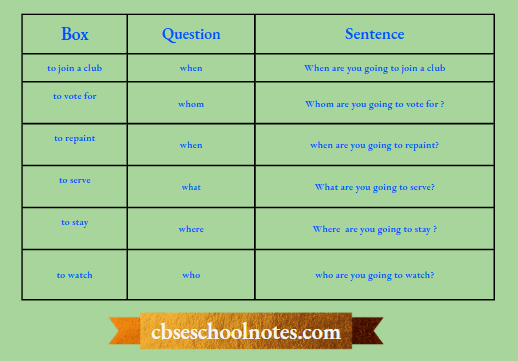
Use the words given in the box to form questions with ‘‘going to”. One is done or you

Use the words given in the box toform questions with going to One is donefor you

Exercise-8

Fill in the blanks with suitable words from the box :—

Fill in the blanks with suitable words from the box

Question 1. Hurry up, by now the early-comers _______ the best seats in the stadium.

Answer: will have occupied

Question 2. The Independence Day celebrations ___________ by the time you reach the Red Fort.

Answer: will have ended

Question 3. The marriage party_____ the venue for the wedding by then.

Answer: will have reached

Question 4. The committee___________ to all the demands of the workers by Monday.

Answer: will have agreed

Question 5. The Indian team ________ their last match in Sydney by 4th March.

Answer: will have played

Question 6. The Prime Minister_______ to the reporters already on the subject by then.

Answer: will have spoken

Exercise – 9

Your are leaving for a Trek near Manali. Using all the forms of Future Tense, write ten lines about what you expect to enjoy in this Trek.

  1. I ‘will go’ on a trek near Manali n ext week.
  2. We ‘ are going to climb some beautiful hills during the trip.
  3. I ‘shall enjoy’ the breathtaking views of the snow-covered mountains.
  4. Our group ‘wil be camping’ near a river under the stars
  5. We ‘are going to cook’ food together around a bonafire.
  6. I ‘will be taking’ lots of photography of the scenery and wildlife.
  7. The guides ‘ will have prepared’ everything for our safety and comfort.
  8. By the end of the trek, ‘I eill heve learned’ many survival skill.
  9. We ‘shall be sharing’ stories and experiences every night.
  10. I will never forget’this amazing adventure in the mountains.


CBSE Class 8 English Chapter 6 The Past Tense

CBSE Class 8 English Class 8 Chapter 6 The Past Tense

Forms of the Past Tense

Simple Past

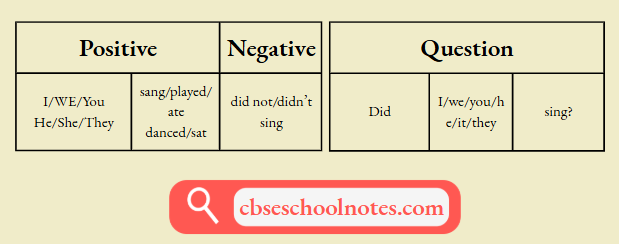
CBSE Class 8 English Part 1 Functional Grammar And Correct Usage Chapter 6 The past Tense Simple Past

Uses: We use Simple Past Tense

  1. to express actions which have been finished before the time of speaking.
  2. to express some past habit.

Examples:

  1. We went to the new Mall in Saket yesterday.
    Did you go to the new Mall in Saket?
    No, we didn’t.
  2. My father always read the newspaper before going to his office.

Exercise – 1

Fill in the blanks with the Past Form of the verbs given in the brackets:—

Question 1. In the olden days, children ________(treat) their elders with great respect.

Answer: teated

Question 2. In 1980, we___________(leave) India to settle down in Canada.

Answer: left

Question 3. American planes continually ________ (bomb) Taliban positions in Afghanistan.

Answer: bombed

Question 4. He __________ (take) early retirement from the army and__________ (start) a publishing firm in Delhi.

Answer: took ; started

Question 5. Kailash __________(try) to persuade his brother to give up his bad habits.

Answer: tried

Question 6. Why ______ (don’t) you stop the boy from throwing stones at people on the road?

Answer: did not

Question 7. We _______(look) everywhere but ______(not) find our little puppy.

Answer: Looked; did not

Question 8. __________ (do) you go to the new showroom opened by Marks and Spencers yesterday?

Answer: Did

Question 9. Last night,I _______(has) a shock when I _______(find) my car missing.

Answer: had ; found

Question 10. The smoke ________(sting) my eyes and I ______(can’t) see where I____________ (be) going.

Answer: stung; couldn’t;was

Exercise – 2

Rewrite the following passage in Simple Past Tense. (First underline all the verbs.):—

Near the bed, two little children — a boy and a girl — sleep together in a cradle and are smiling in their sleep. How soundly they sleep in their old tottering cradle! It seems as if nothing can wake them up. Outside the rain beats down in floods and the sea gives forth a sound like an alarm bell. From the old roof, drops of water fall on the floor.

Answer:

Near the bed, two little children — a boy and a girl — ‘slept’ together in a cradle and are ‘smiled’ in their sleep. How soundly they ‘slpt’ in their old tottering cradle! It ‘seemed’ as if nothing can wake them up. Outside the rain ‘beat’ down in floods and the sea ‘gave’ forth a sound like an alarm bell. From the old roof, drops of water ‘fell’ on the floor.

Past Continuous Tense

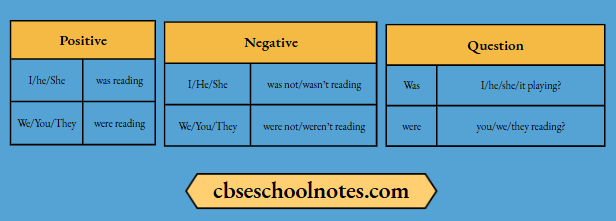
CBSE Class 8 English Part 1 Functional Grammar And Correct Usage Chapter 6 The past Tense Past Continuous Tense

Uses :

  1. We use Past Continuous Tense to express an action in progress at some moment before the time of speaking.
    Examples:

    1. I was checking my car tyres.
    2. The rescue team was looking for survivors of the boat disaster.
  2. We use Past Continuous Tense for the longer action and the Simple Past Tense for the shorter action, to show something happened when a longer action was going on.
    Examples: I was checking my car tyres when my friends arrived.
    My brother and I were fighting over the new game when our mother came and scolded us.
  3. Past Continuous Tense is used to refer to repeated actions in past with always or forever.
    Examples: Anuj and Sheela were forever fighting about their possessions.

Exercise – 3

Rewrite the following sentences, changing the verbs to Past Continuous Tense

Question 1. The boy leans against the tree.

Answer:

The boy ‘was leaning’ against the tree.

Question 2. A cold wind blows.

Answer:

A cold wind ‘was blowing’

Question 3. She hide herself.

Answer:

She ‘was hiding’ herself

Question 4. The leaves fell to the ground.

Answer:

The leaves ‘were falling’ to the ground

Question 5. He works hard for his examination.

Answer:

He ‘was working’ hard for his examination

Question 6. The soldiers fight and win.

Answer:

The soldiers ‘were fighting’ and winning.

Question 7. The birds are flying out of the cage since morning.

Answer:

The birds ‘were flying’ out of the cage since morning

Question 8. She is singing and cannot answer your phone call.

Answer:

She ‘wass singing’ and cannot answer your phone call

Question 9. Many of us live and work great distances from where we are bom or grow up.

Answer:

Many of us ‘were living’ and ‘working’ great distances from where we are bom or grow up

Question 10. They are praising her creative abilities, specially in dancing.

Answer:

They ‘were praising’ her creative abilities, especially in dancing.

Exercise – 4

Tick (S) the correct verb form in the brackets:—

Question 1. While mother (cooked/was cooking) for the party, my sisters cleaned the rooms.

Answer:

was cooking

Question 2. As the car (speeded/was speeding) down the hill, we heard a loud explosion.

Answer: was speeding

Question 3. While the teacher (was correcting/correcting) the exercise books, the children  (were reading/read) storybooks quietly.

Answer: was correcting ; were reading

Question 4. The old lady (was crossing/crossed) the road when she was (knocking/knocked) down.

Answer:

was crossing ; knocked

Question 5. Why (were you fighting/you fought) with your brother last night, whenI came to see you?

Answer:

Were you fighting

Exercise-5

Some of the verbs in the sentences given below are incorrect. Underline them and write the correct form

Question 1. My son coughing so badly last night that he could not sleep.

Answer:

My son ‘coughed’ so badly last night that he could not sleep

Question 2. The book reading this afternoon is very interesting,I couldn’t leave it.

Answer:

The book ‘I read’ this afternoon is very interesting,I couldn’t leave it

Question 3. While I clearing my cupboard,I found my old diary.

Answer:

While I ‘was clearing’ my cupboard,I found my old diary

Question 4. Our teacher last year always reminding us to work harder.

Answer:

Our teacher last year always ‘reminded’ us to work harder

Question 5. The farmers fought to save their homes from the fire which spread quickly through their fields.

Answer:

The farmers ‘were fighting’ to save their homes from the fire which spread quickly through their fields.

Past Perfect Tense

CBSE Class 8 English Part 1 Functional Grammar And Correct Usage Chapter 6 The past Tense Past Perfect Tense

Uses :

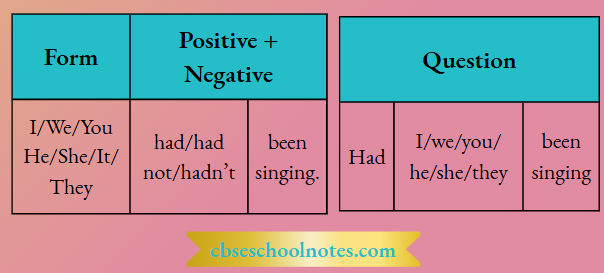
The Past Perfect Tense is used when we wish to say that some action had been completed before another was started.

Examples: We had eaten our dinner before the guests arrived.

Note: The verb expressing the previous action is put into Past Perfect Tense.

CBSE Class 8 English Part 1 Functional Grammar And Correct Usage Chapter 6 The past Tense Past Perfect Tense 1

Exercise – 6

Complete the sentence by putting a tick () against the correct part

Question 1. He had visited many towns before

  1. he was returning home.
  2. he had returned home.
  3. he returned home.

Answer: 3. he returned home.

Question 2. I had been reading this book for two weeks before

  1. she had arrived.
  2. she arrived.
  3. she has arrived.

Answer: 2. she arrived.

Question 3. The servant had finished his work when

  1. I had called him.
  2. I called him.
  3. I have called him.

Answer:

2. I called him.

Question 4. The rain had stopped when

  1. we came out.
  2. we had come out.
  3. we would come out.

Answer:

1. we came out.

Question 5. Three years have passed since

  1. his father had died.
  2. his father have died.
  3. his father died.

Answer:

3. his father died.

Exercise – 7

Fill in the blanks with the correct Past Perfect Tense of the verbs in brackets:—

Question 1. She_____ the dress before she went to sleep, (complete)

Answer: had completed

Question 2. They ________ to India to meet us before returning home,(come)

Answer: had come

Question 3. They went home only after they ___________f or four hours, (work)

Answer: had worked

Question 4. The servant _____ all the cash before his master_____home, (steal, return)

Answer: had stolen; returned

Question 5. We _______ dinner only after we_______ our drinks, (eat,finish)

Answer: had finished

Past Perfect Continuous

CBSE Class 8 English Part 1 Functional Grammar And Correct Usage Chapter 6 The past Tense Past Perfect Continuous Tense

Use :

We use the Past Perfect Continuous Tense to refer to an action which had been going on continuously up to that time in the past that we are talking about.

Example: My father had been managing the factory for thirty years before he retired.

Exercise-8

Fill in the blanks with the correct form of the verbs given in the brackets

Question 1. They ______ for an hour when they _______the doors of the theatre, (wait, open)

Answer: had been waiting; opened

Question 2. Suman ________for almost two hours before the concert__________ (sing, conclude)

Answer: had been singing; concluded

Question 3. Rajan___________throughout the day before his mother_______ him up. (sleep, wake)

Answer: had been sleeping; woke

Question 4. The hospital __________ other specialists before they the treatment of the patient, (consult, started)

Answer: had consulted; started

Question 5. They __________ the examination until all the students ___________ (not start, thoroughly check)

Answer: did not start; had been thoroughly checked.

Exercise – 9

There is an error in each sentence of this passage. Underline error and write the correct word in its place in the space given. One is done for you.

Question 1. The writer was twelve years old and she use to____________

Answer: Usually

Question 2. stay with her grandparents in north Karnataka_________

Answer: North

Question 3. Since there are very few diversions_________

Answer: diversions

4. The entire family eagerly wait for a_______

Answer: waits

Question 5. Weekly magazine call “Karamveera.”________

Answer: called

Question 6. This magazine is publishing a famous____________

Answer: was publishing

Question 7. Novel “Kashi Yatre” as a serial which deal______

Answer: deals

Question 8. With the heroine’s struggle visit Kashi.__________

Answer: to visit

Question 9. Since grandmother believe in Kashi Yatra________

Answer: grandmother believed

Question 10. As a pilgrimage, she would identify with__________

Answer: No error

Question 11. The problems of the main characters._________

Answer: character

Exercise – 10

Take any person you admire — he/she can be a sportsman, a leader, an actor or even a relative. Write ten sentences about him or her using all four forms of the Past Tense.

Here are ten sentences about Dr. A.P.J. Abdul Kalam using all four forms of the past tense:-

  1. Simple past:- Dr. Kalam worked as a scientist at ISRO before becoming president.
  2. Simple past:- He wrote many inspiring book for young indians.
  3. Past Continuous:- while he was serving as president, he was teaching students every weekend.
  4. Past Continuous:- People were cheering when he was giving motivational speeches.
  5. Past Perfect:- Before he became famous, he had developed India’s missile technology.
  6. Past Perfect:- The government had awaeded him the Bharat Ratna long before 2002.
  7. Past perfect continuous : He had been inspiring youth for decaded before his passing.
  8. Past perfect continuous: Scientists had been collaborarting with him long before his presidency.
  9. Mixed past:- When he arrived at events children had been waiting for hours to meet him.
  10. Mixed past:- After he had delivered a speech, the audience clapped for minutes.

CBSE Class 8 English Chapter 5 The Present Tense

CBSE Class 8 English Class 8 Chapter 5 The Present Tense

Simple Present

1. Remember the rules you have learnt in the earlier classes.

Form of Simple Present

CBSE Class 8 English Part 1 Functional Grammar And Correct Usage Chapter 5 The Present Tense Form of Simple Present

2. When do we use the Simple Present?

  1. To express custom or habit; as,
    I play badminton every evening.
    He plays the guitar for his school orchestra.
    Does she take lessons in English?
  2. To express what is actually happening at the present moment; as
    See, how it rains!
    How sweetly Mary sings!
  3. To express general truths; as
    Man is mortal.
    The earth moves round the sun.

Exercise -1

Raman copied some notes about Rameshwaram

Rameshwaram – belief—built on the spot where Lord Rama placed his feet.

Centre of Pilgrimage — during annual Shri Sita-Rama Kalyanam Ceremony.

Pilgrims ferried across the sea—between Rameshwaram and Dhanushkodi.

Dhanushkodi — 20 kilometres away in the sea.

Lord Rama — bathed here – sanctified the place.

Boulders between Dhanushkodi and Sri Lanka — remnants of the bridge used by Lord Rama.

Lanka — Kingdom of Ravana – Epic Ramayana.

Write the account in complete sentences in Simple Present Tense.

Begin: People believe that Rameshwaram is built on the spot where Lord Rama placed his feet.

Answer:

People believe that Rameshwaram is built on the spot where Lord Rama placed his feet.

It serves as a centre of pilgrimage during the annual Shri Sita-Rama kalyanam ceremony.

Pilgrims ferry across the sea between Rameswaram and dhanushkodi.

Dhanushkodi lies 20 kilometers aways in the sea.

Lord Rama baths here and sanctifies the place.

Boulders between dhanushkodi and sri lanka are considered remnants of the bridge used by lord rama.

Sri Lanka is known as the kingdom of Ravana in the epic ramayana.

Exercise -2

Rewrite the passage using the Simple Present Tense of the words given in the brackets :—

At the New Delhi railway station, the Kalam family_______(attract) the attention of a large number of curious onlookers and the media. Dr. Kalam _________ (remain) untouched by the excitement of the masses. The day of the ceremony________ (start) off like any other day with the regular 5 km walk at the Asiad Village. He_____(take) a shower and ______(eat) a light South Indian breakfast consisting of idli, sambar butter milk. He and ______ (dress) immaculately in a suit and ___________ (step) out to acknowledge the greetings of the crowd. There______(be) hordes of cameramen and T.V. crew who________ (focus) on him as he ________ (drive) to the Rashtrapati Bhawan.

At the New Delhi railway station, the Kalam family ‘attracts’ the attention of a large number of curious onlookers and the media. Dr. Kalam ‘remains’ untouched by the excitement of the masses. The day of the ceremony ‘starts’ off like any other day with the regular 5 km walk at the Asiad Village. He’take’ a shower and ‘eats’ a light South Indian breakfast consisting of idli, sambar butter milk. He and dresses immaculately in a suit and ‘steps ‘ out to acknowledge the greetings of the crowd. There’are hordes of cameramen and T.V. crew who ‘focus’ on him as he ‘drives to the Rashtrapati Bhawan.

Exercise-3

Write five sentences about the things you like andfive about things you do not like. (Keep to Simple Present Tense.)

Answer:

Five Things I Like ( simple Present Tense )

  1. I like ‘reading books’ in my free time.
  2. I like ‘listening to music’ while working.
  3. I like ‘playing football’  with my friends.
  4. I like ‘watching movies’ on weekends.
  5. I like ‘eating chocolate ice cream’.

Five Things I Dislike ( Simple Present Tense )

  1. I dislike ‘ waking up early ‘ on holidays
  2. I dislike ‘ loud noises’ when I’m studying.
  3. I dislike ‘rainy days’ because they makes me lazy.
  4. I dislike ‘spicy food’ as it upsets my stomach.
  5. I dislike ‘ waiting in long queues’.

Present Continuous Tense

CBSE Class 8 English Part 1 Functional Grammar And Correct Usage Chapter 5 The Present continuous Tense

Use of Present Continuous Tense

To show that the action is still continuing — that is, the action is incomplete or continuous.

The girls are singing and dancing on the stage.

The audience is clapping loudly

Exercise – 4

Circle the correct words in the boxes to complete the sentences:—

Question 1. It _________ right now [is raining/rains/are raining]

Answer: is raining

Question 2. but the sky______ [tums/are tuming/is turning]

Answer: is turning

Question 3. dark and a cool breeze _________[blows/is blowing/are blowing]

Answer: is blowing

Question 4. All________ [carries/carry/are carrying] umbrellas as the rain__________ [is increasing/increases/are increasing] every minute.

Answer: carry, is increasing

Exercise- 5

Complete the sentences given below with Present Continuous form of the verb :—

Question 1. It_______ (rain) heavily now.

Answer: is raining

Question 2. Normally people speak in English in the Parliament but the new M.P. _________(speak) in Tamil.

Answer: is speaking

Question 3. He___________ (take) a long time to finish his breakfast.

Answer: is taking

Question 4. The Principal________ (announce) the annual result and the students_______ (cheer) the prize winners.

Answer:

is announcing, are cheering

Question 5. The dog____ (chase) the cat, who ______(mew) loudly in fright.

Answer:

is chasing, is mewing

Present Perfect Tense

CBSE Class 8 English Part 1 Functional Grammar And Correct Usage Chapter 5 The Present Perfect Tense

Answer:

Use of the Present Perfect Tense

1. We use the Present Perfect Tense to talk about completed action.

Examples: 1. He has sung in many countries.

2. I have won praise for my research work.

We use since and for to refer to an action that began in the past and is still going on at the point of speaking.

Examples:

1. I have been a member of this club for ten years. (Means: I am still a member.) [mentions time in general]

2. I have studied in this institution since 1988 (means : I joined in 1988 and I am still here.) [mentions specific time]

We use already and just with Present Perfect Tense to show completed actions. We use yet to show that an action is expected to happen but has not taken place at the time of speaking.

Examples: 1. They have already completed the assignment.

2. They have left just now. We use never and ever with the Present Perfect Tense to a time frame that began in past and continues in the present.

Examples: 1. I have never gone to the aquarium.

2. Have you ever been to a dance performance?

Note: The above words already, just, ever, never are not used with Simple Past Tense.

Exercise -6

Answer the following questions using already/just/yet/along with verbs given in brackets. One is done for you

Question 1. Where is he?

Answer: He has just come back (come back, just) from the market.

Question 2. Have you visited Bengaluru?

No, I________(not visit/yet) it.

Answer:

No, I’have not visited’ it ‘yet’.

Question 3. Do you know this town?

I________(live/already) in this town for more than 30 years.

Answer:

I ‘have already lived’ in this town for more than 30 years.

Question 4. We_____(mailed/already) our Diwali Greetings to our friends in India.

Answer:

we have  already mailed our diwali greetings to our friends in india.

Question 5. How is Sania?

I ______(not meet) her _________(since) we left the college a year ago.

Answer:

I ‘have not met’ her since we left the college a year ago.

Exercise -7

Correct the following sentences:-

Question 1. I waited for a bus since 3 o’clock but haven’t caught one.

Answer:

I have been waiting for a bus since 3 O’clock but haven’t caught one.

Question 2. I forgot the exact time of the meeting; let me ask my secretary.

Answer:

I have forgotten the exact time of the meeting; let me ask my secretary.

Question 3. Ramesh already seen this movie so he know story.

Answer:

Ramesh has already seen this movie, so he knows the story.

Question 4. We never won a prize in this competition.

Answer:

We have never won a prize in its competion

Question 5. We didn’t go to the museum yet; we will go next week

Answer:

We haven’t gone to the museum yet ; we will go next week.

Exercise -8

Fill in the blanks with Simple Present / Present Continuous or Present Perfectforms of the Verb given in brackets

Question 1. The rain ________and the sun_________ now. (stop/shine)

Answer: has been stopped; is shining

Question 2. We ________already_________ them that we______donationsfrom business magnates. (tell/accept)

Answer: have; told; accept

Question 3. My sister__________the dinner and her son_______. (cook/play)

Answer: is cooking; is playing

Question 4. I will go out______when ________ my work, (finish/only)

Answer: only; I finish

Question 5. Why__________the child________ ? (be/cry)

Answer: is; crying

Question 6. I asked her where she __________. She____________ me that she_________ to the central market. (be/tells/go)

Answer: was; tells;has gone

Question 7. He____________ in this institution for twenty years, (work)

Answer: has worked

Question 8. I ____________ the table for dinner, can I serve food now? (lay)

Answer: has laid

Question 9. We___________ a very enjoyable holiday in Kashmir, (has)

Answer: have had

Question 10. Why are you_ _______(hide) from me? Have you__________ (do) something wrong?

Answer: hiding; done

Present Perfect Continuous

This form is used to indicate that the action has been going on continuously over a period of time starting in the past and continuing up to the present.

Example:

1. I have been writing letters since 10 o’clock today.

2. It has been raining for the last fifteen minutes.

Exercise – 9

Fill in the blanks in the following sentences with the Present Perfect Continuous Tense of the Verbs given in the brackets:—

Question 1. India’s population _________(steadily, increase) every year.

Answer: has been steadily increasing

Question 2. He__________ (practice) for the match since last week.

Answer: has been practicing

Question 3. You________(disturb) this class for the last one hour, please stop it at once.

Answer: has been distrubing

Question 4. The old man_________ (stand) patiently in the sun for a bus to arrive.

Answer: has been standing

Question 5. The child_______ (cry) for his mother but she has disappeared.

Answer: has been crying

Question 6. I________(watch) the parliament debate on the no-confidence vote with great interest.

Answer: has been watching

Exercise – 10

Use Present Perfect Tense to write a sentence on the following situations

Question 1. You are watching a cricket match. You have never seen before.

Answer: This is the first time I’ve seen a cricket match.

Question 2. You have lost your bank card. It has happened once before.

Answer: This Is The second time I’ve lost my bank card.

Question 3. You have missed the School Bus. This is 4th time in one month.

Answer: This Is the fourth time I’ve missed the school bus this month.

Question 4. You are staying in a hotel for the first time in your life.

Answer: This is the first time I’ve stayed in a hotel.

CBSE Class 8 English Chapter 4 Determiners

CBSE Class 8 English Class 8 Chapter 4 Determiners

1. Like Adjectives, Determiners also qualify the Nouns that follow. They point out the Noun.

Examples: My uncle, the best students, every house, that book, some files.

2. Kinds of Determiners :

  1. Demonstratives: This, that, these, those.
    This is used before Singular Nouns and these before Plural Nouns.
    Examples:
    This book is the best book on Mathematics.
    These dresses belong to a very famous filmstar.
    This and these refer to persons or articles which are near.
    That and those refer to persons or objects which are at a distance.
    That is used before singular nouns and those before plural nouns.
    That house belongs to a famous businessman of Mumbai.
    Those houses are owned by a Corporate House.
  2. Possessives: My, our, your, his, her, its, their.
  3. Distributives: Either, neither, each, every.
  4. Quantifiers: Some, any, much, many, several, little, a little, the little, few, a few, the few,both, all, a lot of, lots of, a large number of, a great deal of, a good deal of.
  5. Interrogative: What, which, whose.
  6. Articles: A, an, the.

Exercise-1

Fill in the blank spaces with this, that, these, those:-

Book shop

Rani: Raman, look! Have you noticed __________ new books on computers?

Answer: These

CBSE Class 8 English Part 1 Functional Grammar And Correct Usage Chapter 4 Determiners Book Shop

Raman: Oh, yes! I have not seen______ books before.

Answer: Those

Rani: I want __________ one with a red cover and ________ book right here.

Answer: That, and this

Raman: Look Rani, at _________ one. It is written by my teacher, there must be more written by him.They must be on _______ counter. I will go and look.

Answer: that, that

Rani: I want to buy __________ books on paintings also. I love looking at them.

Answer: Those

Raman: Okay. Now let us pay for all the books we have bought.

Rani:___________ is a good idea. We have spent a lot of money. I am sure we will enjoy reading __________books.

Answer: That, these

Exercise-2

Fill in the blanks with Possessives (my, our, your, his, her, its, their) :

Question 1. I was astonished at___________ reaction to the good advice given to him.

Answer: his

Question 2. _________performance in the examination was much above expectations.

Answer: His, Her ,Their

Question 3. We have been let down very badly by _________cricket team in the first match against Sri Lanka.

Answer:

Question 4. They were asked to remove_________shoes before entering the building.

Answer: their

Question 5. Hundreds of people came to pay_______________ homage to the departed leader.

Answer: their

Question 6. Reading will help you to improve_________ vocabulary.

Answer: your

Question 7. I was dismayed at the non-arrival of_________ suitcase at the airport.

Answer: my

Question 8. In a rage Hari threw his pencil box on the floor, all________ contents fell in different directions.

Answer: its

Exercise – 3

Complete the passage by filling the blanks with Possessives:—

The children enter their classroom and find their books and stationery thrown by some intruder everywhere. Complete their conversation.

Geeta: Here is_____ maths book.

Answer: my

Vijay: It is __________. Has anyone found _________pencil box?

Answer: mine, my

Rashid: Here it is. I think this pen is also______.

Answer: your

Surbhi: Whose bags are these? They do not seem to belong to anyone in_______ class.

Answer: our

Geeta: They belong to my cousins,_________names are written on them.

Answer: their

Vijay: Thank God, we have found most of ___________things. We must tidy the classroom quickly.

Answer: our

3. Distributives :

Each, every, either, neither — Each means one of two things or one of any number exceeding two. Every is used to in speaking of some number exceeding two, as :

Examples:

  1. Each of them had a gun in his hand.
  2. Each of you can go to the market.
  3. Every man expects to be rich and successful.
  4. Every country expects loyalty from its people.

Either has two meanings: (1) one of two, or (2) each of two, that is, both.

Neither is the negative of either and means neither the one nor the other.

You can leave by either door, (by one door or the other).

Trees grew on either side of the road, (both sides)

He looked at neither side of the road, (neither this side nor the other)

Exercise-4

Fill in the blanks with Each, Every,

Either or Neither:—

Question 1. ___________of the twenty boys was fined.

Answer: Each

Question 2. You can stand on __________ side.

Answer: either

Question 3. _____________soldier was at his post.

Answer: Each

Question 4. ____________seat in the auditorium was occupied.

Answer: Every

Question 5. ____________ of the girls was present.

Answer: Neither

Question 6. __________Reeta nor her sister has to come to work today.

Answer: Neither

Question 7. When we went to Mumbai we visited the beach__________ day.

Answer: every

Question 8. _________of you will be given a uniform to wear in school on Sunday.

Answer: Each

Question 9. ________________ Indian is expected to do his duty.

Answer: Every

Question 10. __________ building has been provided with twenty four hours backup inverters in the case of a power-cut.

Answer: Each

4. Quantifiers :

  1. Much, many; Much stands for quantity and many denotes number.
    Was there much milk left in the pot?
    Were there many people watching the movie?
    We haven’t got many books.
    She doesn’t have much money.
    Note: Words and expressions like the ones given in the box below, may be used instead of many.
    a great many; a good many; a great number (of); plenty (of); a lot (of); lots of.
    Words and expressions used instead of much are :
    a great deal (of); a good deal (of); a large quantity (of); plenty (of); a lot (of).
  2. Little, a little, the little :
    Little means hardly any or not much. It has a negative meaning.
    There was little money in the house.
    There was little that she could do to help the patient.
    A little means- some at least. It has an affirmative meaning.
    A little knowledge is a dangerous thing.
    There is a little milk left in the pot.
    The little means some. It can be used both positively and negatively.
    He wasted the little strength he had in being angry.
    It means 1. The strength he had was not much. (negative)
    2. He wasted all his strength. (positive)
  3. Few, a few, the few: Few means not many and has a negative meaning.
    He has few books left in his library.
    A few means some at least. It has a positive meaning.
    I have a few books left in my library.
    The few means not many. It has both positive and negative meanings.
    He lost the few friends he had.
    It means he lost all the friends he had. (positive)
    The friends he had were not many, (negative).
  4. Less, fewer: Less is used with reference to quantity and fewer with reference to number.
    The huge pumpkin weighed no less than ten pounds.
    I cannot buy less than ten kilograms of rice.
    No fewer than two thousand people joined the strike.
    No fewer than ten civilians were hurt in the firing.
  5. Some, any to express quantity some is used in the affirmative sentences; any in the negative.
    I have some milk but I do not have any sugar.
    She bought some shoes but did not buy any dresses.
    1. Some is used in Interrogative sentences when making polite requests :
      Will you give me some sugar?
      Will you have some more tea?
    2. In conditional sentences as :
      If there are any oranges in the market, please buy some.
      Some is used in conditional sentences.
      If you see any oranges in the market, could you buy some for me?
    3. Use of any in interrogative or negative sentences :
      Did you buy any stamps?
      Have you any articles on the recent events?
      I didn’t see any oranges in the market.

Exercise-5

Fill in the blanks with much or many:-

Question 1. How ________ sugar do you want in your tea?

Answer: much

Question 2. How _________ times have you been to Shimla?

Answer: many

Question 3. We don’t get_______ rain here.

Answer: much

Question 4. He is facing__________ problems.

Answer: many

Question 5. __________ problems can be solved by sitting together and discussing them.

Answer: Many

Question 6. _________time was wasted in trying to break the lock and the thief escaped through the window.

Answer: much

Question 7. He could not do __________ for his family as he was suffering from poor health.

Answer: much

Question 8. Inspite of his ___________ attempts, he could not improve his driving skills.

Answer: many

Question 9. Nothing___________ happened before recess as_________ students were absent due to Asian Flu.

Answer: much

Question 10. __________ people have short tempers, they start shouting over trivial things.

Answer: Many

Exercise-6

Fill in the blanks with Each, Every, Either, or Neither:-

Question 1. _________ of the two soldiers was court-martialled.

Answer: Either

Question 2. You can stand on_______ side.

Answer: either

Question 3. ____________artist sees things differently.

Answer: Every

Question 4. ___________girl in the class took participation.

Answer: Each

Question 5. ____________first class ticket costs a hundred rupees.

Answer: Each

Question 6. __________you nor I are to blame.

Answer: Neither

Question 7. ____________of you is getting a reward.

Answer: Each

Question 8. ____________ you keep quiet at once or leave the classroom.

Answer: Either

Question 9. The teacher has given___________ boy and girl his/her book.

Answer: Each

Question 10. _______________John ____________James were present in the class in the fifth period.

Answer: Neither, nor

Exercise-7

Fill in the blanks with few, a few, little or a little

Question 1. ___________customers have come to the shop and we are busy.

Answer: A few

Question 2. __________customers have come to the shop and we are not so busy.

Answer: Few

Question 3. Shyam has made ___________ progress in his work and is quite unhappy.

Answer: little

Question 4. Vicky has made __________ progress and is quite happy about it.

Answer: a little

Question 5. I cannot lift this box, I need____________ help.

Answer: a little

Question 6. __________tourists have gone to Kashmir this year because of the terrorism there.

Answer: Few

Question 7. I am quite tired and I am having__________ days holiday next week.

Answer: a few

Question 8. ___________ drops of the blue liquid were added to give colour.

Answer: a few

Question 9. _________ caution could have saved the child.

Answer: A little

Question 10. Only ___________ of the books printed by the firm were a hit, the rest failed to find buyers.

Answer: a few

Exercise:8

In the passage given below, there is a missing article or two in every line. Mark the place with ‘/’ and write the missing article in the space provided. One is done for you:-

Question 1.If you spill wax on/carpet by accident, you__________

Answer: a

Question 2. can get rid of wax quite easily. First cover____________

Answer: the

Question 3. with blotting paper or flattened paper bag._____________

Answer:

the, the, a,

Question 4. Next, heat iron. Then, place hot iron over____________

Answer:

the,a

Question 5. blotting paper or paper bag. You have to leave_____________

Answer:

the, the

Question 6. iron on the paper for minute or two. You will________________

Answer:

the a

Question 7. find that paper will absorb wax._______________

Answer:

the, the

Exercise -9

Complete the passage inserting articles in the space given:-

__________(1)dutiful teacher, _______(2)deeply spiritual thinker, _________(3)able policy maker, Dr. Radhakrishnan was every bit_________(4) visionary India needed. Nobel laureate C.V. Raman beautifully summed up his glorious life. “_________(5) frail body of Radhakrishnan enshrined__________(6)great spirit which we have leamt to revere and admire.”

Answer:

(1). A
(2). a
(3). an
(4). the
(5). The
(6). a

Exercise-10

Insert articles wherever they are necessary and rewrite the sentences:-

Question 1. While I was rearranging bookshelf, I found old photograph of my parents.

Answer:

While I was rearranging the bookshelf, I found an old photograph of my parents.

Question 2. As soon as our bus crossed traffic light we heard loud explosion.

Answer:

As soon as our bus crossed the traffic light we heard a loud explosion.

Question 3. The elderly couple were crossing road this morning, when motorcyclist knocked them down.

Answer:

The elderly couple were crossing the road this morning, when a motorcyclist knocked them down.

Question 4. The plane was flying at such low altitude that we had clear view of the Ganga.

Answer:

The plane was flying at such a low altitude that we had a clear view of the Ganga.

Question 5. As girl of 16, I used to walk up hill very often to find quiet place to study.

Answer:

As a girl of 16, I used to walk up a hill very often to find a quiet place to study.

Question 6. I praised honesty of my servant.

Answer:

I praised the honesty of my servant.

Question 7. Apple is a fruit, which eaten daily can keep doctor away.

Answer:

An Apple is a fruit, which eaten daily can keep the doctor away.

Question 8. My neighbours left for Pune week ago.

Answer:

My neighbours left for Pune a week ago.

Question 9. Rajdhani Express was hour late on the first of May.

Answer:

The Rajdhani Express was an hour late on the first of May.

Question 10. Andamans are group of islands in Bay of Bengal.

Answer:

The Andamans are a group of islands in the Bay of Bengal.

CBSE Class 8 English Chapter 3 Pronouns

CBSE Class 8 English Class 8 Chapter 3 Pronouns

1. You already know that Pronouns are words used instead of Nouns. There are seven kinds of Pronouns.

  1. Personal Pronouns
  2. Reflexive/Emphasising Pronouns
  3. Demonstrative Pronouns
  4. Indefinite Pronouns
  5. Distributive Pronouns
  6. Interrogative Pronouns
  7. Relative Pronouns

A Quick Recapitulation

  1. Personal Pronouns are so called because they stand for three persons, viz :
    First Person : I, we, me, us, mine, ours.
    Second Person : You, yours.
    Third Person : He, she, him, her, hers, they, them, theirs, it.
  2. Reflexive/Emphasising Pronouns : Myself, ourselves, yourself, yourselves, himself, herself, themselves, and itself.
  3. Demonstrative Pronouns : They point out objects : this, that, these, those, such.
  4. Indefinite Pronouns : They refer to persons or things in general.
    All, some, many, few, none and others. (They are always Plural.)
  5. Distributive Pronouns : They refer to a number of persons or things, one at a time.
    Each, either, neither, anyone, everyone, all. (They are always Singular.)
  6. Interrogative Pronouns : Pronouns used for asking questions are called Interrogative
    Pronouns. They are : who, what, which, whom and whose.

    1. Who, whom, and whose are used for questions about persons.
    2. What is used for questions about things.
    3. Which is used for asking questions about a particular person or thing.
  7. Relative Pronouns : Who, whom, whose, which and that join two sentences.
    The Noun to which a Relative Pronouns refers or relates is called its Antecedent.

    1. Who is used for persons only.
    2. Which is used for animals and things without life.
    3. That is used for persons, animals and things.

Important

1. Personal Pronouns

  • We use personal pronouns to refer to people, things or animals.
    Example: We want to meet the Director.
  • We use I, you, he, she, it, we, you and they Before verbs as Subjects. We use me, you,him, her, it, us, you, them after verbs as objects.

Example:

CBSE Class 8 English Chapter 3 The Pronouns Example Of Personal Pronouns

Exercise-1

Fill in the blanks with the correct Pronouns to complete the following letter:-

12 September, 20___________

Dear Vivek,

Thank (1) __________ for your present and your letter. It was great fun to meet (2)________after so many years. (3)________ had not seen (4)_______since last winter. When (5)________ all met at Anil’s wedding anniversary (6)_______ really was a special occasion. Do (7)_________ remember the fun______(8) had? Do you remember meeting Pathak? (9)______was so surprised to see (10)________.There were so many familiar faces but (11) ______couldn’t talk to all of (12) ______ When can (13)_____ meet again? Let’s not leave (14)_____to chance. Let’s plan (15)______next meeting.

Bye

Sudhakar

2. Possessive Pronouns and Possessive Adjectives both express possession. Possessive Adjectives come always BEFORE Nouns. Possessive Pronouns are used Instead of a Noun.

Examples:

CBSE Class 8 English Chapter 3 The Pronouns Possessive Pronouns and Possessive Adjectives

This book is mine. That book is yours.

The new car is ours. This dog is yours.

This pen is his. That dress is hers.

The black car is theirs.

Exercise-2

Complete the sentences with either a Possessive Pronoun or a Possessive Adjective. Write PA or PP under the word you have written

Question 1. This is my (I)(PA) room, (you) yours(PP) is on the next floor.

Answer: my (PA) , yours (PP)

Question 2. _________(they) holiday starts before ________(we).

Answer: Their ( PA) , our (PP)

Question 3. Please give us______(you) advice first, we will ask______ (he) later on.

Answer: your (PA) , his (PP)

Question 4. We will have to leave________(she) house earlier so that we can reach ___________ (you) before 10 p.m.

Answer: her (PA) ,yours (PP)

Question 5. I wish _________ (I) voice was as good as ________(she).

Answer: my (PA) , hers (PP)

Exercise-3

Underline the Pronouns in the following sentences and write down their kinds in the space given. One is donefor you:—

Question 1. I shut the gate myself. Emphasising

Answer: Emphasising

Question 2. She hurt herself. __________

Answer: Relative

Question 3. Those books belong to him. __________

Answer: personal

Question 4. What would you do if you were him? __________

Answer: personal

Question 5. That house is ours. __________

Answer: possessive

Question 6. Everyone in our class comes to school early. __________

Answer: Indefinite

Question 7. Both of them are happy with their results. __________

Answer: Distributive

Question 8. Many are poor, only a few are rich. __________

Answer: Indefinite

Question 9. To whom did you give my letter yesterday? __________

Answer: Interrogative

Question 10. This is the man whose son was kidnapped yesterday. __________

Answer: Relative

Question 11. Here is the book which I told you about. __________

Answer: Relative

Question 12. He is one of the greatest leaders that have ever been bom in India. __________

Answer: Relative

3. Agreement of the Relative Pronouns and their Antecedents

The Relative Pronoun must be of the same Number, Gender and Person as its Antecedent; as,

  • The boy who was lazy was punished.
  • The boy who worked hard passed the examination.
  • I, who am your friend, will help you.
  • I am the person that has done this.
  • You, who are rich, should help the poor.
  • He that is contented is happy.
  • They that are wise are always humble.
  • He is one of the greatest leaders that have ever been bom in India.
  • This is the only one of his poems that is worth reading.

Exercise -4

Fill In The Blanks  :—

Question 1. This is the beggar ________ stole my purse.

Answer: who

Question 2. I, __________ is your king, will lead you.

Answer: who

Question 3. I am the person ___________ is to be blamed.

Answer: who

Question 4. God helps those _________help themselves.

Answer: who

Question 5. This is the horse ________ won the race.

Answer: that

Question 6. The answer______ she gave is wrong.

Answer: which

Question 7. I mean _______I say.

Answer: what

Question 8. Tears such __________angels weep burst forth.

Answer: as

Question 9. _______cannot be cured must be endured.

Answer: What

Question 10. He _______is not with me is against me.

Answer: who

Question 11. My answer is the same _________ yours.

Answer: as

Question 12. This is ________ troubles me.

Answer: what

Question 13. He is not such a clever boy ___________ you are.

Answer: as

Question 14. He is one of the greatest men___________have ever lived.

Answer: that

Question 15. He is not the same man______he has been.

Answer: that

Question 16. Listen to________ he says.

Answer: what

Question 17. He _______________ is honest shall prosper.

Answer: who

Question 18. He _________ always speaks the truth shall be respected.

Answer: who

Question 19. He is the man______ you can trust.

Answer: whom

Question 20. Who is here so rude _________ will be a slave?

Answer: as

Question 21. Blessed is he _____ has found his work.

Answer: who

Question 22. Man is the only animal ____can talk.

Answer: that

Question 23. Such a man _________ he should be honoured.

Answer: as

Question 24. Do the same _________I do.

Answer: as

Question 25. _________is done cannot be undone.

Answer: what

Exercise-5

Question 1. There was an old woman __________ lived in a hut.

Answer: who

Question 2. Unfortunately he took the road _______led in the wrong direction.

Answer: that

Question 3. I like the boy ______ temper is good.

Answer: whose

Question 4. This is the boy _______stood first in English.

Answer: who

Question 5. This is the girl_______ parents helped us.

Answer: whose

Question 6. This is the man________ courage saved us.

Answer: whose

Question 7. This is the horse ________won the race.

Answer: that

Question 8. This is the woman _____ I suspected.

Answer: whom

Question 9. This is the house ______ my grandfather built.

Answer: that

Question 10. He is one of the bravest generals ______ have ever fought in India.

Answer: that

Remember : The Pronouns, who, whom, whose, which and that, which join two sentences and refer back to the Nouns going before them, are called Relative Pronouns.

Exercise -6

Choose the correct Verb from the brackets to complete the sentences given below :—

(Remember the rule about Singular and Plural Pronouns.)

Question 1. A few of the apples______ (is/are) left, the rest______ (has/have) been eaten.

Answer: are, have

Question 2. Each apple on the plate________ been cut.(have/has)

Answer: has

Question 3. Look at the children! All ________ asleep.(are/is)

Answer: are

Question 4. Many of your sums_____ wrong. (is/are)

Answer: are

Question 5. Some of the rice______ not cooked properly. (is/are)

Answer: is

Question 6. Either of these two books ______ very interesting to read. (are/is)

Answer: is

Question 7. Nobody _______seen her for the last two days. (have/has)

Answer: has

Question 8. Both of my granddaughters_________ good in study. (is/are)

Answer: are

Question 9. Much of the land ________ lying barren. (is/are)

Answer: is

Question 10. Neither of them ________ ill, they are both lying, (is/are)

Answer: is

Exercise -7

Join together each of the following pairs of sentences by means of a Relative Pronoun :—

who, whom, whose, which, that

Question 1. This is the man. I trusted him.

Answer:

This is the man whom I trusted.

Question 2. I am the person. You sent for me.

Answer:

I am the person who You sent for me.

Question 3. Here is the book. I told you about it.

Answer:

Here is the book which I told you about.

Question 4. This is the road. It leads to the station.

Answer:

This is the road that leads to the station.

Question 5. He does his best,which should be praised.

Answer:

He does his best. He should be praised.

Question 6. The thieves were caught. They had stolen cash and jewellery.

Answer:

The thieves who were caught had stolen cash and jewellery.

Question 7. Rabindranath Tagore, whose literary works are famous,was born in Bengal.

Answer:

Rabindranath Tagore was born in Bengal. His literary works are famous.

Question 8. The boys thanked me sincerely. I had helped them solve the problem.

Answer:

The boys whom I had helped them solve the problem thanked me sincerely.

Question 9. My watch was stolen yesterday.I have not found it yet.

Answer:

My watch,which was stolen yesterday, has been found yet.

Question 10. They met the woman. Her children were hurt in the road accident.

Answer:

They met the woman whose children were hurt in the road accident.

4. Important Note : When sentences are connected to one another by who and which, you must place the connecting word immediately after the Noun to which it refers.

Examples:

  1. The waiter served us who was very clumsy.
    This is a very absurd sentence.
    It should be written as :
    The waiter who served us was very clumsy.
  2. That pretty little hut up on the hill which belongs to me. (wrong)
    That pretty little hut which is up on the hill, belongs to me.

Exercise -8

The following sentences are wrongly constructed. Improve them by putting who and which immediately after the nouns to which they refer:-

Question 1. I sold my house last week which was double-storeyed.

Answer:

I sold my house, ‘which’ was double-storeyed last week.

Question 2. The Principal punished all the truants who was very strict.

Answer:

The Principal, ‘who’ was very strict punished all the truants.

Question 3. The stranger surprised us who came to our house yesterday.

Answer:

The stranger ‘who’ came to our house yesterday surprised us .

Question 4. I noticed the new painting hanging on the wall which belongs to my friend.

Answer:

I noticed the new painting, ‘which’ belongs to my friend hanging on the wall.

Question 5. The girl is my sister who wrote the story of this play.

Answer:

The girl ‘who’ wrote the story of this play is my sister.

CBSE Class 8 English Chapter 2 The Noun

CBSE Class 8 English Class 8 Chapter 2 Kinds Of Nouns

1. You have learnt that there are five kinds of Nouns.

  1. Common Nouns: City, table, television, oven, sea, continent, camera, houseboat, etc.
  2. Proper Nouns: Asia, Srinagar, Harry Potter, Jog Falls, the Pacific Ocean,the Taj Mahal, etc.
  3. Collective Nouns: Audience, pack, deck, cluster, etc
  4. Abstract Nouns: Determination, proposal, happiness, failure, victory, etc.
  5. Material Nouns: Nylon, polyester, jute, silk, wood, etc.

Exercise – 1

Underline the Nouns in the following sentences and write their kinds. One is done for you:-

Question 1. The king said to his son, “There are two things absolutely necessary to be successful in lifehonesty and wisdom.

Answer:

King, son, things – Common Nouns

life, honesty, wisdom – Abstract Nouns

Question 2. Nelson Mandela became the first President of independent South Africa.

Answer:

Nelson Mandela – Proper Noun

President – Common Noun

South Africa – Proper Noun

Question 3. The news of terrorist attack in the city spread like wildfire, and people collected in front of the minister’s house.

Answer:

news – Abstract Noun

attack, city, minister, house terrorist – Common Noun

people – Common Noun or Collective Noun

Question 4. Inspite of her age, the old lady loved wearing ornaments of gold and silver.

Answer:

age – Abstract Noun

lady, ornaments – Common Noun

gold, silver – Material Noun

Question 5. The jury found the prisoner guilty and sentenced him for ten years.

Answer:

jury – Collective Noun

Prisoner, years – Common Noun

Exercise – 2

Underline all the Nouns in the following passage and state their kind :—

The Immortals of Meluha is the first novel of the Shiva trilogy series by Amish Tripathi. The story is set in the land of Meluha and starts with the arrival of the Tibetan tribal Shiva. The Meluhan belief that Shiva is their fabled Neelkanth is confirmed when he consumes the Somras,a legendary healing potion, which turns his throat blue.

It’s sequel, The Secret of the Nagas, along with The Immortals of Melhua, have crossed a print run of a million copies and earned $22 crore within two years of publishing.

CBSE Class 8 English Part 1 Functional Grammar And Correct Usage Chapter 2 The Noun KInd of Nouns In The Passage

Exercise – 3

Fill in the blanks with the Abstract Noun forms of the words given below. One is done for you:—

Fill In The Blanks With The Abstract Noun Forms Of The Words Given Below.

1. No one can deny the importance of education in a child’s life.

Question 2. For days the topic of _________ was the untimely death of the Indian Idol, Ishmith Singh in a swimming pool.

Answer:

discussion (discuss)

Question 3. The Tsunami caused massive _________ of life and property.

Answer:

destruction(destroy)

Question 4. A stupid ________ between two boys led to a pitched battle between two groups.

Answer:

argument (argue)

Question 5. The opposition party vetoed the government _______for more reservation of seats for the weaker sections.

Answer:

proposal (propose)

Question 6. No company can prosper without the________ of the workers.

Answer: coperation (coperate)

Question 7. Watching television is the most popular means of ________ for the elderly in India.

Answer:

relaxation ( relax )

Question 8. Many members of the party were expelled for their__________ of the party’s rules.

Answer:

defiance ( defy )

Question 9. Her parents did not object to her______for flying than medicine and supported her in her choice.

Answer:

preference ( prefer )

Question 10. Some new facts have been discovered about the ancient ______ of Indus Valley.

Answer:

civilisation (civilised)

Exercise – 4

Complete the following sentences by choosing the most suitable Collective Noun from the box:-

Complete The Following Sentences By Choosing The Most Suitable Collective Noun From The Box

Question 1. The violent ___________ was dispersed only when tear gas was used by the police.

Answer:

mob

Question 2. A __________ of warriors attacked the sleeping city and destroyed it.

Answer:

horde

Question 3. She has a wonderful ________ of rare stamps.

Answer:

collection

Question 4. The __________sang melodiously and won applause.

Answer:

choir

Question 5. The famous singer’s ________ has a collection of latest fashions.

Answer:

wardrobe

Question 6. A _________of stones marked the boundary between the two farms.

Answer:

heap

Question 7. A _________ of actors staged many plays of Shakespeare in the city.

Answer:

troupe

Question 8. A_________ of eminent lawyers was formed to look into the legal aspect of the new law.

Answer:

committee

Exercise – 5

Study the Nouns given in the box. Choose one Noun from the box to replace the group of words in italics in the sentences given below. One is done for you:-

Study The Nouns Given In The Box. Choose One Noun From The Box To Replace The Group Of Words In Italics In The Sentences Given Below.

Question 1. The person who served us tea was a new appointment in the hotel.

Answer:

The waiter was a new appointment in the hotel.

Question 2. Sometimes it is the people walking on the street who cause accidents.

Answer:

Sometimes it is the ‘pedestrians’ who cause accidents.

Question 3. Ravi Shankar’s performance was given a standing ovation by the people who had come to hear him.

Answer:

Ravi shankar’s performance was given a standing ovation by the ‘audience.

Question 4. Not a single Indian batsman scored a hundred runs in the match against Sri Lanka.

Answer:

Not a single Indian batsman scored a ‘century’ in the match against sri lanka.

Question 5. He showed me a book in which he had collected pictures of this tour abroad.

Answer:

He showed me an ‘album’ in which he had collected pictures of his tour abroad.

Question 6. Mahatma Gandhi’s story of his life should be read by all the young children.

Answer:

Mahatma Gandhi’s ‘autobiography’ should be read by all the young children.

Question 7. My favourite occupation to relax in free time is reading adventure stories.

Answer:

My favourite ‘hobby’ to relax in free time is reading adventure stories.

Question 8. He brings electronic goods from Japan to India.

Answer:

He brings electronic goods from Japan to India for ‘import’.

Question 9. The most important place in a desert is where water is found.

Answer:

The most important place in a desert is the ‘oasis’.

Question 10. I have recently read a very interesting book about the life and works of Leonardo da Vinci by an Indian author.

Answer:

I have recently read a very intersting ‘biography’ of leonardo da vinci by an Indian author

Exercise – 6

Solve this puzzle with the help of the clues given and write the answers in the cross patch given:-

1. A person who breaks into people’s houses, shops, etc. at night, to steal.

2. Season when the leaves fall.

CBSE Class 8 English Chapter 2 The Noun Solve The Puzzle

3. A person who tells our future with the help of stars.

4. A ship that travels under the sea.

5. A person disloyal to his own country

CBSE Class 8 English Chapter 2 The Noun Answer For The Solve The Puzzle

2. NOUNS can be Countable or Uncountable.

  1. Countable Nouns are things like people, animals, plants (a boss, a dog), concrete objects
    (a desk, a laptop) or units of measurement (a metre, a pound).
  2. Uncountable Nouns include things like substances, materials and commodities. Examples are water, oil, money, information. Abstract ideas like progress, profitability and languages (English, Arabic). We do not say- “three informations,” or “two waters.”
  3. Learn this list of some Uncountable Nouns :CBSE Class 8 English Chapter 2 The Noun Learn This List Of Some Uncountable Nouns
  4. Countable Nouns can be singular or plural but Uncountable Nouns are singular.
    • The new computers have arrived. (Countable)
    • The new furniture has arrived. (Uncountable)
  5. With Uncountable Nouns we can use some instead of a or an.
    He gave me a money. (wrong)  He gave me some money (right)
  6. We can use a or an with Uncountable Nouns by using words of measurement.
    Examples:

    1. A cup of coffee, a glass of water, a glass of orange juice.
    2. You can buy mineral water for Rs 10 a bottle.
    3. The price of petrol is now Rs 68.21 per litre. Here, per means a.

Exercise-7

In the following blanks one word is countable and the other is uncountable. Write some or a before each word:—

Question 1. ________ report was read by the people, along with ___________ news on page 3.

Answer:

A, some

Question 2. ___________furniture has been changed in the room and ________ steel almirah has been added.

Answer:

some, a

Question 3. I needed ________ accommodation in __________hotel immediately.

Answer:

some, a

Question 4. He landed in Canada with _________ cheque book and _______cash.

Answer:

a, some

Question 5. Go and see_________ lawyer and get________ advice about what to do next.

Answer:

a,some

CBSE Class 8 English Chapter 1 Parts Of Speech

CBSE Class 8 Chapter 1 Parts Of Speech

Let us quickly revise what we have learnt in Classes 6 and 7 about Parts of Speech.

  • A There are eight Parts of Speech in English Grammar.
    Parts of Speech are the classes into which words are divided according to their function in a sentence.
  • The Eight Parts Of Speech Are :
    1. Noun: A Noun is the name of a person, place, thing or an animal.
      Examples: John, Anita, Delhi, Chennai, boy, girl, table, honour, gold, etc.
      Nouns have number, gender, case, and are of five kinds.
    2. Pronoun: A Pronoun is a word used instead of a noun.
      Examples: I, we, you, he, she, they, it, us, mine, ours, yours, hers, his, theirs, them, myself, herself.
      Pronouns also have number, gender and are of seven kinds.
    3. Adjective: An Adjective is used to qualify or add something to the meaning of a Noun.
      Examples: a beautiful flower, twenty soldiers, little food, first daughter, each woman; such men, etc.
    4. Verb: A Verb denotes an action, or being or possession.
      Examples: The girl sang (action). Raman is an intelligent boy. (being)
      I have a pet dog. (possession)
      Verbs have three chief forms.

      1. The Present (first form)
      2. The Past Tense (second form)
      3. The Past Participle (third form).
        All the other parts of a verb are formed with their help.
        Examples:
        I begin my work at 10 a.m.
        I began my work at 10 a.m.
        I have begun my work at 10 a.m.
    5. Adverb: An Adverb is a word which qualifies a verb, an adjective or another adverb.
      Examples:

      1. Raman runs quickly. (qualifies a verb)
      2. This painting is very beautiful. (qualifies an adjective)
      3. Sunder was crying so loudly. (qualifies another adverb)
    6. Preposition: A Preposition is a word used with a Noun or Pronoun to show its relation to some other words in the sentences.
      Examples:

      1. A cat hid under the table.
      2. The cat jumped over the hedge.
      3. The cat slept on the chair. (in, out, under, to, for, behind, beneath, beside, about, etc.)
    7. Conjunction: A Conjunction is a word used to join together words, phrases or sentences.
      Examples:

      1. Raman is clever but lazy. (words)
      2.  He was a man of courage but of no reputation. (phrases)
      3. She is fond of music, but she hates dancing. (sentences)
    8. Interjection : An Interjection is an exclamatory word denoting some sudden feeling.
      Examples:
      Hurrah! India won a gold medal.
      Alas! The poor boy was drowned.
      Ah! So now I understand.
      Bravo! What a wonderful century Sachin made.
      Hi! How are you?
      Ugh! What an ugly creature.
      Oh! I am so sorry.
      Good Heavens! Did he lose all his money?
      Hush! You will wake up the baby.

Exercise-1

Name the parts of speech of the underlined words in the sentences given below.

Question 1. You will pass if you work hard. _____________

Answer: Conjunction

Question 2. The new boy was dismissed from service because of misbehaviour._____________

Answer: Preposition

Question 3. My uncle sold his house to a millionaire. _____________

Answer: Noun

Question 4. He generally avoids bad companions. _____________

Answer: Adverb

Question 5. This is the beggar who stole my purse. _____________

Answer: Pronoun

Question 6. This is the oldest house in Mumbai. _____________

Answer: Adjective

Question 7. Human and animal waste cause pollution. _____________

Answer: Verb

Question 8. All work and no play makes Jack a dull boy. ______________

Answer: 

All – Pronoun

and – Conjuction

play –  Noun

makes – Verb

boy – Noun

Question 9. Ambition, optimism and stamina keeps people going. ______________

Answer: 

Ambition – Noun

optimism – Noun

and – Conjuction

Question 10. Everyone at the party last night was wearing a pirate costume.____________

Answer: 

Everyone – Pronoun

pirate – noun

Question 11. They build large nests in trees or the walls of cliffs. _____________

Answer: 

They – pronoun

in – Preposiṭion

or – Conjuction

Question 12. Almost all the luxury cars have been recalled by the manufacturer because of a defective mechanism.     _______________________

Answer: 

Almost – Adverb

by –  preposition

because – Conjunction

mechanism – noun

Question 13. Thirteen prizes will be given out for the Grand draw. ______________

Answer: 

Thirteen – Adjective

out – Adverb

for – preposition

Question 14. The crowd disperses as the firemen prepared to leave. ____________

Answer: 

disperses – Verb

Question 15. Two days after our argument my friend apologised for his rudeness.___________

Answer: 

after – Preposition

our – Pronoun

my – Pronoun

apologised – Verb

for – Preposition

CBSE Class 8 English Revision Test 1

CBSE Class 8 English Revision Test 1

1. Read the passage given below and answer the questions that follow:—

Up the River Hudson in North America are the Catskill Mountains. In a certain village at the foot of these mountains, there lived long ago a man named Rip Van Winkle. He was a simple and good-natured person, a very kind neighbour and a great favourite among all the good wives of the village. Whenever there was a squabble in the family of Rip, the women in the village always took his side and laid all the blame on Dame Van Winkle.

The children of the village too would shout with joy whenever they saw him. He helped at thensports, made playthings for them, taught to fly kites and shoot marbles and told them long stories of ghosts, witches and Indians.

Rip had no love for labour, if it would bring him profit. He would sit for a whole day on a wet rock and fish without a murmur, even though he did not catch a single fish. He would carry a light gun on his shoulder for hours together and shoot only a few squirrels or wild pigeons.

He would never refuse to assist a neighbour even in roughest toil. The women of the village often employed him to run their errands and to do little jobs for them. In a word, Rip was ready to attend to anybody’s business but his own. He was, however, one of those men who take the world easy. He would eat coarse bread or fine, whichever could be got with least thought or trouble. And he would rather starve on a penny than work for a pound.

Question 1. Find five proper nouns in the passage.

Answer:

  1. Hudson
  2. Catskill Mountains
  3. Rip Van Winkle
  4. Dame Van Winkle
  5. Indians

Question 2. Find 10 common nouns. (There are even more!)

Answer:

  1. village
  2. man
  3. neighbour
  4. wives
  5. children
  6. sports
  7. playthings
  8. kites
  9. marbles
  10. ghosts

3. Turn the following words into abstract nouns.

Question 1. refuse

Answer: refuse → refusal

Question 2. assist

Answer: assist → assistance

Question 3. starve

Answer: starve → starvation

4.

Question 1. Find in the first two paragraphs four Personal Pronouns.

Answer:

Personal Pronouns (first two paragraphs):

  1. He (Rip Van Winkle)
  2. They (the children)
  3. Him (Rip)
  4. Their (the children’s)

Question 2. In the 2nd and 3rd paragraphs find three Possessive Adjectives.

Answer:

Possessive Adjectives (2nd & 3rd paragraphs):

  1. His (e.g., “his shoulder”)
  2. Their (e.g., “their sports”)
  3. His (e.g., “his own business”)

Question 3. One Demonstrative three Quantifiers (Determiners).

Answer:

Demonstrative & Quantifiers:

  1. Demonstrative: “those men” (3rd paragraph)
  2. Quantifiers: “a few squirrels,” “little jobs,” “anybody’s business”

Question 4. Give the Comparative and Superlative forms of rough and little.

Answer:

Comparative & Superlative Forms:

rough → rougher (comparative), roughest (superlative)

little → littler (comparative, though rarely used), least (superlative)

Question 5. Change the sentences in the 3rd paragraph “Rip had no love for labour_______________ wild pigeons” into Simple Present Tense.

Answer:

“Rip has no love for labour if it brings him profit. He sits for a whole day on a wet rock and fishes without a murmur, even though he does not catch a single fish. He carries a light gun on his shoulder for hours together and shoots only a few squirrels or wild pigeons.”

Question 6. He helped them at their sports, made play things for them, taught to fly kites and shoot marbles and told them long stories of ghosts, witches and Indians.
Change the bold verbs to Future Continuous Tense and rewrite the sentence.
Begin: He will be helping them._______________

Answer:

“He will be helping them at their sports, will be making playthings for them, will be teaching them to fly kites and shoot marbles, and will be telling them long stories of ghosts, witches, and Indians.”

Question 7. “He told them long stories.” Change the sentence by including an emphasising pronoun in it.

Answer:

“He himself told them long stories.”

2. Fill in the blanks with suitable modals in the following dialogue

Son: Father, (1)___________ I borrow your car for the day?

Father: No, (2) ______. Why do you want it?

Son: I(3)_________ take my friends on a picnic in my car. I had promised them.

I (4)____________ bring my car.

Father: You (5)________ not have made the promise without asking me first. You (6)______ remember your manners, son.

Son: Sorry, Father. I (7)___________ not do so in future. Please, Father, do allow me.

I (8)__________ to leave soon, (9)________ I?

Father : O.K. You (10)________ take the car but remember in future I__________ (11). not allow you to do so.

Son: Thank you, Father. You (12)_________ not worry. I have learnt my lesson.

Answer :

  1. may
  2. you can’t.
  3. must
  4. would
  5. should
  6. must
  7. will
  8. have
  9. may I
  10. can
  11. will
  12. need

3. Read the following phrases :

You can rewrite them in many ways by changing the modals. Study the example and then do the exercise.

She may be late tonight.

Changes

(1) She can / could be late tonight.

(2) She must not be late tonight.

(3) She ought not to be late tonight.

(4) She will be late tonight.

(5) Will she be late tonight?

(6) She needn’t be late tonight.

(7) She should not be late tonight.

Now, change the following phrases and make three new sentences

1. Everyone must obey the law.

  1. Everyone has to obey the law.
  2. Everyone should obey the law. (Mild advice)
  3. Everyone ought to obey the law.

2. Can I do anything for you?

  1. Could I do anything for you?
  2. May I do anything for you?
  3. Shall I do anything for you?

3. My car needs repairing.

  1. My car must be repaired.
  2. My car should be repaired.
  3. My car ought to be repaired.

4. You should drink more water.

  1. You must drink more water.
  2. You ought to drink more water.
  3. You could drink more water.